Gale Crater on Mars has yielded a significant scientific discovery as NASA’s Curiosity rover detected complex organic molecules in sedimentary rock samples, marking a pivotal moment in the ongoing search for signs of ancient life on the Red Planet. The findings, derived from powdered rock drilled by the rover’s Sample Analysis at Mars (SAM) instrument suite, reveal a diverse array of carbon-containing compounds preserved in what was once a lakebed environment approximately 3.5 billion years ago. This discovery adds substantial evidence to the hypothesis that Mars once possessed the necessary chemical ingredients and environmental conditions to support prebiotic chemistry.
The detection was announced through NASA’s official channels, with scientists emphasizing that while organic molecules can be produced by both biological and non-biological processes, their presence in ancient Martian lake sediments increases the plausibility that Mars may have been habitable in its distant past. Curiosity has been exploring Gale Crater since its landing in August 2012, and this latest analysis represents one of the most comprehensive organic compound detections achieved by the mission to date. The rover continues to operate effectively in an extended mission phase, contributing valuable data about Mars’ geological and chemical history.
Organic molecules are fundamental building blocks of life as we know it, though they can likewise arise through abiotic chemical reactions such as volcanic activity or interactions between water, and rock. The specific compounds identified by Curiosity include benzoic acid, ammonia, and various short-chain hydrocarbons, some of which had not been unambiguously detected on Mars before. These findings were made possible through evolved gas analysis and mass spectrometry techniques performed by the SAM instrument, which heats rock samples to release gases that are then analyzed for their molecular composition.
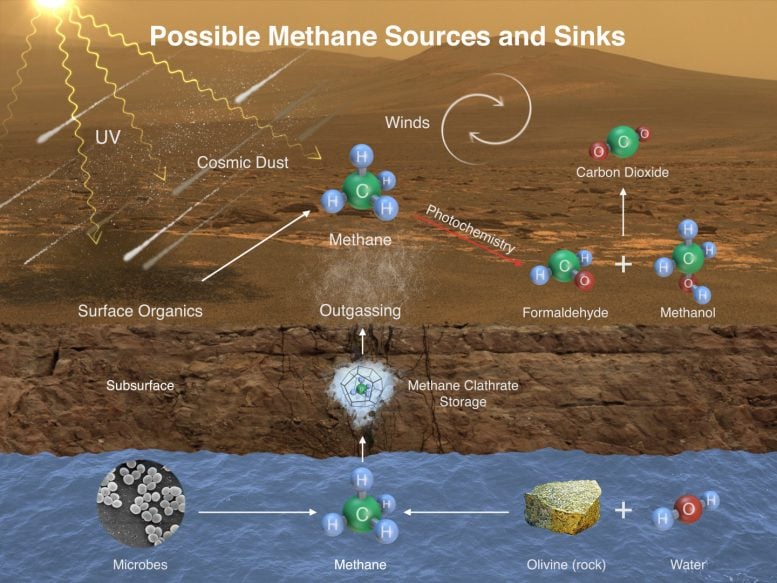
The discovery builds upon previous Curiosity findings, including the 2018 detection of thiophenes and other sulfur-containing organics, as well as seasonal variations in atmospheric methane observed over multiple Martian years. Together, these results suggest that Gale Crater hosted a dynamic environment where water, energy sources, and organic chemistry may have coexisted for extended periods. Such conditions are considered essential for the emergence of life, although scientists stress that the presence of organics alone does not confirm past biological activity.
According to NASA’s Mars Exploration Program, the Curiosity mission is designed to assess whether Mars ever offered an environment capable of supporting microbial life. The rover’s suite of instruments, including SAM and the Chemistry and Mineralogy (CheMin) X-ray diffractometer, works in tandem to characterize the planet’s habitability by examining the chemical, mineralogical, and environmental context of rock and soil samples. Data from Curiosity informs future missions, including the Perseverance rover’s efforts to collect and cache samples for potential return to Earth.
The timing of this announcement coincides with heightened international interest in Mars exploration, as multiple space agencies advance plans for robotic and eventually human missions to the planet. The European Space Agency’s Rosalind Franklin rover, though delayed, aims to search for biosignatures in subsurface environments, while NASA and international partners continue developing the Mars Sample Return campaign. Success in returning carefully selected Martian samples to terrestrial laboratories would allow for far more detailed analysis than is possible with onboard instruments.
For researchers, the implications extend beyond Mars to broader questions about the prevalence of life-friendly conditions in the universe. If Mars once harbored environments conducive to life’s origins, it increases the likelihood that similar processes could have occurred elsewhere under comparable conditions. Conversely, if no evidence of past life is found despite favorable conditions, it may prompt deeper investigation into the specific requirements for life to emerge.
As of April 2026, Curiosity remains operational and continues to ascend the slopes of Mount Sharp, the central peak within Gale Crater, examining progressively younger rock layers to understand how Mars’ climate and environment evolved over time. The mission team regularly publishes updates through NASA’s Mars Exploration Program website, providing raw data and scientific findings for public and academic access. No major mission milestones are currently scheduled in the immediate term, though periodic science updates are expected as analysis of recent drilling campaigns continues.
This discovery reinforces the value of long-term robotic exploration in answering fundamental questions about our solar system’s history. While definitive evidence of past Martian life remains elusive, each new finding brings scientists closer to understanding the planet’s potential to have supported life — and what that might imply about life’s distribution in the cosmos.
For those interested in following the mission’s progress, NASA provides real-time updates, raw images, and scientific reports through its official Mars Exploration Program portal. Readers are encouraged to share their thoughts and questions in the comments section below, and to share this article with others fascinated by the ongoing quest to understand our place in the universe.
Keep reading