
The Complete Guide to Gantt Charts: Examples and Implementation Strategies
A Gantt chart is a visual project management tool that uses horizontal bars to represent individual tasks along a chronological timeline. It enables project managers to track start and end dates, manage task dependencies, and monitor progress, making it essential for coordinating complex schedules and resource allocation.
Project managers use these charts to transform a complex Work Breakdown Structure (WBS) into a readable, time-based roadmap. By visualizing the relationship between different activities, teams can identify potential bottlenecks before they impact the project deadline. While the tool has evolved from manual drafting to sophisticated automated software, its core function remains the synchronization of human and technical resources against a fixed schedule.
The Anatomy of a Gantt Chart: Key Components
A functional Gantt chart relies on several specific data points to provide a meaningful overview of a project’s status. Without these elements, a chart serves only as a simple calendar rather than a management tool.
- Task List: A vertical axis listing every individual activity required to complete the project.
- Timeline: A horizontal axis representing the total duration of the project, divided into days, weeks, or months.
- Task Bars: Horizontal rectangles that indicate the duration of each task. The length of the bar corresponds to the time allotted for that specific work unit.
- Milestones: Significant events or completion points within the project lifecycle. In most software, these are represented by diamond-shaped icons and have zero duration.
- Dependencies: Visual indicators, often arrows, that show how one task relates to another.
- Progress Indicators: Shading or color changes within the task bars that show how much of a task has been completed relative to its total duration.
Effective scheduling requires more than just listing tasks. According to the Project Management Institute (PMI), successful project execution depends on clearly defined task boundaries and the accurate estimation of time and resources. If the task list is incomplete or durations are poorly estimated, the resulting Gantt chart will provide a false sense of security, leading to missed deadlines.
Understanding Task Dependencies
Dependencies define the logical order in which work must occur. In complex projects, tasks rarely exist in isolation. Managing these relationships is what separates a basic schedule from a dynamic project plan.
There are four primary types of logical dependencies used in project scheduling:
- Finish-to-Start (FS): The most common type. Task B cannot begin until Task A is completed. For example, a foundation must be poured before the walls of a building can be erected.
- Start-to-Start (SS): Task B cannot begin until Task A has started. This is used when tasks can run in parallel but require a shared starting trigger.
- Finish-to-Finish (FF): Task B cannot be completed until Task A is finished. This is often used in testing phases where the final sign-off depends on the completion of a preceding activity.
- Start-to-Finish (SF): A rare dependency where Task B cannot be finished until Task A starts. This is typically used in shift handovers or continuous system replacements.
The Critical Path Method and Project Timelines
One of the most significant advantages of using Gantt charts is the ability to identify the “Critical Path.” The critical path is the longest sequence of dependent tasks that must be completed to finish a project on time. Any delay in a task on the critical path will directly result in a delay to the entire project completion date.
Tasks that are not on the critical path possess what project managers call “float” or “slack.” This is the amount of time a task can be delayed without affecting the subsequent task or the final deadline. Identifying these tasks allows managers to reallocate resources from “slack” tasks to “critical” tasks when a project falls behind schedule.
The historical development of these management principles can be traced back to Henry Gantt, an American engineer who developed the chart in the early 1910s. His work revolutionized industrial management by providing a way to visualize production schedules and labor efficiency, moving away from the purely text-based logs used in the 19th century.
Gantt Charts vs. Kanban: Choosing the Right Methodology
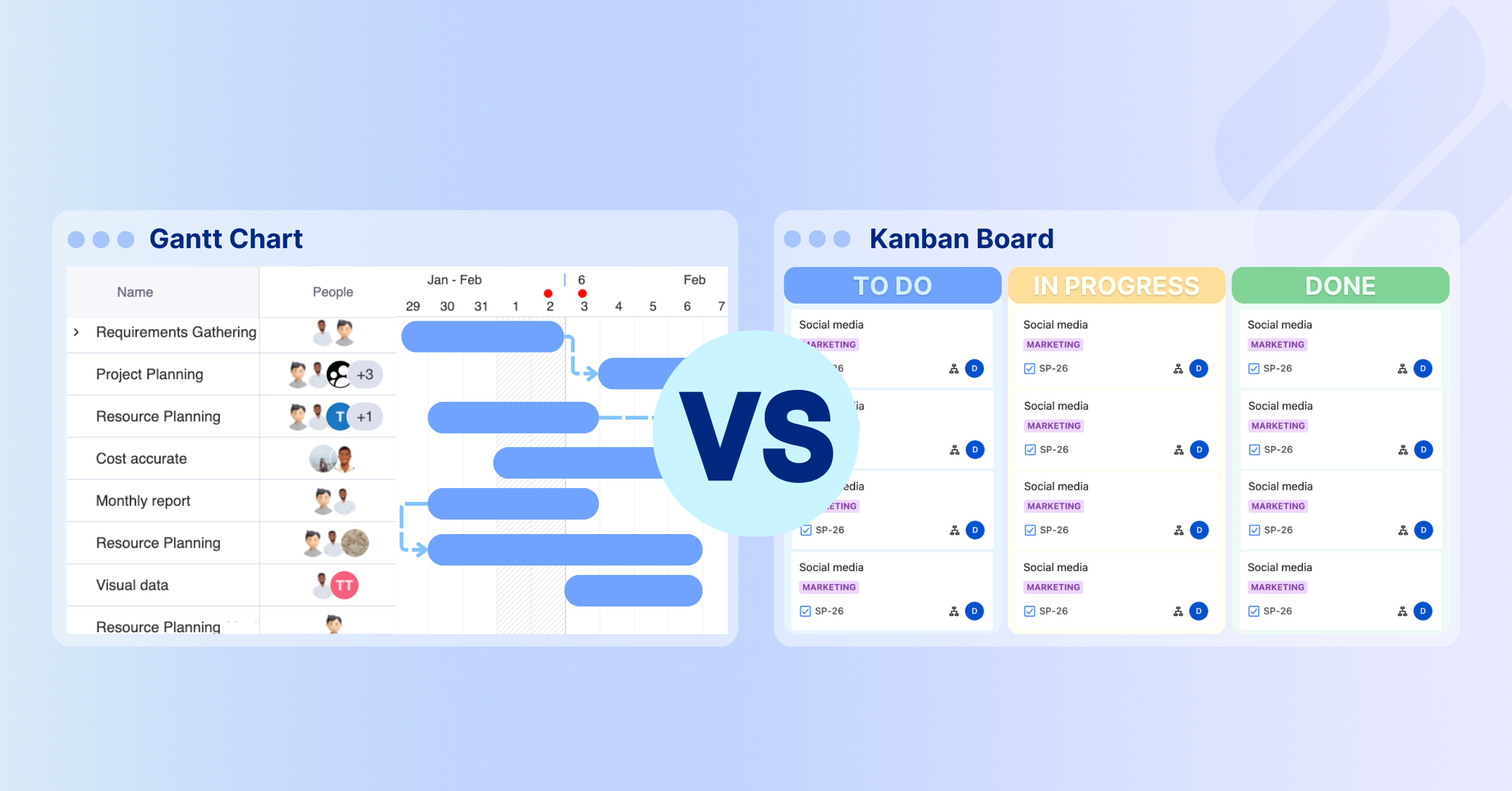
Modern project management often involves choosing between different visual frameworks. While Gantt charts are the gold standard for schedule-driven projects, they are frequently compared to Kanban boards, which are workflow-driven.
| Feature | Gantt Chart | Kanban Board |
|---|---|---|
| Primary Focus | Timeline and task dependencies | Continuous workflow and throughput |
| Best Use Case | Predictable, sequential projects (Waterfall) | Iterative, evolving work (Agile) |
| Visualization | Horizontal bars on a calendar | Cards moving through vertical columns |
| Complexity | High; manages complex interdependencies | Low to medium; focuses on individual tasks |
The choice between these tools depends on the project’s stability. If the project requirements are fixed and the sequence of events is known, a Gantt chart provides the necessary structure. If the project is experimental or requires frequent changes, such as software development in an Agile environment, a Kanban board or a hybrid approach may be more effective.
Industry Applications of Gantt Chart Visualization
While Gantt charts are versatile, certain industries rely on them more heavily due to the highly sequential nature of their work.
Construction and Engineering
In construction, the order of operations is non-negotiable. You cannot install electrical wiring before the framing is complete. Gantt charts allow project managers to coordinate subcontractors, material deliveries, and inspections, ensuring that every phase of the build aligns with the master schedule.
Software Development
Although many software teams use Agile methodologies, Gantt charts remain useful for high-level roadmap planning and managing hardware-software integration projects. They help stakeholders understand when major release milestones will occur and how different development workstreams overlap.
Manufacturing and Supply Chain
Manufacturing processes often follow strict production lines. Gantt charts help managers visualize the movement of goods through various stages of assembly, identify machine downtime, and schedule maintenance without interrupting the entire production flow.

Event Planning and Marketing
Large-scale events, such as international conferences or product launches, involve hundreds of moving parts. Gantt charts help organizers manage everything from venue booking and vendor contracts to marketing campaign rollouts and on-site logistics.
Frequently Asked Questions
Can Gantt charts be used for individual tasks?
Yes. While they are designed for complex projects, individuals can use them to manage personal long-term goals, such as writing a book or planning a home renovation, to visualize how different phases of their work interact.
What is the difference between a Gantt chart and a WBS?
A Work Breakdown Structure (WBS) is a hierarchical decomposition of the total scope of work. It tells you *what* needs to be done. A Gantt chart takes that WBS and adds the *when*—the timeline, durations, and dependencies.
Do I need specialized software to create a Gantt chart?
While they can be created in spreadsheet software like Excel, manual creation is difficult to maintain as projects change. Modern project management software automates dependency updates, making it much easier to adjust the schedule when a task is delayed.
The next major shift in project management technology is the integration of predictive AI to automatically adjust Gantt schedules based on real-time resource data. We will continue to monitor how these automated scheduling tools impact project success rates in the coming fiscal year.
What are your experiences with Gantt charts versus Kanban? Let us know in the comments below, and share this guide with your project management team.
Related reading