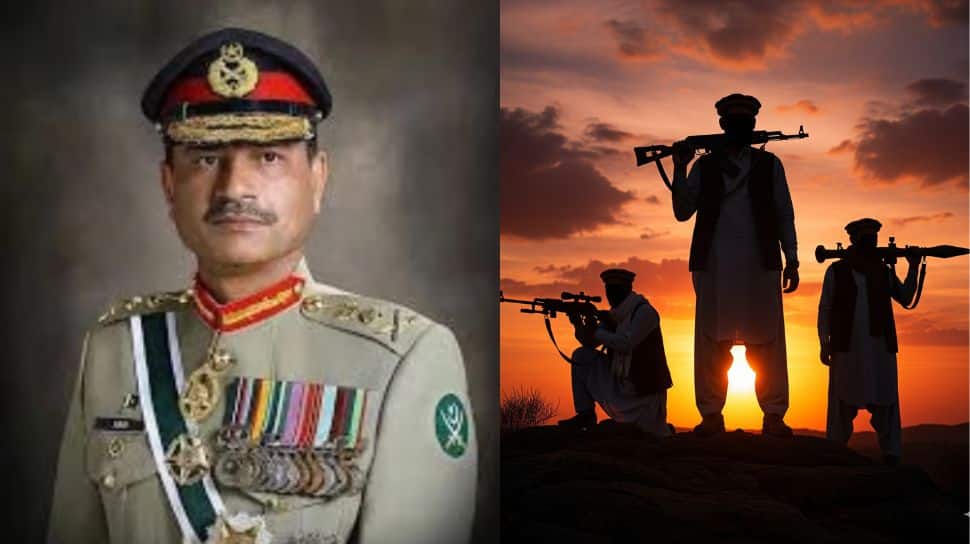
The Shadow of Allegations: Examining Claims Against a Pakistani General and Military Support for Militant Groups
Recent reports have surfaced alleging a concerning pattern of interaction between elements within the Pakistani military and designated terrorist organizations. These claims, originating from leaders of Jaish-e-Mohammed (JeM) and Lashkar-e-Taiba (LeT), paint a troubling picture of potential state-sponsored support for groups actively working against regional stability. This article delves into these allegations, providing context and analysis, while maintaining a commitment to objective reporting.
A High-Ranking Officer under scrutiny
general Munir, a veteran of the Pakistani army, has held some of the nation’s most sensitive positions. He previously headed both Military Intelligence (MI) and the Inter-Services Intelligence (ISI). His career began in 1986, progressing thru the Officers Training school (OTS) in Mangla.
Throughout his service, General Munir has commanded XXX Corps in Gujranwala and served in key administrative roles, including Quartermaster General at General Headquarters (GHQ). These positions granted him significant influence within the Pakistani military structure.
JeM’s explosive Claims Regarding Operation Sindoor
Controversy ignited when Ilyas Kashmiri, a commander within JeM, released a video message making serious accusations against General Munir. Kashmiri alleges that General Munir ordered senior army officers to attend the funerals of terrorists killed during India’s Operation Sindoor.
According to Kashmiri, these directives originated directly from GHQ, the central command of the Pakistani Army. He further claims that corps Commanders were instructed to participate in funeral processions in uniform and render final salutes to slain militants.Such actions,if true,would represent a significant endorsement of terrorist activity.
The IC-814 Hijacking and Maulana masood Azhar
kashmiri’s statements extended beyond operation Sindoor,recalling the aftermath of the 1999 IC-814 hijacking. He claims that Maulana Masood Azhar, the leader of JeM, was sheltered in Pakistan following his release during the hostage crisis.
Furthermore, Kashmiri alleges that Azhar was permitted to operate from Balakot, Pakistan, and orchestrate attacks targeting India. This claim underscores concerns about pakistan’s historical relationship with JeM and its leadership.
LeT’s Account of Support Following Indian Air strikes
Together, Saifullah Kasuri, a deputy chief of LeT, also known as Khalid, made startling revelations. He asserts that the Pakistani military and government actively assisted in rebuilding LeT’s headquarters in Muridke after it sustained damage during Indian air strikes.
Kasuri, accused of masterminding the 2006 Pahalgam attack that resulted in the deaths of 26 pilgrims, is also linked to The Resistance Front (TRF), a proxy organization of LeT. His testimony suggests a continued level of support for LeT operations within Pakistan.
Understanding Operation Sindoor
India launched Operation Sindoor on May 6-7 as a direct response to the Pahalgam massacre. The operation involved precision air strikes against terrorist facilities located in Pakistan and Pakistan-occupied Jammu and Kashmir.
These strikes targeted JeM and LeT infrastructure, reportedly destroying over nine facilities and resulting in the deaths of more than 100 militants. Operation Sindoor represented a significant escalation in tensions between India and Pakistan.
Significant Considerations:
* Source Reliability: It’s crucial to remember that these allegations originate from individuals associated with designated terrorist organizations. Their statements should be viewed with skepticism and corroborated through independent verification.
* Pakistan’s Denials: the Pakistani government has consistently denied providing support to terrorist groups. However, these claims raise serious questions about the extent of state involvement.
* Regional Implications: The alleged connections between the Pakistani military and terrorist organizations have far-reaching implications for regional security and stability.
Looking Ahead:
You, as an informed observer, should understand that these allegations demand thorough examination and obvious accountability. Independent inquiries are essential to determine the veracity of these claims and to address any potential complicity. Ultimately,fostering a secure and stable region requires a commitment to dismantling terrorist networks and preventing state-sponsored support for extremism.