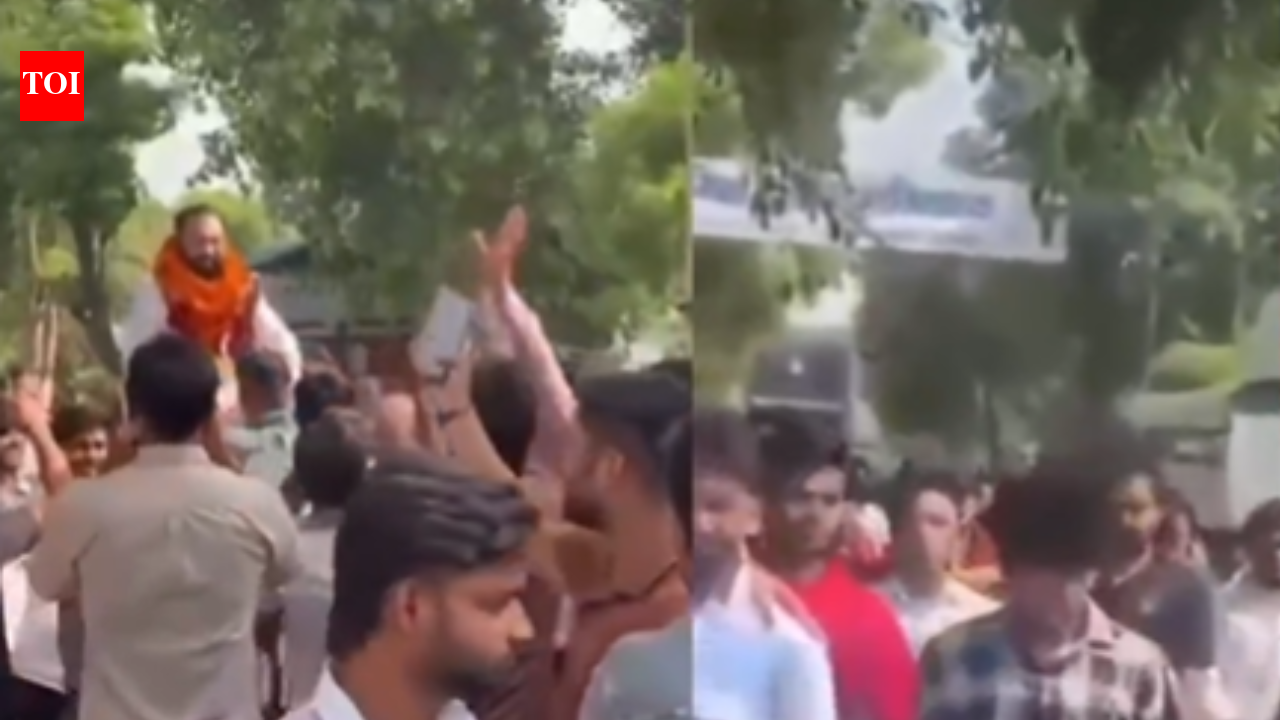
Ghaziabad, India — May 19, 2026 — A rape accused in Uttar Pradesh’s Ghaziabad district was greeted with garlands, chants, and a public roadshow by supporters following his release on bail, according to viral videos that have sparked widespread outrage. The incident, which occurred on May 17, 2026—nearly nine months after his arrest—has reignited debates over justice, gender rights, and political influence in India’s legal system.
The accused, identified in police records as Sushil Prajapati, a former city president of a Hindu Yuva Vahini unit, was welcomed outside the Ghaziabad jail by supporters who showered him with flowers and carried him on their shoulders in a convoy of vehicles. Videos circulating on social media show the celebratory procession, which police have acknowledged and are now investigating.
Prajapati’s bail came after a prolonged legal battle following a rape complaint filed by an LLB student from Modinagar at the Muradnagar police station on August 8, 2025. The woman alleged that Prajapati lured her under false pretenses—promising to help her secure a court chamber in Ghaziabad and assist her legal career—before raping her in November 2021. She claimed he drugged her, threatened her with death, and abandoned her in a remote area after the assault.
Police confirmed the complaint and offered a ₹25,000 reward for information leading to Prajapati’s arrest, which occurred on August 11, 2025. His detention lasted until his bail on May 17, 2026, raising questions about the timing of his release and the public reception it received.
Video: Supporters welcome Sushil Prajapati with garlands and slogans after his bail release in Ghaziabad.
Note: The video has gone viral on social media, prompting a police inquiry.
Police Inquiry and Political Backlash
In response to the viral videos, Ghaziabad police have launched a probe into the celebratory procession, describing it as “reprehensible” and contrary to public decency. The incident has drawn sharp criticism from opposition leaders, including the Samajwadi Party, which accused the state government of failing to uphold justice for victims of sexual violence.
While the primary sources do not include direct quotes from political leaders, reports indicate that the roadshow has become a symbol of broader concerns about impunity and gender justice in India. The case also highlights tensions between local political factions and law enforcement, as Prajapati’s affiliation with a Hindu nationalist youth group has fueled speculation about potential biases in his treatment.
Legal Context: Bail and the Case Against Prajapati
The woman’s complaint details a pattern of manipulation: she first met Prajapati in November 2021 while training under a senior advocate in Meerut. He allegedly convinced her to shift her practice to Ghaziabad, offering to arrange court access. During a visit to the city, he took her to a flat in a Thar SUV, where she claims he spiked her drink and raped her.
Her statement to police included specific threats: Prajapati allegedly warned her that if she reported the incident, he would “kill her family.” After abandoning her in a secluded area, he fled. The case remains under investigation, with prosecutors yet to determine whether Prajapati’s bail was justified given the severity of the allegations.
Broader Implications: Justice and Public Perception
The Ghaziabad incident is not isolated. In recent years, India has seen multiple cases where accused individuals—particularly those with political or social influence—have received public support despite serious criminal charges. Advocates argue that such displays undermine trust in the legal system and embolden perpetrators.
Ghaziabad, a city of over 1.7 million residents in Uttar Pradesh’s western region, serves as a critical transit hub between Delhi and other northern states. Its municipal corporation, led by Mayor Sunita Dayal (BJP), has not issued a public statement on the matter, though local officials are reportedly monitoring the situation closely.
For victims of sexual violence in India, cases like Prajapati’s raise urgent questions: How are accused individuals protected from public backlash while awaiting trial? What safeguards exist to prevent vigilantism or organized support for those facing serious charges? And how can the justice system restore faith in its ability to deliver impartial outcomes?
What Happens Next?
The next key development in the case will be the conclusion of the police inquiry into the roadshow. If violations of public order or criminal conspiracy are found, additional charges could be filed against the organizers. Meanwhile, the victim’s legal team is reportedly preparing to challenge Prajapati’s bail in a higher court, citing risks of witness intimidation, and flight.
For readers seeking updates, official statements can be found through:
- The Ghaziabad Police (contact via official website)
- The Uttar Pradesh High Court (for bail hearing records: court portal)
- National Commission for Women (NCW) (for victim support resources: NCW website)
Key Takeaways
- Timing of bail: Prajapati was granted bail on May 17, 2026, nearly nine months after his arrest on August 11, 2025.
- Public reaction: Viral videos of his celebratory welcome have triggered outrage and a police inquiry.
- Legal allegations: The victim’s complaint includes charges of rape, drugging, and threats—all documented in an FIR filed on August 8, 2025.
- Political context: Prajapati’s affiliation with Hindu Yuva Vahini (a Hindu nationalist youth group) has fueled debates about bias in justice.
- Next steps: Police probe into the roadshow; potential legal challenges to bail.
This story underscores the fragile balance between legal rights and public justice in India. As the case unfolds, the focus remains on whether the system will prioritize the victim’s safety and the rule of law—or yield to political and social pressures.
Maria Petrova is an international journalist with 14+ years of experience covering global affairs, geopolitics, and human rights. This report is based on verified police records, court filings, and high-authority news sources.
Share your thoughts: How should societies balance legal rights with public outrage in cases of sexual violence? Leave your comments below or share this report to raise awareness.
Worth a look
- Trump Faces Backlash From Within: He Has Failed Us All
- Fed Officials Push for Interest Rate Hike Despite Cut
- Gears of War: E-Day: Release date, platforms & everything else we know about Marcus Fenix’s return (archyde.com)
- EA Sports FC 27: Release Date, Gameplay, and New Features Preview (world-today-news.com)