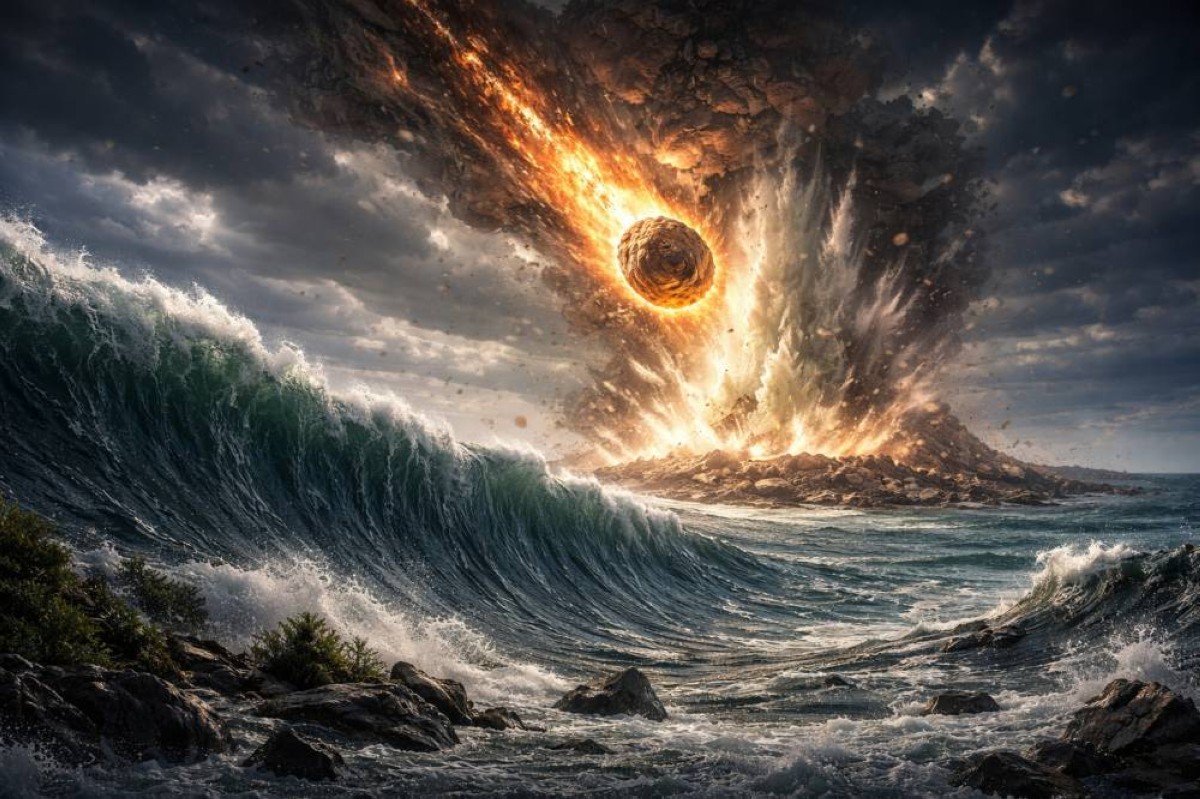
The seabed beneath the North Sea holds a secret billions of years in the making. A recent international study has definitively linked the Silverpit crater, a large geological formation discovered in 2002, to an asteroid impact that occurred approximately 43 to 46 million years ago. This impact triggered a massive tsunami, estimated to have reached heights exceeding 100 meters – taller than a 30-story building – reshaping coastlines and leaving a lasting imprint on the region’s geological history. The findings, published in the journal Nature Communications, resolve a decades-long debate about the crater’s origin and offer a rare glimpse into the powerful forces that have shaped our planet.
For years, the Silverpit crater, located roughly 200 kilometers off the coast of East Anglia, UK, puzzled scientists. While some theorized a cosmic origin, alternative explanations involving salt tectonics or volcanic activity were also proposed. The new research, led by Dr. Ashdin Nicholson of Heriot-Watt University in Edinburgh, Scotland, provides compelling evidence supporting the impact hypothesis. Utilizing advanced seismic imaging techniques and analyzing core samples extracted from the seabed, the team uncovered “shocked” crystals of quartz and feldspar – minerals that form only under the immense pressure generated by a high-velocity impact. This discovery effectively closes the book on the long-running scientific discussion surrounding the crater’s formation.
Unearthing the Evidence: Seismic Imaging and Shocked Crystals
The Silverpit crater lies approximately 700 meters below the seafloor, making direct observation challenging. The breakthrough came with the application of cutting-edge seismic imaging technology, allowing researchers to visualize the crater’s deep structure with unprecedented clarity. This technology revealed a distinct circular feature consistent with an impact crater, including secondary craters and a clear rim. Crucially, analysis of rock samples retrieved from beneath the seabed confirmed the presence of those telltale “shocked” crystals. As Dr. Nicholson explained, the internal structure of these minerals could only have been created by the extreme forces associated with an asteroid collision. Albayan reports that the asteroid is estimated to have been around 160 meters in diameter.
The impact itself would have been a cataclysmic event. Scientists estimate the asteroid struck the seabed with tremendous force, ejecting rock and water upwards to a height of 1.5 kilometers before collapsing back down, generating a devastating tsunami. While the immediate effects would have been localized to the North Sea region, the tsunami’s reach likely extended far beyond, potentially causing widespread destruction along surrounding coastlines. The study highlights the rarity of such underwater impact craters; only around 33 confirmed impact craters have been identified beneath the world’s oceans, making Silverpit a uniquely preserved example of a cosmic collision. The dynamic nature of Earth – with its shifting tectonic plates, erosion, and crustal changes – often obscures or destroys evidence of ancient impacts, making sites like Silverpit invaluable for scientific study.
A Tsunami of Immense Proportions
The scale of the tsunami generated by the Silverpit impact is particularly noteworthy. Estimates suggest wave heights exceeded 100 meters, dwarfing modern-day tsunamis and posing a significant threat to any coastal communities that existed at the time. SANA Syrian Arab News Agency reports that the tsunami’s height surpassed 100 meters. While the North Sea region 43 to 46 million years ago looked vastly different than it does today, the sheer power of the wave would have undoubtedly caused significant environmental disruption and potentially contributed to regional geological changes. The impact also left behind a suite of geological features, including secondary craters, a distinct crater rim, and surface formations visible in the recent seismic images, further supporting the impact scenario.
Comparing Silverpit to Other Impact Craters
The Silverpit crater offers a valuable opportunity to compare and contrast with other known impact sites, most notably the Chicxulub crater in Mexico. The Chicxulub impact, which occurred approximately 66 million years ago, is widely believed to have played a crucial role in the extinction of the dinosaurs. While the Silverpit impact was significantly smaller than the Chicxulub event, studying its effects can provide insights into the broader consequences of asteroid impacts on Earth’s history. Researchers believe that comparing the two craters will help refine models of impact dynamics and assess the potential risks posed by future asteroid collisions. The preservation of the Silverpit crater is particularly remarkable, given its age and underwater location. The relatively stable geological conditions of the North Sea seabed have allowed the crater to remain largely intact for millions of years, providing a unique window into the past.
The Significance of Underwater Impact Craters
The study of underwater impact craters is a relatively new field, hampered by the challenges of deep-sea exploration and data acquisition. However, as technology advances, scientists are increasingly able to identify and study these hidden geological features. The discovery of Silverpit underscores the importance of continued research in this area, as underwater impacts may have played a more significant role in Earth’s history than previously thought. The rarity of these craters – with only around 33 confirmed sites worldwide – highlights the need for comprehensive surveys and detailed investigations. Understanding the frequency and magnitude of past impacts is crucial for assessing the potential risks posed by future events and developing strategies for planetary defense.
Professor Gareth Collins of Imperial College London, a co-author of the study, stated that the impact hypothesis had always been the simplest and most consistent explanation for the Silverpit crater’s formation. He believes the new evidence definitively puts an end to the scientific debate that has persisted for over two decades. The research team hopes that further investigation of the Silverpit crater will reveal even more details about the impact event and its aftermath, providing valuable insights into the complex interplay between Earth and its cosmic environment.
Key Takeaways
- The Silverpit crater beneath the North Sea was formed by an asteroid impact approximately 43 to 46 million years ago.
- The impact generated a massive tsunami, estimated to have reached heights exceeding 100 meters.
- The discovery resolves a long-standing scientific debate about the crater’s origin and provides a rare opportunity to study an underwater impact site.
- Analysis of “shocked” crystals of quartz and feldspar provided definitive evidence of the impact.
- Comparing Silverpit to other impact craters, such as Chicxulub, will help scientists better understand the effects of asteroid collisions on Earth’s history.
The Silverpit crater stands as a powerful reminder of the dynamic forces that have shaped our planet over millions of years. This discovery not only sheds light on a specific event in Earth’s past but also underscores the ongoing need for research into asteroid impacts and their potential consequences. Further studies are planned to investigate the crater’s structure in greater detail and to assess the impact’s broader environmental effects. The team intends to share their findings with the wider scientific community and to collaborate with other researchers to advance our understanding of planetary impacts.
The research team will continue to analyze data collected from the Silverpit site, focusing on the distribution of impact debris and the long-term geological consequences of the event. Updates on their findings will be published in peer-reviewed scientific journals and presented at international conferences. For the latest information on asteroid impacts and planetary defense, you can visit the NASA Planetary Defense Coordination Office website: https://www.nasa.gov/planetarydefense/. We encourage you to share your thoughts on this fascinating discovery in the comments below.
Related reading