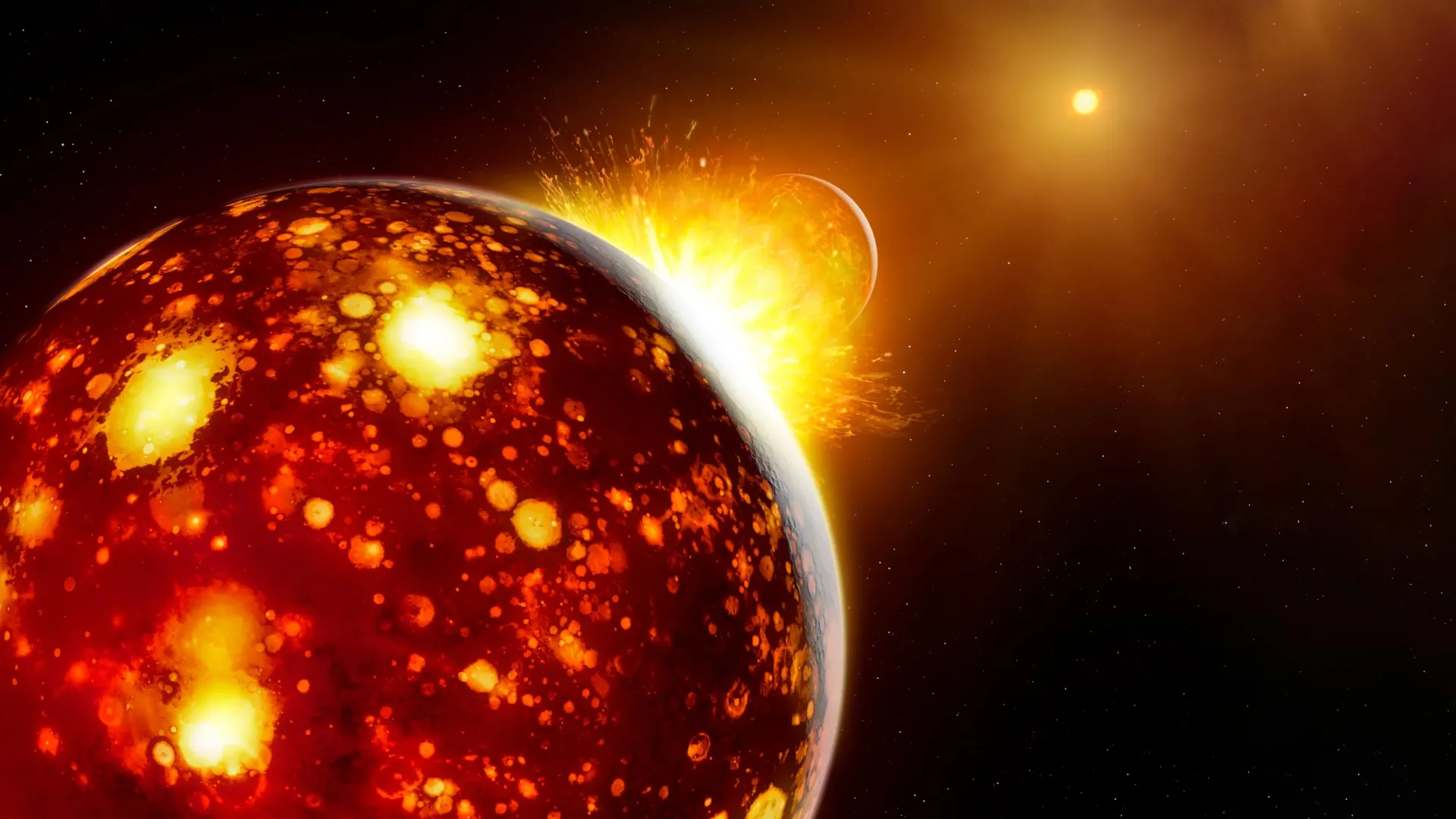
The Giant Impact: New Research Illuminates the Origins of Theia, Earth’s ancient Colliding Partner
For decades, the prevailing theory for the Moon’s formation has centered around a cataclysmic event: a giant impact between the early Earth and a Mars-sized protoplanet named Theia.While the impact itself is well-established, the nature of Theia - its size, composition, and origin – has remained a profound mystery. After all, Theia was utterly destroyed in the collision, leaving scientists to piece together its story from the faint chemical echoes preserved within Earth and the Moon. now,groundbreaking research published November 20,2025,in Science,conducted by teams at the max Planck Institute for Solar System Research (MPS) and the University of Chicago,is providing the most detailed reconstruction yet of this lost world,offering compelling clues to its birthplace and composition.
The Enduring Puzzle of Theia
The giant impact hypothesis elegantly explains several key features of the Earth-Moon system, including the Moon’s relatively large size compared to Earth, its depleted volatile content, and the similarity in isotopic composition between Earth and the Moon. Though, the lack of direct evidence from Theia itself presents a significant challenge. Determining how the impact occurred – whether the Moon formed primarily from Theia’s debris, Earth’s material, or a homogenous mixture – requires a deep understanding of Theia’s original characteristics.
“The composition of a body archives its entire history of formation,including its place of origin,” explains Thorsten Kleine,Director at MPS and co-author of the study. This principle guides the search for clues within the isotopic signatures of Earth and lunar rocks.
Isotopic Fingerprints: Deciphering Planetary Origins
The key to unlocking Theia’s secrets lies in the subtle variations in isotope ratios. Isotopes are diffrent forms of the same element, distinguished by the number of neutrons in their nucleus. In the early Solar System, the distribution of these isotopes wasn’t uniform.Materials closer to the Sun exhibited different ratios than those forming further out, a result of temperature gradients and the processes of nucleosynthesis. Therefore, a planet’s isotopic composition acts as a record of where its building blocks originated.
The new study leverages this principle with unprecedented precision. Researchers meticulously analyzed iron isotope ratios in 15 earth rocks and six samples collected during the Apollo missions to the Moon. These measurements, combined with previous analyses of chromium, calcium, titanium, and zirconium isotopes, revealed a striking consistency: Earth and the Moon exhibit virtually identical isotope ratios for these elements.
While this similarity is significant, it doesn’t immediately reveal Theia’s composition. Multiple impact scenarios can yield the same observed outcome. The challenge lies in disentangling the contributions of Theia and the early Earth to the final isotopic mix.
A Reverse Engineering Approach to Planetary Formation
To overcome this hurdle,the research team employed a elegant “reverse engineering” approach. They treated the Earth-Moon system as a puzzle, systematically testing various combinations of Theia’s potential composition, size, and the properties of the early Earth to determine which scenarios best matched the observed isotopic signatures.
Their analysis incorporated data from iron, chromium, molybdenum, and zirconium isotopes, each providing insights into different stages of planetary development. The team recognized that the early Earth underwent a crucial process called internal differentiation, where heavier elements like iron and molybdenum sank towards the core. This means the iron currently present in Earth’s mantle likely arrived after core formation, potentially delivered by Theia.Elements like zirconium, which remained in the mantle, preserve a more complete record of the planet’s formation history.
Theia’s Inner Solar system origins
After rigorously evaluating countless combinations, the researchers arrived at a compelling conclusion. “The most convincing scenario is that most of the building blocks of Earth and Theia originated in the inner Solar System. Earth and Theia are likely to have been neighbors,” states Timo Hopp, MPS scientist and lead author of the study.
This finding challenges previous hypotheses suggesting Theia formed further out in the Solar System and migrated inward. The team found that Theia’s composition couldn’t be fully explained by known meteorite types, which serve as representative samples of materials from different regions of the early Solar System. Instead, the data suggest that Theia’s building materials originated even closer to the Sun than Earth’s, potentially interior to Earth’s current orbit.
Implications and Future Research
this research represents a significant leap forward in our understanding of the Earth-Moon system’s formation. It suggests that both Earth and Theia were born in a relatively crowded and dynamic region of the inner Solar System, likely experiencing frequent collisions and interactions.
While this study provides the most detailed picture of