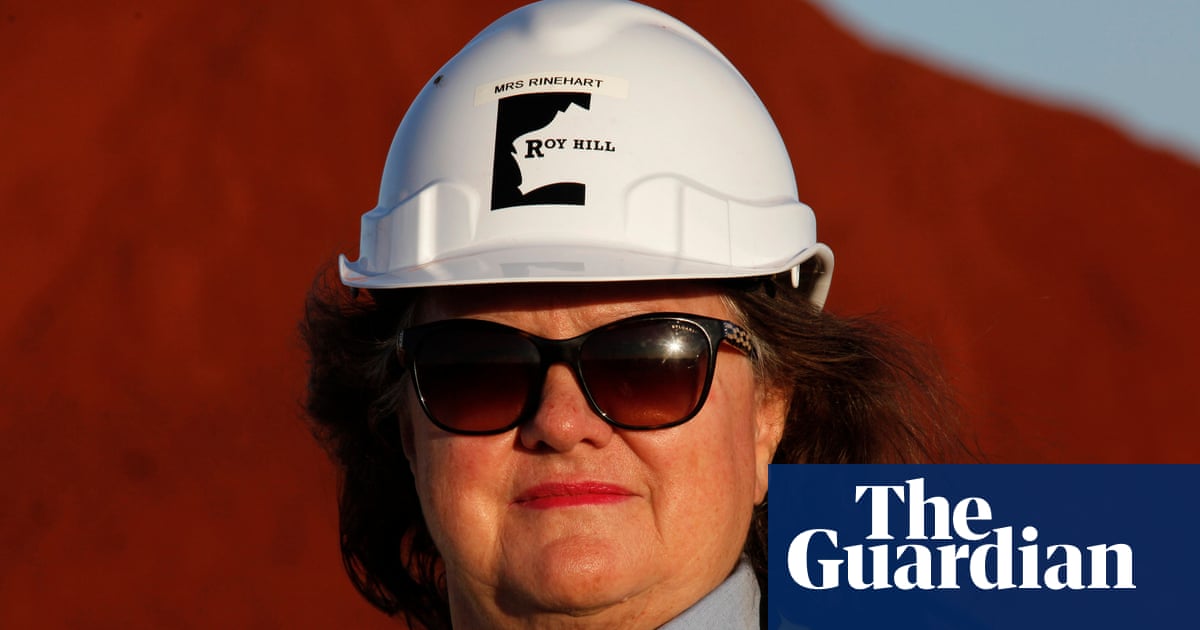
Gina Rinehart, Australia’s wealthiest individual, faces a significant financial setback after a Western Australian Supreme Court ruling determined her company must share royalties from the lucrative Hope Downs iron ore project with the heirs of her father’s former business partner.
The decision, delivered by Justice Jennifer Smith on April 15, 2026, concludes a legal battle spanning over a decade that has pitted Rinehart’s Hancock Prospecting against the descendants of Peter Wright, one of the original pioneers of iron ore exploration in Western Australia’s Pilbara region. According to the court judgment, Wright Prospecting is entitled to half of the historical royalties from the Hope Downs mines, a sum estimated to be worth hundreds of millions of dollars.
The ruling confirms Rinehart’s continued ownership of key mining assets while affirming that the Wright family has a legitimate claim to a portion of the revenue generated from the joint venture between Hancock Prospecting and Rio Tinto. Justice Smith described the outcome as a “half-win” for the Wrights, having rejected their claim for ownership of additional tenements within the project.
Despite the financial impact, Rinehart remains Australia’s richest person, with her fortune estimated at $38 billion. The case has drawn widespread attention not only for its monetary implications but also for its roots in a partnership formed in the 1930s between Lang Hancock, Rinehart’s father, and Peter Wright, whose collaboration laid the foundation for some of the nation’s most valuable iron ore holdings.
The legal dispute originated from efforts by Hancock and Wright in the late 1970s and 1980s to formalize the division of their interests before their deaths. Over the years, disagreements over the interpretation of those agreements led to litigation, with both sides asserting competing claims to royalties and ownership stakes in the Hope Downs tenements.
Hancock Prospecting has maintained that it fulfilled all obligations under the original arrangements, while the Wright family argued that subsequent actions by the Hancock lineage diluted their entitlement. The court’s examination of decades-old correspondence, partnership documents, and financial records formed the basis for Justice Smith’s detailed 1,600-page judgment.
In addition to the Wright family’s claim, the proceedings also involved allegations from Rinehart’s own children, John Hancock and Bianca Rinehart, who asserted ownership rights through a trust established by their grandfather. Justice Smith dismissed those claims, a point emphasized in Hancock Prospecting’s public response to the ruling.
Following the judgment, John Hancock issued a public statement expressing hope for familial reconciliation, urging an end to the prolonged conflict and a renewed focus on the family’s contributions to Australia’s resource sector. Hancock Prospecting echoed this sentiment, noting that the court had rejected the ownership claims made by Rinehart’s eldest children.
The financial scale of the ruling remains subject to further determination, as additional hearings are scheduled to calculate the exact value of the royalties, interest, and costs owed. Hancock Prospecting has indicated it believes the annual obligation amounts to approximately $14 million, whereas the Wright family’s representatives have suggested the total entitlement could approach nearly $1 billion when including historical payments.
Rio Tinto, as the operator of the Hope Downs mine under the joint venture agreement, continues to extract and sell iron ore from the Pilbara deposits, with the resulting royalty streams forming the core of the financial dispute. The arrangement, originating from a 1960s agreement, originally granted Hancock and Wright a combined 2.5 percent share of royalties from iron ore produced by the multinational miner.
The case underscores the long-term complexities that can arise when familial business arrangements, particularly those rooted in informal agreements and handshake deals, are tested across generations and shifting corporate structures. It also highlights how early-stage exploration efforts in Australia’s resource-rich regions can generate wealth that persists for decades, becoming the subject of intricate legal interpretation.
As of the ruling date, no appeal has been formally announced, though both parties have signaled preparedness for further legal proceedings. The next phase of the case will focus on quantifying the financial obligations, with a timetable for those hearings yet to be publicly disclosed.
For readers seeking to understand the broader context of Australia’s mining wealth and its intergenerational impact, this case offers a concrete example of how foundational industry partnerships can evolve into prolonged legal and financial reckonings.
If you have insights or perspectives on this case, we invite you to share them in the comments below. Feel free to distribute this article to others who may be following developments in global resource markets or corporate governance.
Worth a look