
Executions Surge to 40-Year High as Global Death Penalty Crisis Deepens
The number of state-sanctioned executions worldwide has reached its highest level in more than four decades, according to new data from Amnesty International and other human rights organizations. In 2025, at least 1,250 people were executed in 22 countries—a 30% increase from the previous year—marking the most dramatic rise in capital punishment since systematic records began in the 1970s. The surge underscores a troubling global trend: despite growing international opposition, governments in Asia, the Middle East, and parts of Africa are increasingly turning to the death penalty as a tool of criminal justice, often amid political crises or public pressure for swift retribution.
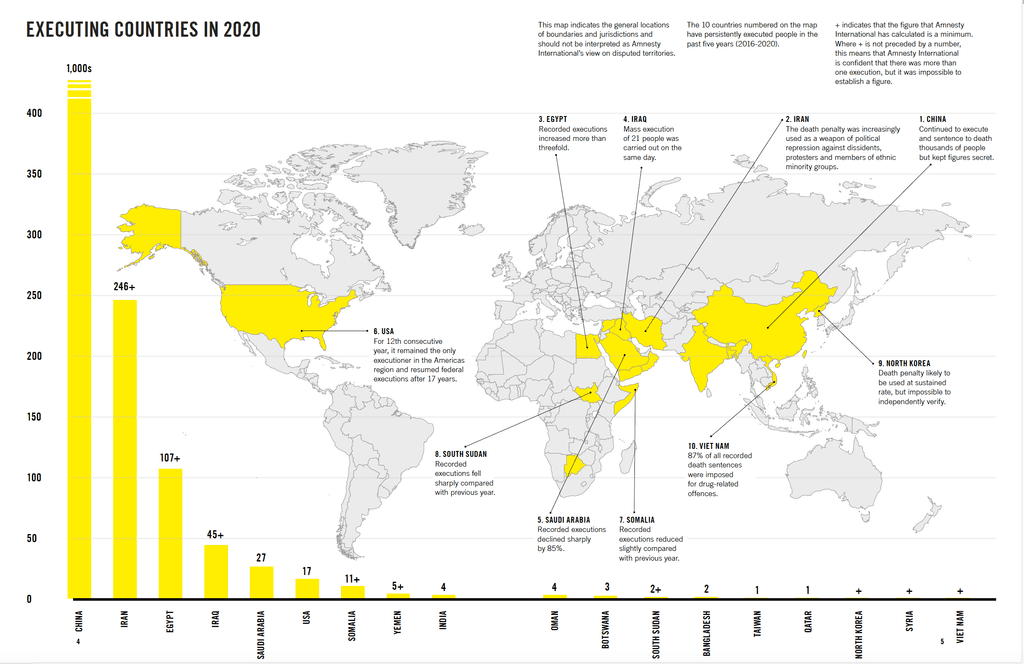
The data, compiled from official government reports, court records, and firsthand accounts of executions, reveals a stark regional disparity. China—where executions are classified as state secrets—remains the world’s leading practitioner, though independent verification is impossible. Excluding China, the number of executions in 2025 still exceeded 800, the second-highest total ever recorded. Iran, Saudi Arabia, Egypt, and Iraq accounted for the largest increases, with Iran alone executing more than 850 individuals—a figure that includes prisoners convicted under controversial anti-drug and anti-state security laws.
Legal experts warn that the rise in executions coincides with a broader erosion of due process in many countries. In Saudi Arabia, for example, at least 193 people were executed in 2025, including 81 foreigners, many of whom had been convicted in closed military courts without access to adequate legal representation. Meanwhile, Egypt’s state media reported 27 executions in the first six months of 2025 alone, a sharp contrast to the country’s previous reluctance to carry out capital punishment in recent years. The United Nations High Commissioner for Human Rights, Volker Türk, condemned the trend in a statement last month, calling it “a grave violation of international human rights law” and urging member states to impose a global moratorium.
The Drivers Behind the Surge
Analysts attribute the increase to a combination of political, social, and legal factors. In Iran, the government has justified the spike in executions by framing them as necessary to combat drug trafficking and “moral corruption,” despite widespread criticism from the international community. Human Rights Watch reported that at least 430 executions in Iran last year were carried out for drug-related offenses, a category that includes possession quantities as low as 30 grams of cannabis—a threshold critics argue is disproportionate and violates international drug policy standards.
Saudi Arabia’s execution rate has also soared, with officials citing the need to deter terrorism and maintain public order. The kingdom executed 17 people in a single day in April 2025, including eight individuals convicted of murder and nine for drug trafficking. Legal scholars note that Saudi Arabia’s justice system lacks transparency, with executions often announced only after they have taken place. In a rare public statement, Saudi Arabia’s Minister of Justice, Walid al-Samaani, defended the measures in state media, stating that “the death penalty is a necessary deterrent against crimes that threaten the security of society.” However, the UN Special Rapporteur on Extrajudicial Executions, Morris Tidball-Binz, called the practices “a flagrant disregard for human dignity.”
Africa has seen a resurgence of the death penalty in countries like Somalia, where the federal government executed 11 individuals in 2025—its first executions in nearly a decade. The move followed a high-profile court case involving alleged members of the Al-Shabaab militant group. Meanwhile, Nigeria’s government has revived capital punishment for terrorism-related offenses, with at least 12 executions carried out in 2025. Legal observers warn that these trends could reverse decades of progress in reducing executions on the continent.
Regional Breakdown: Where Executions Are Rising
| Region | Countries with Executions (2025) | Key Trends | Notable Cases |
|---|---|---|---|
| Middle East | Iran, Saudi Arabia, Iraq, Egypt, Yemen | 30% increase; drug-related executions dominant in Iran; public beheadings in Saudi Arabia | Iran: Execution of Narges Mohammadi (human rights activist) postponed under international pressure |
| Asia-Pacific | China (data classified), Vietnam, Singapore, Bangladesh | Vietnam executes 12 for drug trafficking; Singapore upholds mandatory death penalty for trafficking | Vietnam: Execution of 12 individuals in a single month, first such case in years |
| Africa | Somalia, Nigeria, South Sudan, Egypt | Somalia revives death penalty after decade-long moratorium; Nigeria executes terrorists | Nigeria: Execution of Boko Haram members in Kano State prison |
| Americas | United States (24 executions), Guatemala | U.S. Executions rise 20% from 2024; Guatemala executes first prisoner in 20 years | U.S.: Texas executes 12 individuals, highest in a single state since 2017 |
International Response and Legal Challenges
The global rise in executions has sparked a heated debate among human rights organizations, legal scholars, and governments. The European Union and several Latin American nations have condemned the trend, with the EU’s foreign policy chief, Josep Borrell, stating in a recent address that “the death penalty has no place in the 21st century.” Meanwhile, the African Commission on Human and Peoples’ Rights has urged member states to abolish capital punishment entirely, citing its irreconcilability with international human rights law.
Legal challenges are mounting in several countries. In the United States, where 24 executions were carried out in 2025—a 20% increase from the previous year—courts have blocked several death penalty cases on grounds of racial bias and inadequate legal representation. Texas, which accounted for nearly half of U.S. Executions, saw its highest annual total since 2017, with 12 individuals put to death. The state’s use of lethal injection has come under scrutiny after reports of prolonged suffering in some cases, leading to calls for a moratorium from medical associations.
The United Nations General Assembly will convene a high-level debate on the death penalty in September 2026, where member states are expected to address the recent surge. Amnesty International has launched a global campaign, “#AbolishNotExecute,” urging governments to impose a moratorium on executions and commute death sentences. The campaign has gained traction in Europe, where several countries have recently abolished the death penalty for all crimes, including in peacetime.
Who Is Affected? The Human Cost of the Death Penalty
Behind the statistics lie individual stories of families shattered by state violence. In Iran, the execution of Mohsen Shekari, a protester convicted of “enmity against God” during the 2022 uprising, drew international condemnation. His family, who had not been notified of the execution, discovered his death through state media. “They took my son without a trial, without justice,” his mother, Fatemeh Shekari, told Reuters. “Now, I have no one left to fight for him.”
In Saudi Arabia, the execution of eight Pakistani nationals in April 2025 highlighted the plight of foreign prisoners. The men, convicted of drug smuggling, had been on death row for nearly a decade without consular access. Their families, many of whom were unaware of their sons’ fates, later learned of the executions through Pakistani government channels. “We were not even allowed to say goodbye,” said one family member, who requested anonymity. “This is not justice—it is murder.”
The death penalty also disproportionately affects marginalized communities. In the United States, Black defendants are three times more likely to receive a death sentence than white defendants for similar crimes, according to a 2024 study by the Death Penalty Information Center. Similarly, in Iran, ethnic and religious minorities—particularly Baloch and Kurdish populations—are overrepresented among death row inmates. Human rights groups argue that these disparities reflect systemic biases in criminal justice systems worldwide.
What Happens Next? The Path Forward
The next critical checkpoint will be the 51st session of the UN Human Rights Council in March 2026, where a resolution on the death penalty is expected to be tabled. The resolution, co-sponsored by 60 countries, calls for a global moratorium on executions and urges states to abolish capital punishment entirely. Supporters argue that the recent surge in executions demonstrates the urgent need for collective action.
At the national level, several countries are poised to take significant steps. In Malaysia, where the death penalty has been abolished for all crimes except terrorism, lawmakers are debating a complete repeal of capital punishment. Meanwhile, in the Philippines, President Bongbong Marcos has signaled support for a moratorium, citing humanitarian concerns. “The death penalty is irreversible and irreparable,” Marcos stated in a recent interview. “We must ask ourselves: Is this really justice?”
For families of the executed, the fight for justice continues. In Egypt, the families of those executed in 2025 have filed petitions with the African Commission, seeking compensation and an investigation into the circumstances of their loved ones’ deaths. Legal experts warn that without international pressure, the trend toward increased executions is likely to persist.
Key Takeaways
- Record High: At least 1,250 executions in 2025—30% increase from 2024—marking the highest total in 40 years.
- Regional Hotspots: Middle East (Iran, Saudi Arabia) and Asia (China, Vietnam) account for 80% of documented executions.
- Legal Erosion: Due process concerns rise as closed military courts and lack of legal representation become common.
- Human Cost: Families of the executed face lifelong trauma, often without closure or compensation.
- International Pushback: UN, EU, and human rights groups urge moratoriums; 60+ countries co-sponsor UN resolution.
- Next Steps: UN Human Rights Council debate in March 2026; national moratoriums under consideration in Malaysia, and Philippines.
As the global death penalty crisis deepens, the question remains: Can the international community reverse this dangerous trend, or will state-sanctioned killing continue to rise unchecked? The answers will shape the future of justice—and the lives of millions.
What are your thoughts on the death penalty? Share your perspective in the comments below or join the discussion on Twitter using #AbolishNotExecute. For official updates, follow the UN Human Rights Council proceedings here.
Related reading