
For decades, the actuarial tables used by the insurance industry have been relatively stable, predicting life expectancy based on established risk factors like smoking, age, and chronic illness. However, a new pharmacological shift is beginning to challenge these mathematical certainties. The rapid adoption of GLP-1 medications—originally designed for type 2 diabetes but now widely used for obesity—is doing more than just helping patients lose weight; it is potentially bending the curves of human longevity.
As a physician and journalist, I have watched the clinical excitement surrounding glucagon-like peptide-1 (GLP-1) receptor agonists grow from a niche metabolic treatment to a global cultural phenomenon. But the conversation is now moving beyond the clinic and into the boardroom of one of the world’s largest reinsurance firms. Swiss Re has released a detailed analysis, The future of metabolic health and weight loss drugs, which models how these medications could fundamentally alter mortality risk across entire populations.
The implications are profound. When a reinsurer—an entity whose entire business model relies on the precise prediction of death and disease—suggests that a class of drugs could meaningfully shift life expectancy, it signals a transition from “weight loss trend” to “public health transformation.” This is not merely about aesthetics or the management of a single symptom, but about the systemic reduction of all-cause mortality through the improvement of metabolic health.
The Metabolic Ecosystem: Beyond the Medication
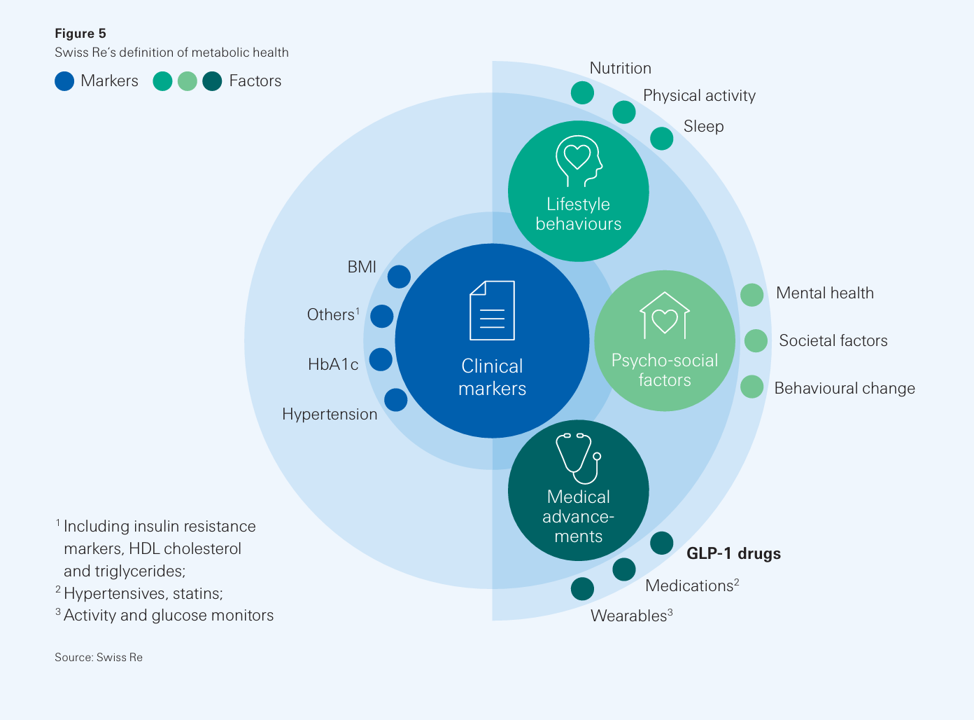
To understand how GLP-1 medications life expectancy projections are being recalculated, we must first look at how Swiss Re defines metabolic health. Rather than viewing weight loss as a standalone achievement, the firm proposes a “broad ecosystem view.” This approach recognizes that a medication alone cannot solve a systemic health crisis.
The Swiss Re model rests on three critical pillars: lifestyle behaviors, psycho-social factors, and medical advancements. Within the medical pillar, GLP-1 drugs are positioned alongside traditional interventions like statins for cholesterol and antihypertensives for blood pressure, as well as wearable technologies such as continuous glucose monitors and activity trackers. The goal is a synergistic effect where the drug manages insulin resistance and appetite, while lifestyle changes and monitoring ensure the weight loss is sustainable and the metabolic gains are permanent.
GLP-1 agonists work by mimicking a natural hormone that regulates blood sugar levels and signals fullness to the brain. By reducing the biological drive to overeat and improving the body’s response to insulin, these drugs target the root causes of metabolic syndrome. When these clinical markers improve, the risk of catastrophic events—such as myocardial infarction or stroke—drops, which is exactly what shifts the actuarial curve.
Modeling the Shift: The Data Behind the Longevity
To quantify this impact, Swiss Re developed complex models analyzing populations in the United States and the United Kingdom. The researchers examined a population base of 100,000 people, stratifying the data by age, sex, and socioeconomic status to see how the benefits varied across different demographics. The models projected outcomes over a 20-year horizon, focusing on three primary risk factors for metabolic ill-health: Body Mass Index (BMI), blood pressure, and HbA1c (a measure of average blood sugar over three months).
Because Swiss Re possesses vast institutional knowledge and access to proprietary mortality risk curves from its underwriting manuals, the model provides a high-fidelity look at how clinical improvements translate into extra years of life. The study explored three distinct scenarios to account for the unpredictability of human behavior and healthcare access:
- The Optimistic Scenario: This path assumes high consumer engagement, widespread uptake of the medication, and a strong commitment to accompanying lifestyle changes. In this scenario, the improvement in the three clinical markers is maximized.
- The Baseline Scenario: Considered the “most likely” outcome, this scenario assumes moderate improvements in clinical markers and a steady, but not universal, adoption of the drugs and lifestyle shifts.
- The Pessimistic Scenario: Labeled as “positive yet guarded,” this scenario envisions limited drug uptake, poor adoption of lifestyle changes, and only modest gains in metabolic markers.
The results of these models are striking. In the United States, the optimistic scenario suggests a cumulative all-cause mortality reduction of up to 6.4%, while the baseline scenario indicates a reduction of approximately 4%. For context, in the United Kingdom, the optimistic model suggests a mortality reduction of 5.1%, according to Swiss Re’s analysis of metabolic health trends.
The Socioeconomic Divide: A Barrier to Longevity
While the mathematical models offer a glimpse of a healthier future, the reality of clinical implementation is fraught with inequality. One of the most critical findings in the Swiss Re report is that the “bending” of the actuarial curve will not happen uniformly. The benefits of GLP-1s are heavily dependent on a patient’s socioeconomic status and their access to a supportive healthcare infrastructure.
Cost remains the most significant barrier. In the short term, the high price of these medications may make them prohibitive for a large segment of the population. This creates a “longevity gap,” where individuals in higher socioeconomic brackets not only have better access to the drugs but also the means to implement the lifestyle changes—such as high-quality nutrition and personal training—that maximize the drug’s efficacy. Those with comprehensive insurance are more likely to receive the necessary medical supervision to manage side effects and optimize dosing.
From a public health perspective, this is a concerning trajectory. If the most potent tools for reducing metabolic disease are only available to the wealthy, we risk widening the existing health disparities. The Swiss Re report notes that larger mortality reductions are expected in insured populations with high obesity rates and a suitable age distribution, effectively suggesting that the “win” for life expectancy may be concentrated among those who already have the best health outcomes.
The Strategic Pivot: Health as a Business Priority
It may seem unusual for a reinsurance company to advocate for public health, but the alignment of interests is clear. For the insurance industry, managing risk is the core of the business. If a significant portion of the population lives longer and healthier lives, the long-term resilience of insurance portfolios improves. Reducing the prevalence of chronic metabolic diseases lowers the cost of long-term care and reduces the frequency of high-cost medical interventions for heart failure and kidney disease.


Swiss Re describes improving overall health as both a “social imperative and a strategic business priority.” By positioning themselves as an “agent of active change,” the company is acknowledging that the industry cannot simply react to mortality trends—it must help shape them. This involves supporting a healthcare ecosystem where GLP-1s are not viewed as a “magic pill” but as a catalyst for a broader transition toward metabolic wellness.
This shift represents a move away from a transactional view of health—where a drug is prescribed to treat a symptom—toward a longitudinal view of health, where the goal is the lifelong management of metabolic risk. For the global population, this means a potential future where obesity is no longer a guaranteed precursor to a shorter life, provided the systemic barriers to access are dismantled.
What Happens Next?
The long-term impact of GLP-1s on life expectancy will depend on how governments and insurers handle the “access crisis.” We are currently in a period of rapid clinical adoption, but the next phase will be defined by policy. Will these drugs be integrated into standard public health protocols? Will insurance coverage expand to treat obesity as a primary disease rather than a comorbid condition?
The medical community is also awaiting more long-term data on the sustainability of these gains. While the 20-year models from Swiss Re are promising, real-world evidence on “weight regain” after cessation of the drug will be crucial in determining if the actuarial curves stay bent or snap back to their original positions.
As we move toward the next round of clinical trial updates and insurance policy reviews in 2026, the focus will likely shift from whether these drugs work to who gets to benefit from them. The mathematical possibility of a 6.4% reduction in mortality is an inspiring prospect, but the true measure of success will be whether that gain is shared across all socioeconomic strata.
Do you believe the cost of GLP-1s will remain a barrier to public health, or will insurance models evolve to cover them as essential preventative care? Share your thoughts in the comments below.