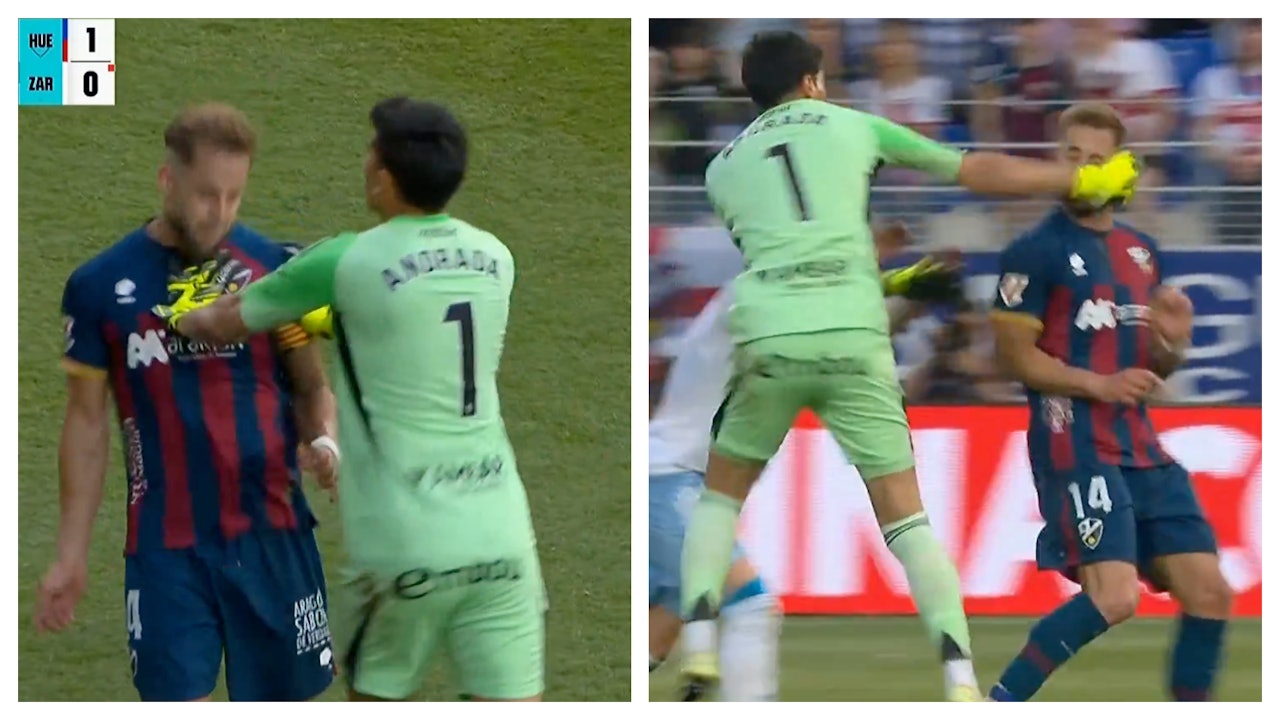
Zaragoza Goalkeeper Esteban Andrada’s Violent Outburst Sparks Mass Brawl in Spanish Segunda División
In a shocking display of violence that has sent ripples through Spanish football, Real Zaragoza goalkeeper Esteban Andrada was sent off in the dying moments of a tense relegation battle before launching a vicious punch at SD Huesca captain Jorge Pulido, triggering a full-scale brawl involving players, staff, and even riot police. The incident, which occurred during the 99th minute of Sunday’s Aragon Derby at Estadio El Alcoraz, has left the football world grappling with questions about sportsmanship, discipline, and the pressures of high-stakes competition.
Andrada, 32, was already on a yellow card when he shoved Pulido to the ground following a heated exchange with referee Dámaso Arcediano Monescillo. The Argentine goalkeeper was shown a second yellow—resulting in a red card—but his fury only escalated. Instead of leaving the pitch, Andrada sprinted toward Pulido and delivered a brutal right hook to his face, knocking the 35-year-old defender to the ground. The attack immediately ignited chaos, with players from both teams rushing onto the field, forcing stewards and riot police to intervene to restore order.

The match, which ended in a 1-0 victory for Huesca, was overshadowed by the ugly scenes, with fans, pundits, and officials condemning Andrada’s actions. The incident has raised serious concerns about player conduct in Spanish football’s second tier, where the stakes of relegation battles can push athletes to their emotional limits. Andrada now faces severe disciplinary action, with reports suggesting he could be banned for up to 12 matches, a penalty that could derail Zaragoza’s already precarious survival hopes.
Can’t believe what I’ve just watched 🤯
Zaragoza GK Esteban Andrada was sent off in Spain’s 2nd tier. Then, he sprinted over to Huesca captain Jorge Pulido &. punched him in the face.
“Complete loss of control," Huesca manager Jose Luis said. “It’s ugly.” pic.twitter.com/kuDyRQCT7t— Sacha Pisani (@Sachk0) April 26, 2026
The Incident: A Timeline of Chaos
The match between Huesca and Zaragoza had been a tightly contested affair, with both teams fighting for survival in Spain’s Segunda División. Zaragoza entered the game in 18th place, just one point above the relegation zone, while Huesca sat in 16th, too desperate to secure their safety. The tension was palpable throughout, but no one could have predicted the explosive finale.
In the 99th minute, with Zaragoza trailing 1-0, Andrada became embroiled in a confrontation with Pulido near the touchline. The goalkeeper, already frustrated by the referee’s decisions, shoved Pulido in the chest, sending the Huesca captain sprawling to the ground. Referee Monescillo immediately brandished a second yellow card, ejecting Andrada from the game. Though, instead of accepting the decision, Andrada’s anger boiled over. He broke free from the officials restraining him and charged at Pulido, delivering a devastating right hook that sent the defender crashing to the turf.
The aftermath was chaotic. Huesca players rushed onto the field to confront Andrada, while Zaragoza’s squad attempted to defend their teammate. The situation escalated rapidly, with coaching staff and substitutes joining the fray. It took several minutes for stewards and riot police to separate the warring factions and restore calm. The images of the brawl, captured on live television and shared widely on social media, have since gone viral, drawing widespread condemnation from football authorities and fans alike.
Reactions: Shock, Condemnation, and Calls for Action
The football world has reacted with a mix of shock and dismay to Andrada’s actions. Huesca manager José Luis Oltra, whose team secured a crucial three points from the match, expressed his disappointment at the way the game concluded. “On one hand, I’m happy with the victory,” Oltra said. “But on the other, I’m saddened. People will remember the brawl, not the result. That kind of behavior is ugly, and there’s no excuse for it. I understand the pressure can sometimes boil over in the worst way, but I sincerely hope both teams can still achieve survival.”

Zaragoza captain Francho Serrano, who took responsibility for the team’s conduct in a post-match statement, issued a public apology. “As captain, I must apologize to the public,” Serrano said. “Real Zaragoza should never have displayed such a negative image. Many children look up to us, and we must set an example. While I question the fairness of some of the referee’s decisions, that doesn’t justify what happened. We must accept that officiating is part of the game and keep fighting as long as there’s a chance.”
Zaragoza head coach David Navarro was equally critical of Andrada’s behavior. “The whole incident is regrettable,” Navarro stated. “While Pulido’s provocation was unnecessary, it doesn’t justify resorting to violence. I’ve spoken to Esteban, and he’s usually a calm person. He has his reasons, but there are lines that cannot be crossed. I don’t know how the club will handle this, but we will respect the competition committee’s decision.”
The Spanish Football Federation (RFEF) has yet to announce a formal punishment for Andrada, but early indications suggest the goalkeeper could face a lengthy suspension. According to reports from Spanish sports daily *AS*, the RFEF’s disciplinary committee is considering a ban of up to 12 matches, which would be one of the harshest penalties ever handed down for on-field violence in Spanish football. Such a suspension would be a devastating blow to Zaragoza, who are already struggling near the bottom of the table with just four matches remaining in the season.
Andrada’s Career: From Promise to Infamy
Esteban Andrada’s career has been marked by both promise and controversy. The Argentine goalkeeper, who began his professional career at Lanús in 2012, has played for several top clubs in South America, including Boca Juniors and Monterrey. He joined Real Zaragoza in 2023, bringing with him a reputation as a talented shot-stopper but also a fiery temperament.
Andrada’s time in Spain has been turbulent. In addition to his disciplinary issues, he has faced criticism for inconsistent performances, which have contributed to Zaragoza’s struggles this season. The club, one of Spain’s most historic, has been battling relegation for much of the campaign, and Andrada’s red card against Huesca—his second of the season—only compounds their problems.
For Jorge Pulido, the incident adds another chapter to a career defined by resilience. The 35-year-old defender, who has played for clubs like Atlético Madrid and Rayo Vallecano, has been a stalwart for Huesca since joining in 2021. While Pulido did not require immediate medical attention following the punch, the incident has reignited debates about player safety and the need for stricter measures to curb on-field violence.
The Broader Impact: What So for Spanish Football
Andrada’s actions have sparked a broader conversation about the state of discipline in Spanish football, particularly in the lower divisions where financial pressures and the threat of relegation can create a volatile environment. The incident comes just weeks after another high-profile brawl in Spain’s Segunda División, when Real Oviedo and Racing Santander players clashed following a contentious late penalty decision.
Football authorities are under increasing pressure to address the issue. The RFEF has previously introduced measures to combat violence, including stricter penalties for red cards and fines for clubs whose players engage in misconduct. However, critics argue that these measures have not gone far enough, particularly in cases where players target opponents with deliberate acts of aggression.
For Zaragoza, the fallout from the incident could be severe. The club is already facing an uphill battle to avoid relegation, and Andrada’s potential suspension would leave them without their first-choice goalkeeper for the remainder of the season. With just four matches left, every point is crucial, and Zaragoza will need to rally in the absence of their embattled shot-stopper.
What Happens Next?
The RFEF’s disciplinary committee is expected to convene later this week to review the incident and determine Andrada’s punishment. A decision is likely to be announced by Friday, May 1, with the goalkeeper facing a possible ban of up to 12 matches. If handed such a suspension, Andrada would miss the remainder of Zaragoza’s season, as well as the early stages of the 2026-27 campaign.

In the meantime, Zaragoza will need to focus on damage control. The club has already issued a statement condemning Andrada’s actions and pledging to cooperate fully with the RFEF’s investigation. However, the incident has tarnished their reputation, and they will need to work hard to regain the trust of fans and the football community.
For Huesca, the victory over Zaragoza provides a much-needed boost in their own relegation battle. The team will look to build on the result as they prepare for their next match against CD Leganés on May 3. However, the lingering effects of the brawl serve as a reminder of the fine line between passion and violence in football.
Key Takeaways
- Violent Outburst: Esteban Andrada was sent off for shoving Jorge Pulido before delivering a brutal right hook to his face, sparking a mass brawl.
- Potential Ban: Andrada could face a suspension of up to 12 matches, which would be a devastating blow to Zaragoza’s relegation fight.
- Reactions: Both teams have condemned the incident, with Zaragoza captain Francho Serrano issuing a public apology.
- Broader Impact: The incident has reignited debates about discipline in Spanish football, particularly in high-pressure relegation battles.
- Next Steps: The RFEF’s disciplinary committee is expected to announce Andrada’s punishment by May 1.
Conclusion
The images of Esteban Andrada’s violent outburst will linger long after the final whistle in Sunday’s Aragon Derby. The incident serves as a stark reminder of the pressures faced by players in high-stakes matches and the need for stricter measures to curb on-field violence. As the RFEF prepares to deliver its verdict, the football world will be watching closely to see how Spanish football addresses this latest crisis.
For now, Zaragoza must regroup and focus on their remaining matches, while Huesca will look to build on their hard-fought victory. One thing is certain: the fallout from this incident will reverberate through Spanish football for weeks to come.
What do you think should be the appropriate punishment for Andrada? Should football authorities do more to prevent such incidents? Share your thoughts in the comments below and join the conversation.