
Major financial institutions, including Goldman Sachs and Morgan Stanley, have recently revised their long-term price forecasts for Brent crude oil, adjusting expectations toward the $80 per barrel mark for 2026. These downward revisions follow shifting geopolitical dynamics and evolving supply-side assessments in global energy markets. As investors recalibrate their portfolios, the consensus among analysts points toward a period of price stabilization driven by increased production capacity and diplomatic developments in key oil-producing regions.
The adjustment in price targets reflects a broader market trend where institutional analysts are moving away from the high-volatility projections that dominated much of the previous fiscal year. According to market data, Brent crude has experienced downward pressure, leading analysts to adjust their models to reflect a more balanced supply-demand equilibrium. This shift is significant for global markets, as energy prices remain a primary variable in inflation forecasting and central bank policy decisions globally, as noted by the International Energy Agency (IEA) regarding medium-term market stability.
Factors Driving the Revision in Oil Price Forecasts
The decision by major investment banks to lower their 2026 outlooks is largely attributed to a reassessment of global supply chains and geopolitical risk premiums. Historically, the potential for disruption in critical maritime chokepoints, such as the Strait of Hormuz, has kept a “risk premium” attached to the price of oil. However, recent diplomatic signaling and the stabilization of transit routes have allowed analysts to strip away some of this premium from their long-term models, according to reports from Reuters on energy commodity trends.
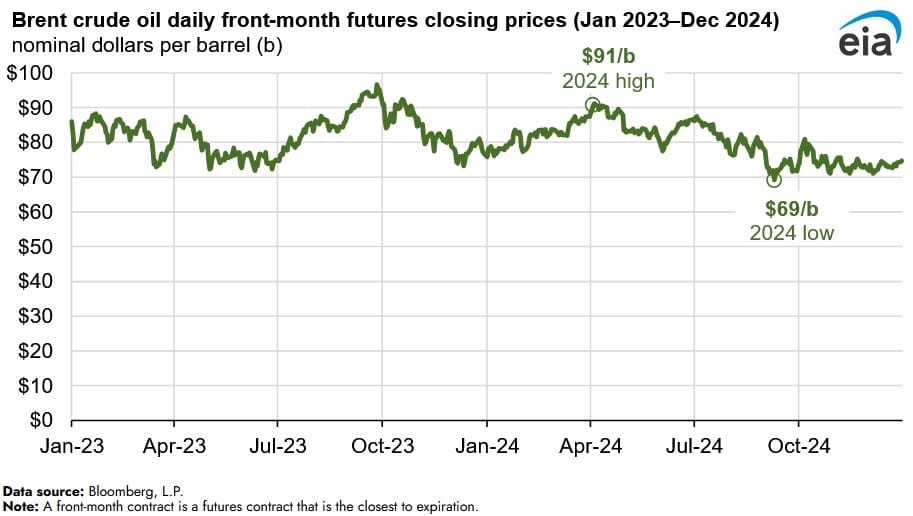
Furthermore, the increase in non-OPEC production, particularly from the United States and other key producers, has provided a buffer against supply shocks that might have previously triggered sustained price spikes. When supply-side capacity grows faster than global demand, the natural result is a softening of long-term price expectations. This structural change in the energy landscape is the primary driver behind the $80-per-barrel target, which analysts now view as a sustainable mean for the 2026 timeframe.
Market Response and Economic Implications
Energy markets have reacted to these revised outlooks with increased sensitivity, as seen in recent trading sessions where crude benchmarks faced downward pressure. When institutional giants like Goldman Sachs adjust their long-term targets, it often triggers a wider re-evaluation among hedge funds and commodity traders, leading to the price volatility witnessed in recent months. The U.S. Energy Information Administration (EIA) continues to track these fluctuations, providing data that serves as a cornerstone for institutional analysts when they update their quarterly and annual forecasts.
For the average consumer and industrial buyer, these forecasts suggest a potential easing of energy-related cost pressures. If Brent crude settles near the $80 level, it could provide central banks with more room to maneuver regarding interest rates, as energy costs are a major component of the Consumer Price Index (CPI). Conversely, for oil-exporting nations, these projections necessitate a focus on fiscal discipline and economic diversification to mitigate the impact of lower per-barrel revenue compared to the peaks observed in previous years.
Comparative Analysis of Institutional Forecasts
While Goldman Sachs and Morgan Stanley have converged on the $80 figure for the 2026 window, it is important to recognize that these are projections rather than certainties. Commodity markets are notoriously reactive to “black swan” events, ranging from sudden shifts in OPEC+ policy to unexpected macroeconomic downturns in major economies like China or the Eurozone. Analysts emphasize that these forecasts are based on current data sets and are subject to change should the underlying geopolitical or macroeconomic variables shift.
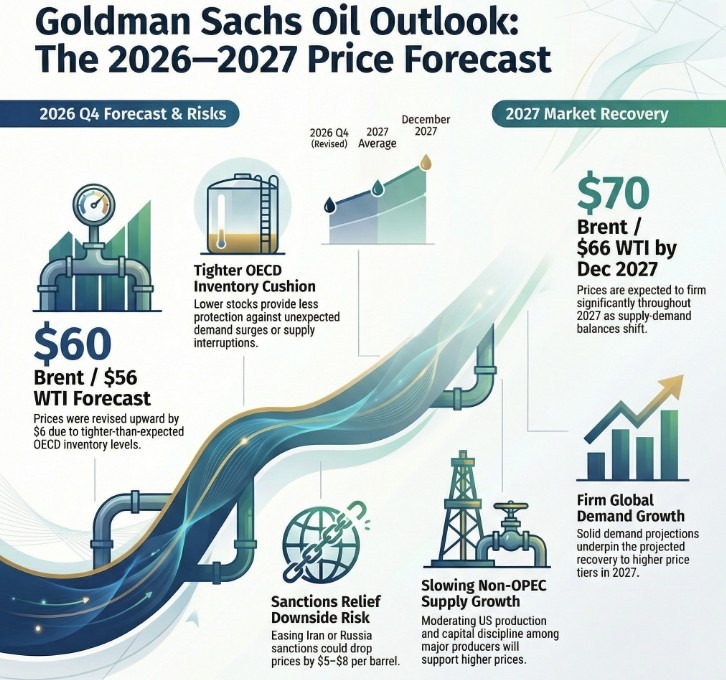
The following table outlines the current sentiment regarding oil price projections as reported by major financial analysts:
| Financial Institution | Forecast Target (2026) | Primary Rationale |
|---|---|---|
| Goldman Sachs | $80/bbl | Increased supply-side capacity |
| Morgan Stanley | $80/bbl | Geopolitical stabilization |
As the market moves toward the next quarter, investors are looking for confirmation of these trends in the upcoming earnings calls from major oil supermajors and official production updates from the OPEC+ secretariat. These official releases, typically found on the OPEC official website, will provide the next set of confirmed data points to validate or challenge the current $80-per-barrel consensus. We will continue to monitor these developments as they unfold; please share your thoughts or questions in the comments section below.