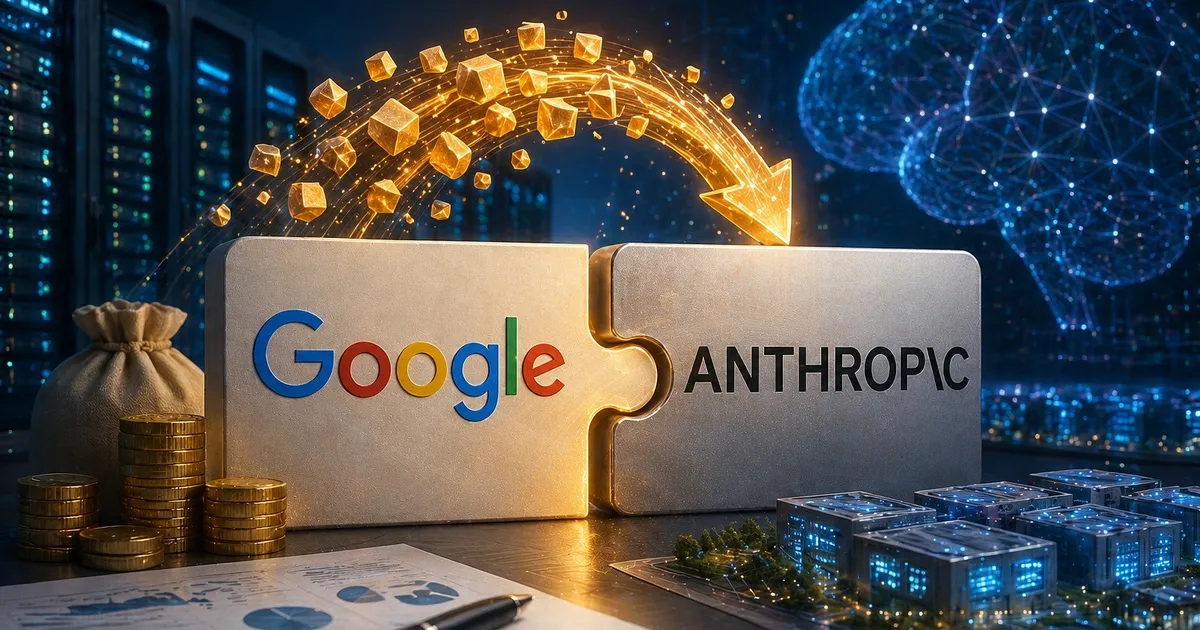
Google is planning an additional $40 billion investment in Anthropic, the artificial intelligence startup known for its Claude series of large language models, according to multiple verified reports from April 2026. This potential infusion of capital would significantly expand Google’s existing stake in the company and intensify its competition with rivals like Microsoft and Amazon in the rapidly evolving generative AI landscape.
The reported investment aligns with Google’s broader strategy to strengthen its position in foundational AI models and cloud-based AI services. Anthropic, founded in 2021 by former OpenAI researchers Dario and Daniela Amodei, has emerged as a key player in AI safety and scalable model development. Its Claude 3 family of models, released in early 2024, has gained traction among enterprise clients seeking reliable and interpretable AI systems.
According to a Bloomberg report dated April 24, 2026, Google is in advanced discussions to allocate the funds to support Anthropic’s infrastructure expansion and the training of next-generation generative models. The investment would be structured to accelerate computing capacity, particularly through Google Cloud’s TPU v5e and upcoming v6 processors, which are optimized for large-scale AI workloads.
Reuters also confirmed on April 24, 2026, that the planned investment reflects growing pressure on tech giants to secure long-term partnerships with leading AI innovators. The report noted that Google’s move follows Amazon’s earlier $4 billion commitment to Anthropic in late 2023, which was later increased to $8 billion in early 2024. Yet, the $40 billion figure under discussion represents a substantial escalation in scale.
Anthropic has not publicly disclosed the exact terms of any potential new funding round as of April 26, 2026. The company’s most recent disclosed valuation, following its Series C round in 2023, was approximately $18.4 billion. A $40 billion investment at this stage would imply a significant uplift in perceived future value, though no official post-money valuation has been confirmed by either party.
The strategic rationale behind the investment centers on enhancing Google’s Gemini AI ecosystem. By deepening ties with Anthropic, Google aims to integrate Claude’s strengths in reasoning and safety into its own product suite, including Vertex AI and Google Workspace. Industry analysts suggest this could allow Google to offer differentiated AI solutions that emphasize reliability and enterprise governance — areas where Anthropic has positioned itself as a leader.
Regulatory scrutiny remains a potential factor. In March 2026, the U.S. Federal Trade Commission launched an inquiry into major tech companies’ investments in AI startups, examining whether such partnerships could circumvent antitrust laws through de facto control without formal acquisition. While Google’s investment in Anthropic would likely fall under review, no enforcement actions have been announced as of April 2026.
Internationally, the European Union’s AI Act, which came into full effect in August 2025, imposes strict transparency and risk-management requirements on foundation model providers. Anthropic has publicly committed to compliance with the Act’s provisions, including documentation of training data and model evaluation protocols — factors that may appeal to Google as it seeks to expand its AI offerings in regulated markets.
Should the investment proceed, it would mark one of the largest single private investments in an AI company to date. For context, Microsoft’s total investment in OpenAI exceeds $13 billion as of early 2026, while Amazon’s cumulative commitment to Anthropic stands at $8 billion. A $40 billion infusion would dwarf these figures and signal Google’s determination to compete at the highest level of AI innovation.
The funds, if allocated, are expected to support Anthropic’s ongoing research into constitutional AI, a methodology designed to align model behavior with human-readable principles. This approach, pioneered by the company, aims to reduce harmful outputs and improve interpretability — features increasingly valued by government and financial sector clients.
Google Cloud would likely serve as the primary computational backbone for Anthropic’s expanded training efforts. The company has already committed to offering Anthropic’s models via its Model Garden service, and deeper integration could lead to co-optimized hardware-software stacks that improve efficiency and lower inference costs for enterprise users.
As of April 26, 2026, neither Google nor Anthropic has issued an official statement confirming the $40 billion investment plan. Both companies declined to comment when contacted by Reuters and Bloomberg ahead of the reports’ publication. Industry observers note that such large-scale investments are typically disclosed through SEC filings or press releases once definitive agreements are reached.
The next key development to watch is any formal announcement from either company regarding a definitive investment agreement, which would likely be accompanied by updated financial disclosures or a joint press release. Until then, the $40 billion figure remains a reported plan under discussion, not a confirmed transaction.
For readers seeking to follow this story, official updates may be found in Google’s investor relations portal, Anthropic’s corporate blog, or regulatory filings with the U.S. Securities and Exchange Commission. Major technology journalists at outlets like Reuters, Bloomberg, and the Financial Times continue to monitor the situation for verifiable developments.
What does this potential investment mean for the future of AI development? It underscores the intensifying race among tech giants to secure access to cutting-edge AI capabilities through strategic partnerships rather than outright acquisitions. As foundation models become increasingly expensive to train and deploy, alliances like the one between Google and Anthropic may define the next phase of innovation — where scale, safety, and cloud infrastructure converge.
Stay informed. Share your thoughts in the comments below, and help others understand what Which means for the future of artificial intelligence.
Worth a look