Google Leverages AI and Historical News Data to Predict Flooding
Flash floods remain among the deadliest natural disasters globally, and accurately predicting their occurrence presents a significant challenge. Now, Google is pioneering a novel approach, harnessing the power of artificial intelligence and analyzing millions of archived news articles to improve flood forecasting, particularly in regions lacking robust sensor networks. This initiative builds upon Google’s existing efforts in disaster prediction, demonstrating a growing commitment to leveraging technology for public safety.
For years, major technology companies have been developing tools to anticipate natural catastrophes. Google first entered this space in 2020 with the launch of Android Earthquake Alerts, a system that utilizes smartphone sensors to detect seismic activity. As of March 12, 2026, this technology is operational in 98 countries and relies on approximately 2.5 billion Android devices, according to Google’s official blog post. The system has already issued over 1,200 alerts, providing users with crucial seconds—sometimes just moments—to seek safety before tremors hit. Google has further refined the system for Wear OS smartwatches, enabling alerts even without a paired smartphone. Now, the company is applying similar methodologies to the complex problem of predicting sudden floods.
The increasing frequency and intensity of extreme weather events, driven by climate change, underscore the urgency of improved disaster preparedness. According to the World Bank, over 1.8 billion people—more than one in five globally—are exposed to significant flood risk. Swiss Re, a leading reinsurance company, estimates that flood damage costs the world $82 billion annually. These figures highlight the critical need for effective early warning systems, especially in vulnerable communities.
Mining the Past to Protect the Future: How Google’s AI Works
To enhance flood prediction, Google researchers developed a unique method centered around its Gemini artificial intelligence model. The team analyzed approximately 5 million news articles from around the world, aiming to identify reports of past flooding events and transform qualitative narratives into quantifiable data. This process successfully identified 2.6 million flood events, creating a vast dataset known as Groundsource. Groundsource links each event to a specific date and location, providing a historical record for analysis.
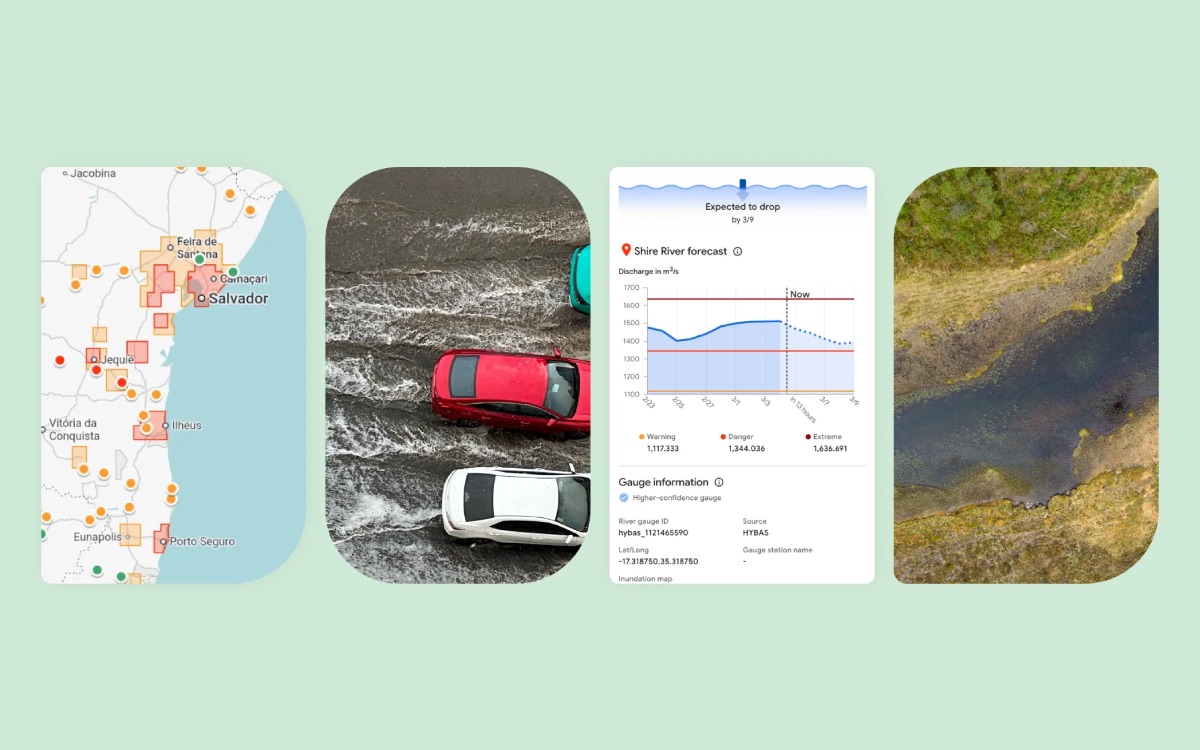
This historical data is then used to train a machine learning model, which combines it with current weather forecasts to estimate the probability of flash floods in a given area. The resulting predictions are integrated into Google’s Flood Hub platform, currently displaying risk zones in 150 countries. Authorities and emergency responders can access these maps to proactively prepare for potential disasters. The platform, initially launched in India and Bangladesh in 2018, has since expanded to include South America, Sub-Saharan Africa, and Asia, and now covers a significant portion of the globe. As of May 22, 2023, Google expanded Flood Hub to include France and 17 other countries, as reported by BFM TV .
While promising, the current system has limitations. The precision of the predictions is relatively low, with analysis zones spanning approximately 20 square kilometers. However, this approach holds particular value in regions where traditional meteorological infrastructure is limited or non-existent. The ability to extract valuable data from historical news reports offers a cost-effective and scalable solution for improving flood preparedness in underserved areas.
Beyond Prediction: Google’s Broader Disaster Response Efforts
Google’s foray into disaster prediction extends beyond earthquakes, and floods. The company’s Flood Hub platform combines hydrological models—which predict water volume in rivers—with inundation models, which forecast the extent and depth of flooding. Yossi Matias, Vice President of Engineering and Research at Google, explained in a statement to Le Point that the goal is to prevent urban flooding and flash floods, particularly as the effects of climate change intensify. The system relies on hundreds of thousands of simulations to generate accurate risk assessments.
The development of these technologies reflects a broader trend of leveraging artificial intelligence for disaster management. AI algorithms can analyze vast datasets, identify patterns, and provide early warnings that can save lives and mitigate damage. However, it’s crucial to acknowledge that these systems are not foolproof and require continuous refinement and validation. The accuracy of predictions depends on the quality and completeness of the data used to train the models.
Google’s initial success with Android Earthquake Alerts demonstrates the potential of using widespread sensor networks—in this case, smartphones—to detect and respond to natural disasters. The company’s expansion into flood prediction, utilizing a novel approach of analyzing historical news data, further underscores its commitment to harnessing technology for the benefit of communities worldwide. The Groundsource database, built on the analysis of 2.6 million flood events, represents a significant step forward in understanding and mitigating the risks associated with these devastating events.
The apply of AI to analyze unstructured data, such as news reports, is a particularly innovative aspect of this initiative. Traditionally, disaster prediction models have relied on structured data from weather stations, river gauges, and other sensors. However, in many parts of the world, such data is scarce or unavailable. By extracting valuable information from historical news articles, Google is able to overcome this limitation and provide early warnings in areas where they are most needed.
Looking ahead, Google plans to continue refining its flood prediction models and expanding the coverage of Flood Hub to additional countries. The company is also exploring ways to integrate its AI-powered tools with other disaster response systems, such as emergency alert networks and evacuation planning tools. The ultimate goal is to create a more resilient and prepared world, capable of mitigating the devastating impacts of natural disasters.
The next major update regarding Google’s Flood Hub and AI-driven disaster prediction is expected during the company’s annual I/O developer conference in May 2026, where further details on model improvements and expansion plans are anticipated. We encourage readers to share their thoughts and experiences with disaster preparedness in the comments below.
Keep reading