
Unveiling the Secrets of Interstellar Comet 3I/ATLAS: A Deep Dive into its Unusual Behavior
Comet 3I/ATLAS, a visitor from beyond our solar system, continues to captivate astronomers with its unique characteristics. Recent observations are providing crucial insights into its composition and origins,revealing a celestial body unlike any we’ve encountered before. This article delves into the latest findings, explaining what makes 3I/ATLAS so special and what scientists are learning as it journeys through our cosmic neighborhood.
A Comet Unlike Others: Origin and Early Observations
Initially discovered in 2019, 3I/ATLAS is only the third confirmed interstellar comet to visit our solar system. Unlike comets born within our sun’s family, this icy wanderer originated from another star system, offering a rare opportunity to study materials from a different planetary formation process.
Recently, the comet made its closest approach to the sun (perihelion) in late September 2023. Following this event, astronomers have been racing to gather data, especially focusing on the material being released as the comet warms. Importantly,this isn’t pristine material from its home system,but rather material altered by its journey through our own solar system and exposure to the sun’s radiation.
New Observations Reveal a Distinctive Hue
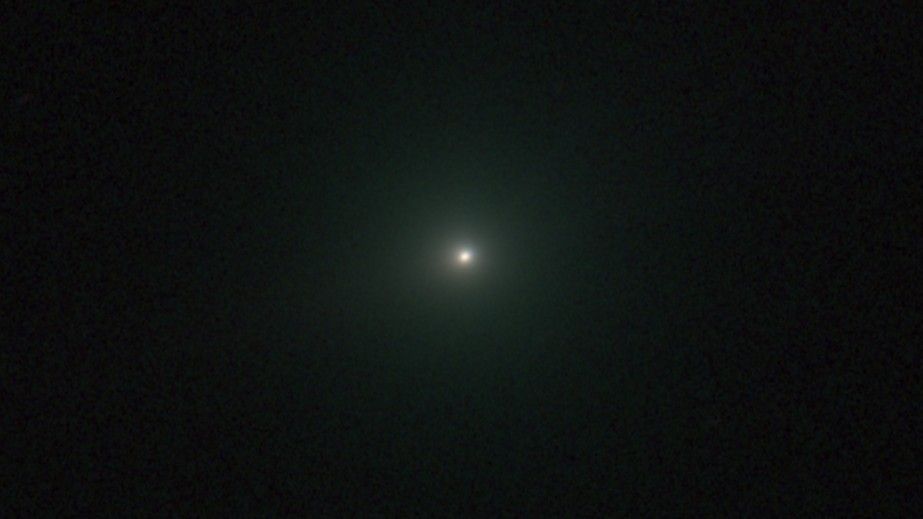
Qicheng Zhang, a researcher specializing in cometary studies, has been at the forefront of observing 3I/ATLAS. Using the Lowell Discovery Telescope in Arizona, Zhang captured a new image of the comet on Halloween, revealing a striking greenish glow.
This color isn’t necessarily a recent change.Earlier observations,detailed in a study published on the preprint server arXiv in late October,indicated the comet was distinctly bluer than the sun before perihelion. The green hue likely stems from the way different filters interpret the wavelengths of light emitted by the comet.
* Astronomers use filters to isolate specific wavelengths.
* “Bluer” and “redder” refer to shorter and longer wavelengths of light, respectively.
* The comet appears brightest when viewed through filters sensitive to blue and green light.
Rapid Brightening and Compositional Clues
Zhang’s research, alongside his colleagues, suggests 3I/ATLAS experienced a period of rapid brightening as it approached the sun. This unusual behavior, coupled with its blue coloration, points to a unique composition.
The team’s study suggests the comet is venting irradiated material, meaning the gases and dust being released have been altered by the sun’s energy. This is crucial for deciphering the comet’s origins, as it provides clues about the conditions in the star system it came from.
Observing 3I/ATLAS: Accessibility for Astronomers and Enthusiasts
Fortunately, you don’t need access to a massive observatory to observe 3I/ATLAS. While the Lowell Discovery Telescope was ideally positioned to capture early post-perihelion views, the comet is now high enough in the sky for larger telescopes to observe.
Even amateur astronomers with a 6-inch (15 centimeter) lens telescope can potentially spot this interstellar visitor. It’s currently visible in the early morning hours, rising above the northeastern horizon.
What’s Next for 3I/ATLAS?
Expect a surge of new data and discoveries in the coming months. As more telescopes turn their gaze towards 3I/ATLAS, scientists will continue to refine our understanding of its composition, behavior, and ultimately, its origins.
This comet represents a rare opportunity to study materials from another star system, offering invaluable insights into the diversity of planetary formation processes throughout the galaxy. Stay tuned for further updates as this interstellar traveler continues its journey through our solar system.
Resources:
* Qicheng Zhang’s Cometary Blog
* [LiveScience: Rapid Brightening of 3I/ATLAS](https://www.livescience.com/space/comets/nasa-spacecraft-reveal-interstellar-com





