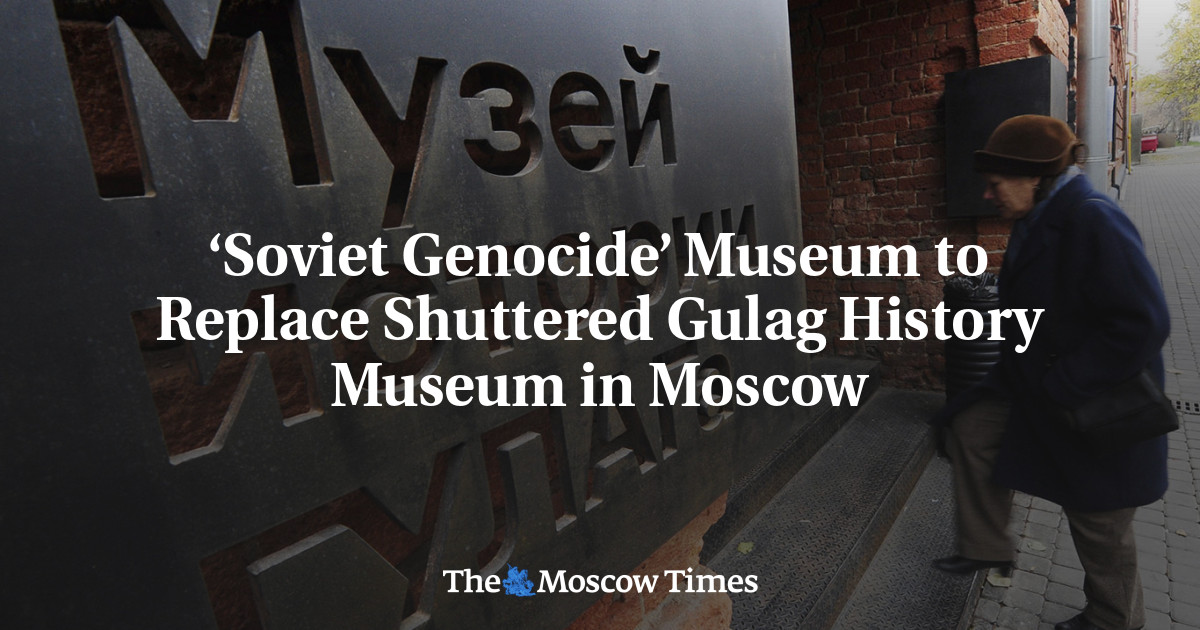
Moscow to Replace Gulag History Museum with Institution Focusing on “Soviet Genocide” and Nazi War Crimes
A museum dedicated to the “genocide of the Soviet people” and Nazi war crimes is slated to replace Moscow’s acclaimed Gulag History Museum, more than a year after the latter’s abrupt closure. The move, announced via a brief statement on the Gulag History Museum’s website, has sparked concern among historians and human rights advocates who view it as another step in a broader effort by the Kremlin to rewrite Soviet history and downplay the atrocities committed under Joseph Stalin. The recent Museum of Memory will, according to the statement, cover “all stages of Nazi war crimes during the Great Patriotic War,” a term used in Russia to refer to the Eastern Front of World War II.
The closure of the Gulag History Museum in November 2024, ostensibly due to “fire safety violations,” was widely seen as politically motivated. Multiple inspections reportedly found no such violations, according to a Moscow government official who spoke to The Moscow Times. The museum, established in 2001, served as a vital repository of artifacts and testimonies documenting the vast network of forced labor camps that operated across the Soviet Union, and their enduring legacy in modern Russia. Its closure and the subsequent replacement raise questions about the future of historical memory and independent scholarship within the country.
A Shift in Historical Narrative
The decision to replace the Gulag History Museum with an institution focused on Nazi war crimes aligns with a broader trend in Russia of emphasizing the country’s role as a victim during World War II, while simultaneously minimizing or justifying the repressions of the Soviet era. President Vladimir Putin has frequently invoked the narrative of fighting Nazism to bolster national unity and justify current political actions, including the 2022 full-scale invasion of Ukraine. He has repeatedly claimed the invasion was necessary to “denazify” Ukraine and protect Russian-speaking populations, assertions widely dismissed by Kyiv and its Western allies.
This reframing of history is not new. Since 2022, authorities have increasingly worked to downplay Soviet-era repressions, a trend that has accelerated following the invasion of Ukraine. The focus on Nazi crimes, while undeniably critical, is seen by some as a deliberate attempt to divert attention from the darker chapters of Soviet history and to create a narrative of moral equivalence. Historians argue that acknowledging both the horrors of Nazi occupation and the internal repression within the Soviet Union is crucial for a complete and honest understanding of the past.
New Leadership and Museum Focus
Natalia Kalashnikova, currently the director of the Smolensk Fortress museum, has been appointed to lead the new Museum of Memory. According to Russian news agencies citing Moscow’s Department of Culture, Kalashnikova defined the new institution’s mission as “cultivating a strong rejection of Nazism in all its forms in the current generation.” This focus, while seemingly uncontroversial, has raised concerns that the museum will prioritize a specific political agenda over a nuanced and comprehensive historical account.
The Smolensk Fortress museum, under Kalashnikova’s leadership, has been involved in projects related to commemorating Soviet soldiers who died during World War II. Her appointment signals a clear intention to emphasize the “Great Patriotic War” narrative and potentially downplay the significance of the Gulag system and other forms of Soviet repression. The museum is slated to open later this year, though a specific date has not yet been announced.
The Closure of the Gulag History Museum: A Pattern of Suppression
The circumstances surrounding the closure of the Gulag History Museum have been shrouded in controversy. While authorities cited fire safety violations, critics allege that the move was orchestrated by high-ranking Kremlin officials and the FSB security service. The museum’s long-time director was replaced just a few months after the initial closure, further fueling suspicions of political interference.
The Gulag History Museum was widely recognized for its meticulous research, compelling exhibits, and commitment to preserving the memory of the millions who suffered under the Soviet regime. It housed a vast collection of artifacts, documents, and testimonies gathered from across Russia, providing a powerful and often harrowing account of the Gulag system. Its closure represents a significant loss for historical scholarship and public understanding of this crucial period in Russian history. Approximately 27 million Soviet citizens are estimated to have died during World War II, a staggering loss that underscores the immense suffering endured by the country during the conflict.
Broader Crackdown on Historical Memory
The closure of the Gulag History Museum is part of a broader pattern of increasing restrictions on historical research and public discourse in Russia. Independent historians and journalists have faced growing pressure, and laws have been enacted that criminalize the “distortion of historical facts.” These measures have created a climate of fear and self-censorship, making it increasingly difficult to conduct objective research and to engage in open debate about the past.
In a related development, reports indicate that the Museum of Moscow removed an exhibit section on Soviet repression in January 2025, further demonstrating the authorities’ efforts to sanitize the historical record. These actions have drawn condemnation from international human rights organizations and scholars, who warn that they undermine the principles of historical truth and reconciliation. The Kremlin’s actions are seen by many as an attempt to control the narrative of the past in order to legitimize its present-day policies and to consolidate its grip on power.
What Happens Next?
The opening of the Museum of Memory later this year will be closely watched by historians and observers of Russian politics. The museum’s exhibits and programming will likely provide further insight into the Kremlin’s evolving approach to historical memory. The fate of the Gulag History Museum’s collection remains uncertain, though officials have indicated that some artifacts may be incorporated into the new museum. However, concerns remain that the collection will be curated in a way that aligns with the Kremlin’s preferred narrative.
The ongoing suppression of independent historical research and public discourse in Russia raises serious questions about the future of historical truth and accountability. The closure of the Gulag History Museum and the establishment of the Museum of Memory represent a significant setback for efforts to come to terms with the country’s complex and often painful past. The situation underscores the importance of preserving and promoting independent historical scholarship and of defending the right to freedom of expression.
Further updates regarding the opening date and specific exhibits of the Museum of Memory are expected from the Moscow Department of Culture in the coming months. The international community will continue to monitor the situation and advocate for the preservation of historical memory and academic freedom in Russia.
Do you have thoughts on this developing story? Share your comments below and consider sharing this article with your network.
Related reading