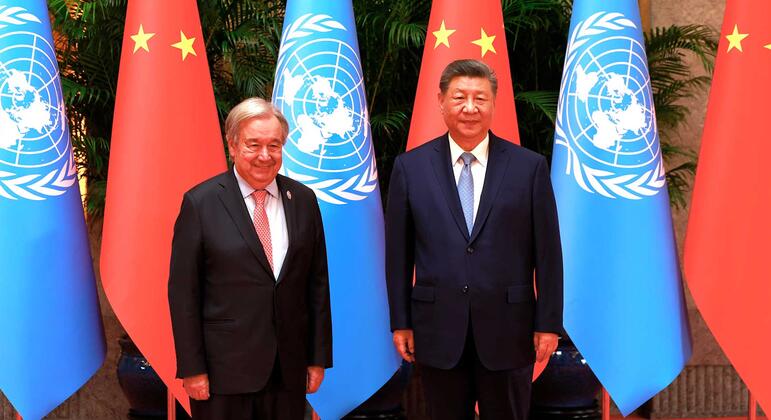
United Nations Secretary-General António Guterres has called for a global, inclusive approach to the governance of artificial intelligence, warning that the technology must be shaped by “all of humanity” rather than a small group of powerful nations or corporations. Speaking at the launch of the final report from the UN High-Level Advisory Body on AI in September 2024, Guterres emphasized that the current trajectory of AI development risks deepening global inequalities and leaving developing nations behind.
The Secretary-General’s remarks come as the international community grapples with how to regulate rapidly advancing generative AI models. According to the final report of the UN High-Level Advisory Body on Artificial Intelligence, the concentration of AI power within a handful of companies and countries creates a “governance gap” that could undermine human rights and sustainable development goals. Guterres stressed that AI should not be the exclusive domain of a few, asserting that the benefits of the digital revolution must be shared equitably across the Global South.
The Governance Gap in Artificial Intelligence
The central concern highlighted by the UN is the lack of international coordination. While several nations, including the United States, China, and members of the European Union, have introduced domestic regulations, there is no global framework to manage the cross-border risks posed by AI. The UN Advisory Body’s report, titled Governing AI for Humanity, proposes the creation of an International Scientific Panel on AI, modeled after the Intergovernmental Panel on Climate Change (IPCC), to provide objective, science-based assessments of AI capabilities and risks.
This initiative aims to establish a common baseline of understanding that all nations can rely on. By fostering global scientific cooperation, the UN seeks to prevent a scenario where AI development is driven solely by commercial interests or geopolitical competition. The report specifically calls for the establishment of an AI Office within the UN Secretariat to coordinate these efforts and ensure that technical standards are developed with input from a diverse range of stakeholders, including civil society and academic institutions from developing countries.
Addressing Inequality in the Digital Age
A primary point of contention is the accessibility of AI infrastructure. Advanced AI requires significant computing power, massive datasets, and high-level technical expertise—assets currently concentrated in a few wealthy economies. Without deliberate intervention, the UN warns that the divide between those who control AI and those who merely consume it will widen, potentially leading to new forms of economic dependency.
In his address, Guterres noted that AI has the potential to accelerate progress toward the UN’s Sustainable Development Goals (SDGs), particularly in fields like medicine, climate modeling, and education. However, he cautioned that without inclusive policies, these tools might instead be used to automate surveillance, intensify biases, or displace labor in ways that disproportionately harm vulnerable populations. The UN is advocating for an “AI Fund for Development,” which would support capacity-building initiatives, providing the digital infrastructure and training necessary for developing nations to participate in the AI economy.
Global Regulatory Perspectives and the Way Forward
The push for international AI governance coincides with legislative efforts in major jurisdictions. The European Union has already implemented the EU AI Act, the world’s first comprehensive legal framework for artificial intelligence, which categorizes AI systems based on risk levels. Similarly, the United States has issued various executive orders regarding AI safety and security, focusing on transparency and testing protocols.
Despite these efforts, Guterres maintains that regional regulations are insufficient to address the global nature of AI development and deployment. Data flows, model training, and the impact of AI-driven misinformation do not respect national borders. The UN’s proposed governance model emphasizes the need for an “AI Global Compact” that would align national policies with international human rights standards. This approach seeks to ensure that as companies develop increasingly powerful models, they remain accountable to the public interest rather than solely to shareholders.
The next major checkpoint for these initiatives will be the follow-up discussions at the UN Summit of the Future, where member states are expected to review proposals for digital cooperation and the integration of these governance structures into the multilateral system. The Secretary-General has invited all member states and private sector leaders to engage in these discussions to ensure that the development of AI remains a tool for human empowerment rather than a source of global division.
For ongoing updates regarding the UN’s AI governance initiatives, readers are encouraged to visit the official United Nations High-Level Advisory Body on AI website. We invite our readers to share their perspectives on the role of international bodies in regulating emerging technology in the comments section below.
Related reading