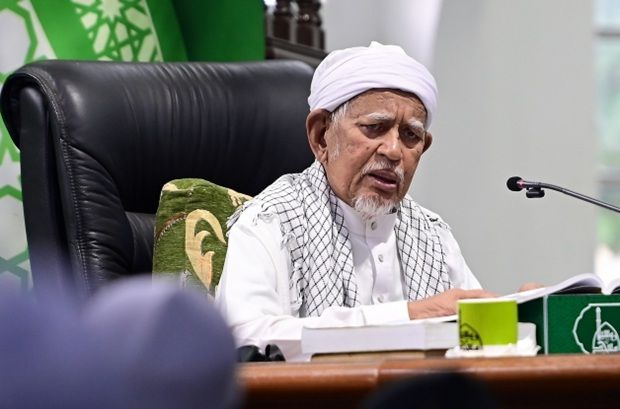
PAS president Tan Sri Abdul Hadi Awang is calling for a formal political alliance between PAS, Umno, and non-extremist non-Muslim parties to consolidate Malay-Muslim political power. Writing in a Facebook post on Tuesday, July 21, Hadi argued this coalition is essential to prevent further divisions and secure the future of the Malay-Muslim community in Malaysia. He stated that the weakness of democracy, together with divisions among Malay Muslims and widespread ignorance of religion and politics, has placed the country in a dangerous situation where Islamic political power could be lost.
Hadi’s Strategy for a Unified Malay-Muslim Front
In his latest Minda Presiden PAS
article, Tan Sri Abdul Hadi Awang advocated for a political realignment aimed at strengthening Malay-Muslim political unity. Hadi argued that internal divisions have weakened the community’s influence, warning that continued fragmentation could result in the loss of political power if they fail to unite ahead of future elections. He described the pursuit of unity as “compulsory” for the Malay Muslim community, alongside non-Muslims who are not extremists.
Hadi’s proposed formula seeks to bring together PAS, Umno, and non-Muslim parties that do not adopt what he characterizes as extreme positions. He specifically identified MCA, MIC, and the Dewan Himpunan Pendukung Pas (DHPP) as potential partners in this effort, describing them as non-extremist organizations compatible with a leadership structure rooted in Malay-Muslim values. He added that the cooperation should eventually extend to Sabah and Sarawak as part of efforts to save our beloved Malaysia.
Strategic Objectives in Negri Sembilan and Beyond
The push for cooperation comes as PAS and Umno navigate a complex electoral landscape. In Negri Sembilan, the two parties have coordinated seat distributions to avoid direct clashes, with Barisan Nasional (BN) contesting 25 of the 36 state seats, while Perikatan Nasional (PN) is fielding candidates in 11 constituencies, including five seats for PAS under the PN banner. This arrangement has sparked debate within Pakatan Harapan, with some leaders questioning whether BN’s continued participation in the Federal Government’s unity arrangement is compatible with its cooperation with PN at the state level.
Hadi defended the varied strategies employed by PAS across different states. While the party’s involvement in Johor—where he noted Umno is already strong—was described as symbolic to provide support, he framed the approach in Negri Sembilan as an attacking force.
He asserted that this is a strategic move to take over Malay Muslim political power in a state currently governed by Pakatan Harapan and what he described as the dominance of the extremist DAP and Malays who have drifted away.
Historical Context and Party Principles
Hadi framed the current overtures toward Umno as an obligatory response to historical patterns of decline. He noted that PAS had previously worked with Umno before and after independence, but those partnerships ended when conditions and principles were violated. He also recalled PAS’ past cooperation with DAP and PKR through opposition coalitions such as Barisan Alternatif (BA) and Pakatan Rakyat (PR), which he said collapsed due to disagreements over principles, including PAS’ push for an Islamic state and its stance on syariah implementation in Kelantan and Terengganu.
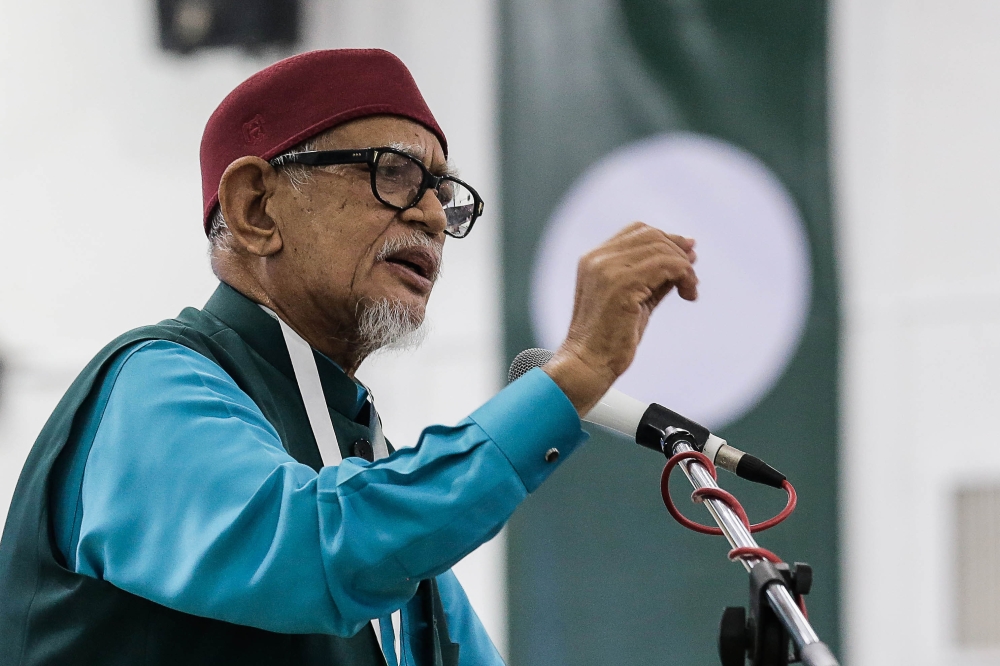

His rhetoric has drawn clear lines against parties currently aligned with the Democratic Action Party (DAP), specifically PKR and Amanah. Hadi urged voters to reject what he termed unnatural Malay groups,
claiming these fanatical secular and extreme chauvinist groups threaten Islam and the Malay community. He maintained that his emphasis on Malay-Muslim leadership is not an expression of racial fanaticism, but a commitment to what he described as Islam’s obligation to uphold justice for all communities. He noted that the performance of PAS in the 15th general election, where it secured the highest number of parliamentary seats won by a single party and formed governments in four states, reflected strong support from Malay Muslim voters.
As the political landscape shifts toward the 16th General Election, the potential for this cooperation to evolve remains a point of contention. Hadi explicitly rejected claims that the current cooperation between PN and BN was merely a political game,
insisting it is a necessary effort to strengthen the position and interests of the Malay Muslim community.
Sources: Thestar, NST Online.
Worth a look