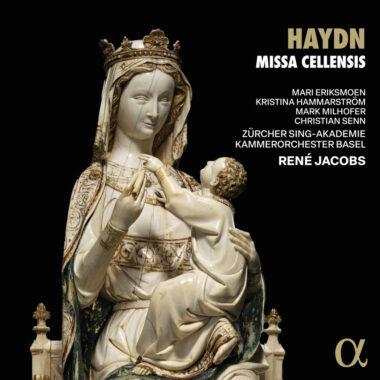
The world of classical music is experiencing a renewed appreciation for the complexities and beauty of Joseph Haydn’s Missa Cellensis, thanks to a compelling new recording led by the esteemed conductor René Jacobs. This work, often shrouded in historical ambiguity, is brought to life with a vibrant energy and insightful interpretation, marking the beginning of a multi-album collaboration between Jacobs, the Basel Chamber Orchestra, the Zurich Sing-Akademie, and the Alpha label. The project, slated to continue through 2028, will encompass all six of Haydn’s later masses, promising a deep dive into a pivotal period of the composer’s sacred music.
Haydn’s Missa Cellensis, composed in 1766, holds a unique place in his catalog of fourteen masses. Initially commissioned as a Missa Solemnis – a grand mass featuring trumpets and timpani – it quickly became known as the “Missa Sanctae Ceciliae,” or Mass of Saint Cecilia. Yet, this association proved to be somewhat misleading. As detailed in research from the early 1970s, a fragment of the original manuscript discovered in Budapest revealed the work’s true title and its original dedication to the pilgrimage church of Mariazell in Styria, Austria. This discovery helped clarify the work’s intended purpose and corrected a long-held misattribution.
A History Shrouded in Mystery
The story of the Missa Cellensis is far from straightforward. The composer’s connection to Saint Cecilia, the patron saint of music, appears to be a later association stemming from performances held by the Saint Cecilia brotherhood in Vienna. This explains the apocryphal nickname, despite Haydn never explicitly dedicating the work to the saint. The discovery of the original manuscript fragment in 1970, however, was a pivotal moment in understanding the piece’s origins. The manuscript, as noted by sources, was actually found in Budapest, not Bucharest as previously claimed by some musicological accounts. This finding provided crucial insight into the work’s initial purpose and corrected a historical inaccuracy.
Adding to the intrigue, scholars have debated whether the Missa Cellensis was originally conceived as a complete work or if it evolved over time. Some theories suggest that the Kyrie and Gloria sections were composed as early as 1766, with the remaining movements added later. Others propose that the extant copies represent an earlier version of the mass, reconstructed from memory. These ongoing musicological debates highlight the complexities inherent in reconstructing the history of this fascinating composition. It’s crucial to note that Haydn composed three masses named “Cellensis,” with this particular work being the earlier of the two, dating back to 1766, and commissioned before the later, smaller-scale mass of 1782 commissioned by Anton Liebe von Kreutzner.
Jacobs’ Interpretation: A Blend of Scholarship and Passion
René Jacobs’ approach to the Missa Cellensis is characterized by both meticulous scholarship and a palpable passion for the music. His interpretation, as highlighted in reviews, brings a theatricality and playfulness to the work, reminiscent of the operatic style prevalent during Haydn’s time. Jacobs masterfully balances the solemnity of the liturgical text with moments of joyful exuberance, creating a dynamic and engaging performance. This represents achieved through a careful attention to detail, a nuanced understanding of the harmonic language, and a willingness to embrace the inherent drama within the score.
The performance features a stellar cast of soloists – Mari Eriksmoen (soprano), Kristina Hammarström (mezzo-soprano), Mark Milhofer (tenor), and Christian Senn (baritone) – alongside the renowned Zürcher Sing-Akademie and the Kammerorchester Basel. Jacobs’ long-standing collaborations with these musicians are evident in the seamless interplay and expressive depth of the performance. The choral writing, in particular, is beautifully rendered, showcasing the Sing-Akademie’s precision and tonal richness. The orchestra provides a sensitive and supportive accompaniment, allowing the vocal lines to soar and the dramatic moments to resonate with full impact.
The Classical Style and Haydn’s Innovations
The Missa Cellensis exemplifies the characteristics of the Classical period in music, which flourished after 1750. This style is marked by clarity of form, balance, and a focus on melodic elegance. Haydn, a central figure in the development of the Classical style, masterfully employs these principles in his mass settings. The Missa Cellensis, like other works from this era, adheres to the traditional structure of the Catholic Mass, illustrating the various moments of the religious service through music. However, Haydn’s genius lies in his ability to infuse this established framework with his own unique voice and expressive sensibility.
The work opens with a somber Kyrie, imbued with a sense of repentance, before transitioning into a radiant and joyful Gloria. This contrast between darkness and light is a hallmark of Haydn’s compositional style. The use of both vocal and orchestral forces is particularly noteworthy, creating a rich and dynamic texture. Jacobs’ interpretation emphasizes this interplay, bringing out the subtle nuances and dramatic contrasts within the score. The recording highlights the work’s operatic qualities, a characteristic shared with the compositions of Mozart, adding a layer of theatricality and emotional depth.
A Promising Collaboration and Future Recordings
This recording marks the first installment in a four-album series featuring Jacobs, the Basel Chamber Orchestra, the Zurich Sing-Akademie, and Alpha Records. The subsequent releases will be dedicated to Haydn’s six later masses, including well-known works such as the Paukenmesse (Mass with Timpani), the Theresienmesse (Theresa Mass), and the Harmoniemesse (Harmony Mass). This ambitious project promises to offer a comprehensive and insightful exploration of Haydn’s sacred music, providing listeners with a deeper understanding of his compositional evolution and artistic vision.
The release of this Missa Cellensis recording is a significant event for Haydn enthusiasts and classical music lovers alike. It’s a testament to the enduring power of Haydn’s music and the artistry of René Jacobs and his collaborators. The recording is already being hailed as a benchmark interpretation, offering a fresh and compelling perspective on a work that has long been overshadowed by its more famous counterparts. The collaboration between Jacobs and Alpha Records signals a commitment to bringing high-quality, historically informed performances to a wider audience.
As the project unfolds over the next three years, audiences can anticipate further illuminating recordings that will undoubtedly shed new light on Haydn’s remarkable legacy. The next release in the series is expected in 2027, focusing on the Paukenmesse. Listeners can locate more information about the Alpha Records label and upcoming releases on their official website: https://www.alpha-records.com/.
The Missa Cellensis, as interpreted by René Jacobs, is more than just a historical artifact; it’s a vibrant and emotionally resonant work of art that continues to speak to audiences today. It’s a reminder of the power of music to transcend time and connect us to the deepest aspects of the human experience.
Keep reading