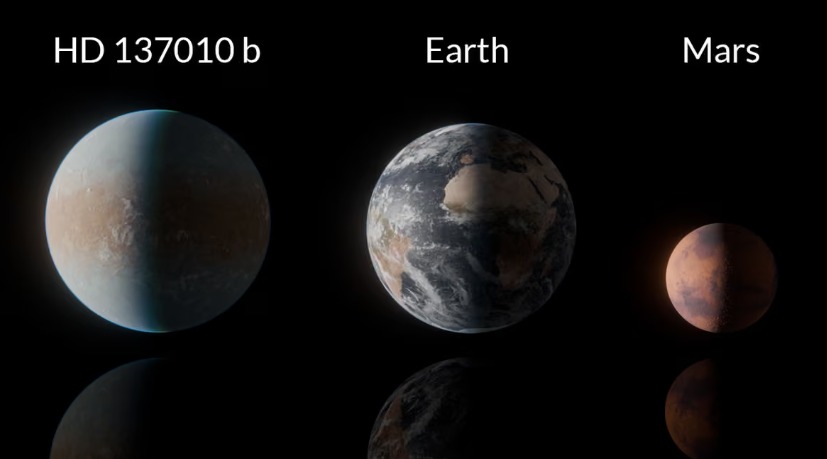
The search for planets beyond our solar system – exoplanets – continues to yield fascinating discoveries. Recently, astronomers identified a candidate planet, designated HD 137010 b, that shares striking similarities with Earth in terms of size and orbital period. However, this newfound world, located 146 light-years away, presents a chilling contrast to our own: it’s potentially colder than the surface of Mars. The findings, initially presented in a paper published in *The Astrophysical Journal Letters* on January 27, 2026, stem from a re-examination of data collected by NASA’s now-retired Kepler Space Telescope.
This “cold Earth,” as some researchers have dubbed it, is approximately 6% larger than our planet and orbits a star similar to our Sun, though somewhat cooler and dimmer. While HD 137010 b resides near the outer edge of its star’s habitable zone – the region where liquid water could theoretically exist – it receives only about one-third the heat that Earth receives from the Sun. This diminished solar energy suggests a surface temperature potentially plummeting to -90 degrees Fahrenheit (-68 degrees Celsius), making it a frigid landscape even compared to the average Martian temperature of around -85 degrees Fahrenheit (-65 degrees Celsius). The discovery highlights the diverse range of planetary conditions that exist beyond our solar system and underscores the challenges in identifying truly Earth-like worlds capable of supporting life.
The detection of HD 137010 b wasn’t a straightforward process. The signal indicating its presence was initially overlooked by automated detection algorithms, which typically prioritize multiple transit events – instances where a planet passes in front of its star, causing a slight dip in brightness. It was flagged by citizen scientists participating in the Planet Hunters project, a collaborative effort that enlists the public in sifting through astronomical data. Astrophysicist Alexander Venner, then a doctoral student at the University of Southern Queensland and now a postdoctoral researcher at the Max Planck Institute for Astronomy, subsequently re-examined the data from Kepler’s K2 mission, confirming the potential planetary signal. The initial detection relied on a single transit event observed during K2 Campaign 15 in 2017, making further observations crucial for confirmation.
A Chillingly Familiar Orbit
HD 137010 b orbits its host star, HD 137010, at a distance comparable to Earth’s orbit around the Sun, completing one revolution approximately every 355 days. This orbital period is remarkably similar to our own year. However, the star HD 137010 is a K-type dwarf star, meaning it’s smaller and cooler than our Sun. According to NASA, K-type stars are orange in color and represent about 12% of the stars in the Milky Way galaxy. NASA provides detailed information on stellar classifications, explaining that these stars have lower masses and temperatures than our Sun, resulting in reduced energy output. This lower energy output is the primary reason for the significantly colder temperatures predicted for HD 137010 b.
Despite its frigid potential, the planet’s location near the outer edge of the habitable zone sparks intrigue. The habitable zone, also known as the “Goldilocks zone,” is the region around a star where temperatures could allow liquid water to exist on a planet’s surface, a crucial ingredient for life as we know it. However, the presence of liquid water depends heavily on atmospheric conditions. A sufficiently thick atmosphere could trap heat and potentially raise the surface temperature, even on a planet receiving limited solar radiation. The possibility of a dense atmosphere on HD 137010 b remains speculative, but it’s a key factor in assessing its potential habitability.
Confirming a Candidate: The Challenges Ahead
Currently, HD 137010 b is classified as a “candidate” planet, meaning its existence hasn’t been definitively confirmed. The single transit event detected by Kepler isn’t enough to rule out other explanations for the observed dip in starlight. Confirmation requires observing additional transit events, which would demonstrate a consistent orbital pattern. However, the planet’s long orbital period – nearly a year – makes these observations challenging. Transits are infrequent, demanding patience and advanced observational capabilities.
Astronomers are hopeful that future missions, such as the Transiting Exoplanet Survey Satellite (TESS) and the Characterising Exoplanet Satellite (CHEOPS), will be able to provide the necessary follow-up observations. TESS, launched in 2018, is designed to survey a vast portion of the sky, searching for exoplanets orbiting bright, nearby stars. CHEOPS, launched in 2019, focuses on precisely measuring the sizes of known exoplanets. These missions, combined with ground-based telescopes, offer the best chance of confirming HD 137010 b’s existence and characterizing its atmosphere.
The Search for Earth 2.0: What Does This Signify?
The discovery of HD 137010 b, even as a candidate, is significant in the ongoing quest to find Earth-like planets beyond our solar system. While its frigid temperatures may preclude the possibility of life as we know it, it provides valuable insights into the diversity of planetary environments. The fact that a planet with Earth-like characteristics can exist in such a cold environment challenges our assumptions about habitability and expands the range of potential targets in the search for extraterrestrial life.
The ongoing analysis of data from retired missions like Kepler continues to yield new discoveries, demonstrating the enduring value of these space-based observatories. The Kepler mission, which operated from 2009 to 2018, revolutionized our understanding of exoplanets, discovering thousands of candidates and confirming the existence of hundreds. Its legacy continues to inspire and inform the next generation of exoplanet research. The techniques used to identify HD 137010 b, such as the transit method, remain fundamental to exoplanet detection, and advancements in data analysis are constantly improving our ability to identify subtle planetary signals.
The confirmation of HD 137010 b would not only add another exoplanet to the growing catalog but also provide a valuable opportunity to study the atmospheres of potentially habitable worlds. By analyzing the light that passes through a planet’s atmosphere during a transit, astronomers can identify the presence of various gases, including those that could indicate the presence of life. While the distance to HD 137010 b – 146 light-years – makes direct observation challenging, future telescopes with advanced capabilities may eventually allow us to probe its atmosphere in greater detail.
Key Takeaways
- HD 137010 b is a candidate exoplanet approximately 146 light-years from Earth.
- It is roughly 6% larger than Earth and orbits a star similar to our Sun, but cooler and dimmer.
- The planet’s estimated surface temperature is significantly colder than Mars, potentially reaching -90°F (-68°C).
- Confirmation of its existence requires further observations to detect additional transit events.
- The discovery highlights the diversity of exoplanetary environments and the challenges in finding truly Earth-like worlds.
The next crucial step in understanding HD 137010 b will be securing additional observation time on telescopes like TESS and CHEOPS. Astronomers will be closely monitoring the HD 137010 system for future transit events, hoping to confirm the planet’s existence and gather more data about its characteristics. The results of these observations are eagerly anticipated by the scientific community and will undoubtedly contribute to our growing knowledge of exoplanets and the potential for life beyond Earth.
What are your thoughts on the discovery of HD 137010 b? Share your comments below, and don’t hesitate to share this article with your network to spread awareness about the exciting world of exoplanet research.
Related reading