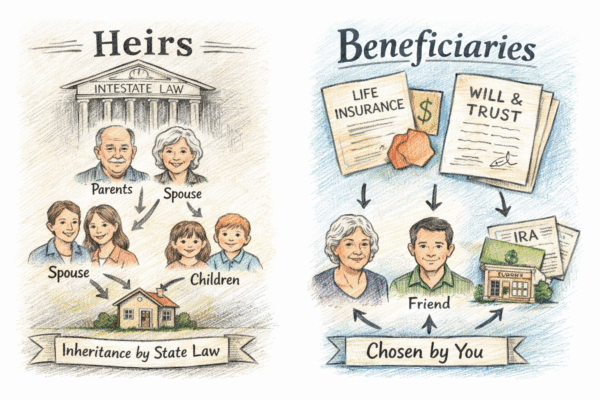
The primary legal distinction between an heir and a beneficiary is whether the recipient is named through a formal legal document or identified by state law. A beneficiary is a person specifically named by the owner to receive property from an estate, while an heir is a relative legally entitled to assets when no Will or Trust is available.
The Role of Intestacy and State Law
When an individual dies without a valid estate plan, the process is legally referred to as dying intestate.
In these cases, state law dictates how the estate is distributed through a set of rules known as Intestate Succession or statutes of descent and distribution.
According to the provided text, these laws create a clear “pecking order” or hierarchy of relatives to ensure property remains within the family. While specific rules vary by state, many are modeled after the Uniform Probate Code (UPC). A typical hierarchy follows this order:
- Surviving spouse
- Descendants (children and grandchildren)
- Parents
- Siblings and other close relatives
Defining Types of Heirs
Not all heirs hold the same legal standing. The law recognizes several specific categories of heirs based on their relationship to the deceased and their position in the line of succession:
- Heir Apparent: The person most likely to have rights to assets whose claim cannot be discounted by the birth of another heir.
- Presumptive Heir: Someone entitled to inherit—often a throne or hereditary honor—whose right could be displaced or defeated.
- Adoptive Heir: Generally granted the same rights as biological children, though some state laws may prevent them from sharing equally in an estate.
- Collateral Heir: A relative from the bloodline who is not a direct descendant, such as a brother, sister, aunt, uncle, or cousin.
Beneficiaries and the Impact of Estate Planning
A beneficiary is designated by the Grantor or owner to receive assets. The presence of a valid Will or Trust can override the default rights of heirs. If a valid Will exists, an heir does not necessarily have any rights to the estate, as the plan explicitly spells out who is entitled to the inheritance.
For more on this story, see Inheritance vs. Gifting During Life: Which Is Better?.
Certain assets are designed to pass directly to a beneficiary regardless of a Will. For example, proceeds from a life insurance policy will go to the listed beneficiary rather than the next of kin (the heir) if a beneficiary was named on the policy.
Jurisdictional Differences and Historical Context
Inheritance law is almost exclusively a state-level matter, with federal law applying only in rare instances, such as certain Native American tribal property. Modern laws have evolved significantly from English Common Law, which once utilized “Primogeniture(where the eldest son inherited everything) and
dower” (which gave widows a life estate in one-third of husband’s lands but no right to sell it).
Current laws reflect a shift toward viewing marriage as an economic partnership. For instance, in community property states like California, a surviving spouse inherits 100% of community property. For separate property in California, the spouse receives 100% if there are no children, 1/2 if there is one child, and 1/3 if there are two or more children.
Worth a look