
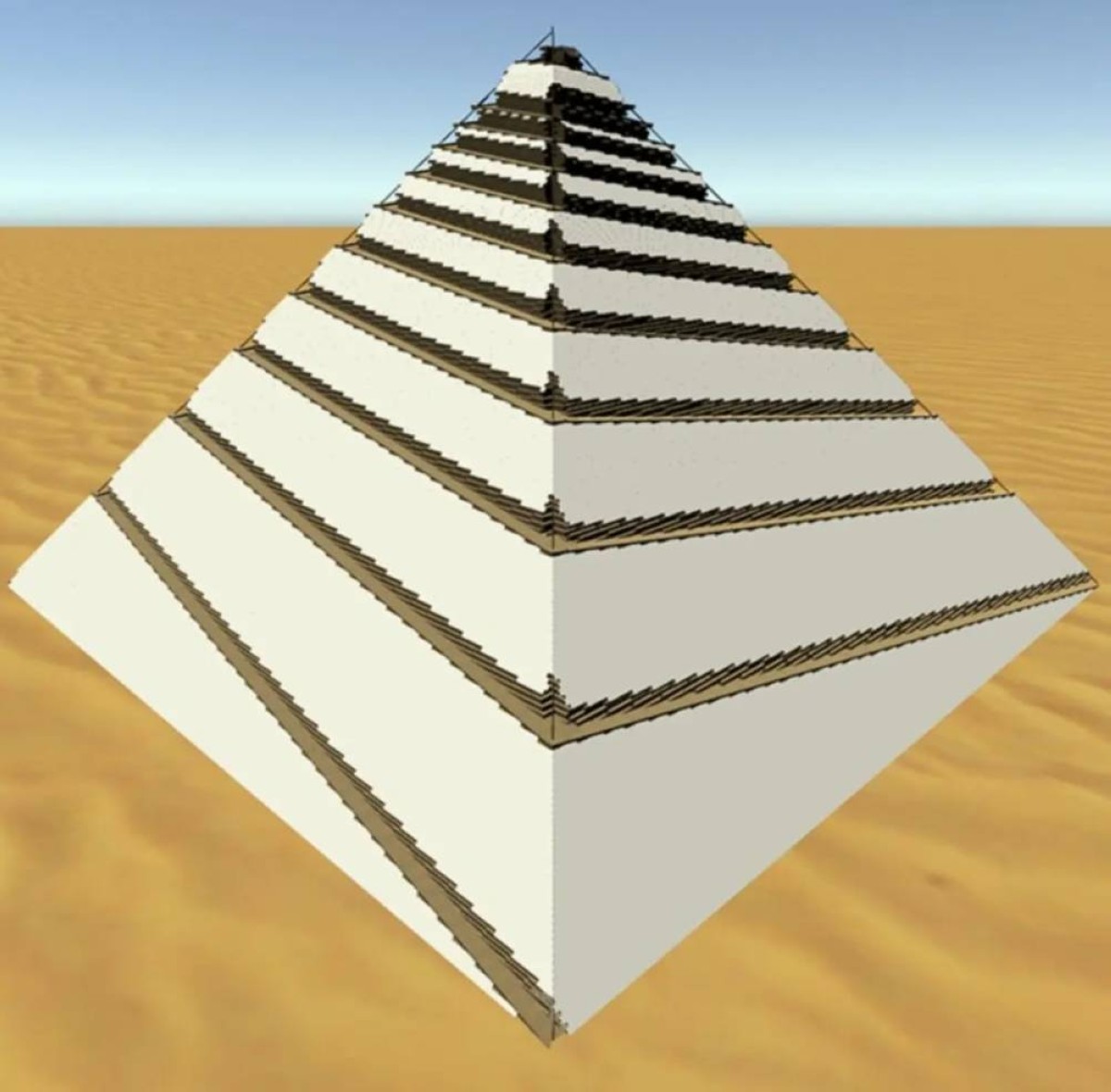
For millennia, the Great Pyramid of Giza has stood as the ultimate architectural enigma, drawing explorers, historians, and theorists to the Giza plateau in search of hidden knowledge. While the structure’s external majesty is well-documented, the internal mysteries—specifically the secrets of the Great Pyramid of Giza—have remained largely shielded by millions of tons of limestone and granite.
Until recently, the search for hidden chambers relied on invasive methods or limited physical exploration. However, a paradigm shift in archaeological methodology has emerged, replacing chisels and torches with particle physics. By utilizing cosmic-ray muons, researchers are now “seeing” through the stone, revealing voids that have remained sealed since the reign of Pharaoh Khufu over 4,500 years ago.
These discoveries are not merely academic; they challenge our understanding of ancient Egyptian engineering and the purpose of the pyramid’s internal layout. As new data emerges from international collaborations, the focus has shifted from speculative treasure hunting to a rigorous, non-invasive scientific investigation into the pyramid’s structural anomalies.
The Science of the Invisible: Muon Tomography
The most significant breakthroughs in uncovering the pyramid’s hidden spaces have come from the ScanPyramids project, an international collaboration of physicists and archaeologists. The team employs a technique known as muon tomography, which utilizes muons—subatomic particles created when cosmic rays hit the Earth’s atmosphere.
Muons penetrate solid stone but are absorbed at different rates depending on the density of the material. By placing muon detectors inside and around the pyramid, scientists can create a three-dimensional map of the interior. Areas where more muons pass through indicate a lower density, signaling the presence of a void or a chamber. This process allows researchers to identify hidden structures without drilling a single hole into the ancient masonry.
This technology has effectively turned the Great Pyramid into a giant X-ray subject, revealing that the internal architecture is far more complex than the traditional maps of the King’s Chamber, Queen’s Chamber, and Grand Gallery suggest.
Unveiling the ‘Big Void’ and the North Face Corridor
One of the most startling revelations of the modern era was the discovery of a massive internal space, often referred to as the “Big Void.” First reported in a 2017 study published in the journal Nature, this void is located directly above the Grand Gallery and measures approximately 30 meters (nearly 100 feet) in length. While its exact purpose remains unknown, its scale suggests it was a deliberate architectural feature rather than a structural gap.

Building on this momentum, researchers announced a further discovery in March 2023: a previously unknown corridor located behind the chevron structure on the pyramid’s north face. This corridor, measuring approximately 9 meters in length and 2 meters in width, was confirmed using muon imaging and later verified via an endoscope camera inserted through an existing joint in the masonry.
The discovery of the North Face Corridor is particularly significant because it provides a tangible example of a “hidden” space that can be visually confirmed. Archaeologists believe these corridors and voids may have served as weight-relieving structures to prevent the pyramid from collapsing under its own mass, or they could have been ceremonial passages intended to remain secret.
The Enigma of the King’s Chamber
At the heart of the pyramid lies the King’s Chamber, a room constructed entirely of red granite. Within this chamber sits a lidless, rectangular granite sarcophagus. For decades, the sarcophagus has been a focal point of speculation regarding the secrets of the Great Pyramid of Giza, primarily because it is devoid of any inscriptions and appears slightly too large to have fit the original wooden coffin of Pharaoh Khufu.
The precision of the granite work in the King’s Chamber is a testament to Old Kingdom engineering, yet the lack of organic remains or funerary goods has led to enduring debates. While the sarcophagus is officially viewed as the intended resting place for the Pharaoh, the absence of a mummy has fueled theories about the pyramid’s potential secondary functions or the possibility that the royal remains were moved to prevent looting.
the “air shafts” leading from the King’s and Queen’s chambers have long been scrutinized. While once thought to be for ventilation, many Egyptologists now argue they were “star shafts” designed to align with specific constellations, allowing the Pharaoh’s soul to ascend to the northern stars.
Why These Discoveries Matter for History
The ongoing revelation of hidden voids transforms the Great Pyramid from a static tomb into a dynamic puzzle. Each new corridor or void discovered suggests that the Egyptians possessed a more sophisticated understanding of structural engineering and spatial planning than previously credited. The integration of muon tomography proves that the “golden age” of Egyptology is not in the past, but is happening now through the lens of high-energy physics.

These findings also highlight the importance of non-invasive archaeology. By prioritizing the preservation of the site, the ScanPyramids team ensures that the structural integrity of the monument is maintained while still extracting critical data. This approach sets a global standard for how humanity interacts with World Heritage sites.
- Muon Tomography: The primary technology used to detect hidden voids by measuring cosmic-ray penetration.
- The Big Void: A massive, 30-meter space located above the Grand Gallery, discovered via muon imaging.
- North Face Corridor: A 9-meter corridor confirmed in 2023, providing visual evidence of hidden structural elements.
- Structural Purpose: Many voids likely served as “weight-relieving” chambers to protect the internal rooms from collapse.
- Preservation First: Modern discoveries rely on non-invasive methods to protect the pyramid’s 4,500-year-old masonry.
The Path Forward: What Happens Next?
The investigation into the Great Pyramid is far from over. The current objective for the international research teams is to determine whether the “Big Void” and the North Face Corridor are connected or if they lead to further, undiscovered chambers. The goal is to move from “detection” (knowing something is there) to “characterization” (knowing exactly what it is).
The next phase of research involves refining the resolution of muon maps to identify smaller apertures or hidden doors that could allow for robotic exploration. As sensor technology improves, the possibility of finding a “hidden library” or a royal burial chamber remains a tantalizing, albeit unconfirmed, prospect.
For those following these developments, official updates are typically released through the ScanPyramids project and peer-reviewed journals such as Nature. As the data becomes more precise, the world may finally uncover the definitive purpose behind the Great Pyramid’s most secretive spaces.
Do you believe the hidden voids were designed for structural support or spiritual purposes? Share your thoughts in the comments below and subscribe to World Today Journal for more updates on global archaeological breakthroughs.