The Rise of Vertical Hospitals: Redefining Healthcare for a Denser Future
The relentless march of urbanization demands innovative solutions across all sectors, and healthcare is no exception. Increasingly, we’re looking up – to high-rise hospitals – as a vital strategy for delivering accessible, enduring, and profoundly human-centered care in our growing cities. This isn’t simply about building taller; it’s a basic shift in how we design, deliver, and experience healthcare, prioritizing both clinical excellence and the holistic wellbeing of patients and staff. At HDR, we’ve been at the forefront of this evolution, witnessing firsthand the transformative potential of vertical healthcare facilities.
Beyond Bricks and Mortar: The Wellbeing Imperative
For too long, hospital design has focused primarily on functionality. Though, a growing body of evidence demonstrates the profound impact of the physical environment on healing and recovery. Access to natural light, outdoor views, and connection wiht nature are no longer considered luxuries, but essential components of a therapeutic environment. These elements demonstrably reduce stress, improve patient outcomes, and even accelerate recovery times.
this understanding is driving a new wave of design thinking. Facilities like NHS england’s Chelsea and Westminster Hospital exemplify this, pioneering “wobble rooms” – dedicated, high-rise sanctuaries offering healthcare providers a crucial space for respite and emotional decompression.Similarly, thoughtfully designed communal lounges and shared spaces foster vital social and emotional connections between patients, families, and caregivers, complementing traditional clinical interventions. We recognize that healing isn’t solely a biological process; it’s deeply intertwined with emotional and social support.
The impact extends to the individual patient room. The Ohio State University Wexner Medical Center New Hospital Tower showcases this beautifully with its groundbreaking 3-meter-wide by 3-metre-tall single-pane windows – the largest of their kind in a patient ward globally. This seemingly simple design choice dramatically alters the psychological experience, eliminating the claustrophobia of segmented windows and fostering a sense of openness, perspective, and connection to the outside world. It’s a powerful example of how empathetic design can actively contribute to the healing process.
Sustainability: Building Up, Minimizing Impact
The benefits of high-rise hospitals extend beyond patient and staff wellbeing. They also play a crucial role in promoting sustainable urban development. By minimizing land use and encouraging dense, walkable environments, these facilities contribute to more efficient and environmentally responsible cities.
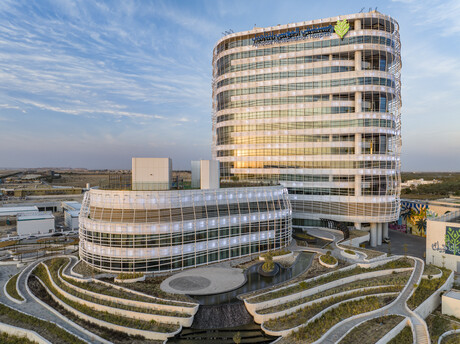
While the construction of tall structures traditionally requires significant material resources, innovative approaches are mitigating these impacts. At Almoosa Rehabilitation Hospital, a prime example of our work, a hybrid construction method utilizes concrete for lower levels, providing stability, and steel for upper floors, maximizing efficiency. This, coupled with ultra-thin floor plates, onsite energy systems, and extensive water-saving strategies, earned the facility LEED Platinum certification – a testament to its commitment to environmental stewardship.
[Image of Almoosa Rehabilitation hospital (Credit Gerry O’Leary). supplied by HDR]
Almoosa Rehabilitation Hospital (Credit Gerry O’Leary). Supplied by HDR
Furthermore, cutting-edge high-rise hospital design increasingly incorporates water reclamation systems and renewable energy sources, reducing environmental footprints and enhancing operational efficiency. The industry is rapidly moving towards full electrification, further minimizing carbon emissions and contributing to a healthier planet.
The Future of Vertical Healthcare: Adaptability and Integration
The high-rise hospital represents a paradigm shift – a move away from isolated institutions towards adaptive, human-centered environments. As urban populations grow and healthcare needs become increasingly complex, these facilities are poised to become critical hubs within broader, connected healthcare ecosystems.
Designed with modular systems and standardized grids, they are inherently flexible, capable of adapting to future technologies and evolving care models. This future-proofing is essential in an era of rapid innovation. As predictive and personalized medicine become the norm, high-rise hospitals will serve as agile platforms for integrated, long-term health management, facilitating proactive care and empowering patients to take control of their wellbeing.
But the vision extends beyond operational efficiency and spatial optimization. We envision high-rise hospitals as integral components of the urban fabric – inclusive, accessible spaces that support holistic wellbeing. Strategically located in city centers, embedded in high streets, and readily accessible by public transport, they offer unique opportunities to co-locate healthcare with essential social services, creating seamless continuity between acute care and everyday life.
this integration is key to fostering a truly preventative and community-focused approach to healthcare. High-rise hospitals aren’t just places to treat illness; they’re places to promote wellness and build healthier communities.
Ultimately, the rise of vertical hospitals represents a bold, future-ready vision for healthcare – one rooted in resilience, adaptability, and, above all, human connection.
**About
Worth a look