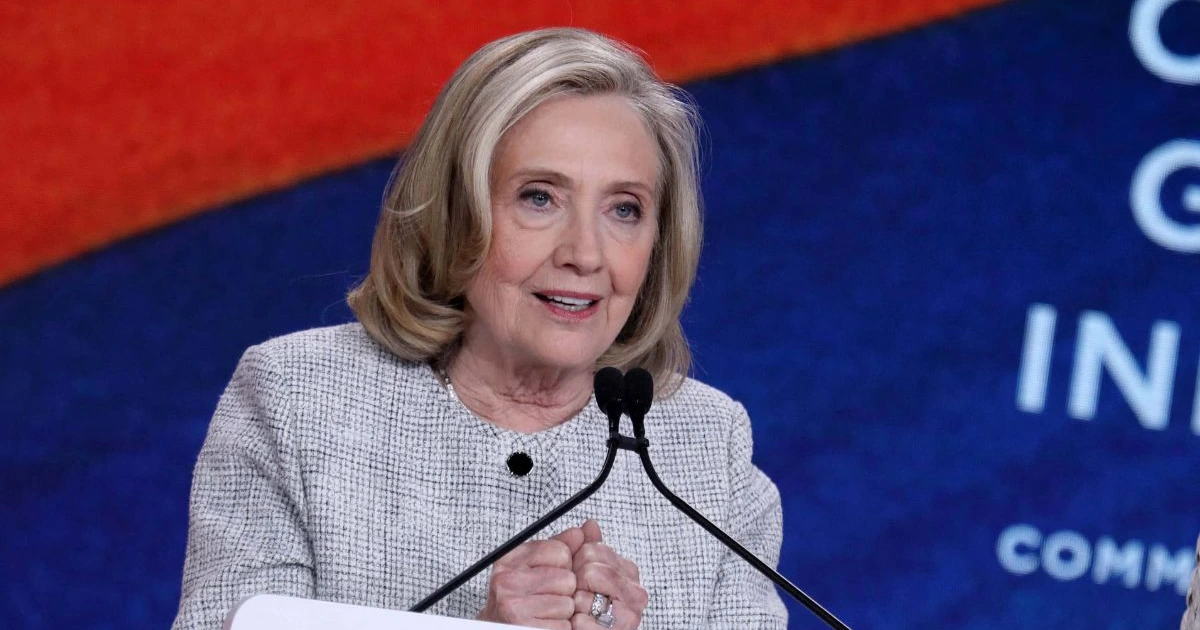
Former Secretary of State Hillary Clinton has launched a stinging critique of the Republican Party, targeting their current approach to family affordability. In a guest op-ed published in The New York Times, Hillary Clinton slams ‘politically brain-dead’ Republicans, arguing that the GOP has abandoned the financial needs of American families in favor of culture-war rhetoric and increased military spending.
Writing to the Democratic base as the country moves toward the November 2026 midterm elections, Clinton asserted that national Republicans are ignoring the real-world financial pressures crushing parents. She specifically singled out Vice President JD Vance and other right-leaning groups, accusing them of focusing on birthrates although disregarding the costs associated with providing a safe, healthy, middle-class life for children.
The op-ed represents one of Clinton’s most direct political interventions since the start of President Donald Trump’s second term. Her critique centers on the tension between defense priorities and domestic stability, suggesting that the current administration’s priorities are fundamentally misaligned with the needs of the modern American family. Clinton’s accusations regarding the GOP’s stance on affordability highlight a growing divide in how the two major parties define “family support.”
The Fiscal 2027 Budget Dispute
The catalyst for Clinton’s op-ed was the administration’s fiscal year 2027 budget proposal. According to the critique, the White House has proposed approximately $1.5 trillion for defense, pushing military spending to a modern high amid ongoing conflict with Iran. Clinton argued that this increase comes at the direct expense of domestic programs.

The proposal reportedly includes a $500 billion increase in military spending, offset by substantial cuts to non-defense discretionary spending. According to the details cited in the op-ed, this includes a 10% decrease—roughly $73 billion—in non-defense spending. Specifically, the Department of Health and Human Services would see a 12% cut, reducing National Institutes of Health funding by $5 billion, while the Department of Housing and Urban Development would face a 13% reduction, including the elimination of the HOME Investment Partnership Program.
Clinton further criticized a reported remark made by President Trump at a private Easter brunch, where he allegedly stated that his administration was “fighting wars” and “can’t take care of day care.” She characterized this sentiment as revealing of a president who views the affordability crisis as a “hoax” or a “con job,” asserting that children will ultimately pay the price for such indifference.
A Proposed ‘Kids Agenda’ for Democrats
Beyond her criticisms, Clinton outlined a comprehensive “kids agenda” intended to serve as a roadmap for Democrats heading into the midterms. This platform focuses on systemic financial support and modern safety protections for children.
Key pillars of this proposed agenda include:
- Expanded Child Tax Credits: Clinton specifically advocated for refundable credits, which allow low-income families to receive payments even if they owe no federal income tax, a model she argues has previously reduced child poverty.
- National Paid Family Leave: The creation of a federal standard to ensure parents can care for newborns or sick children without losing their livelihoods.
- Early Childhood Investment: Increased funding for universal child care and early education to reduce the burden on working parents.
- Digital Safety Standards: Clinton warned that federal action has lagged behind state-level efforts to restrict addictive design features in technology, require age verification and limit unsafe A.I. Tools.
On the issue of technology, Clinton noted that several states have already begun adopting phone-free school policies and restricting harmful A.I. Tools. She argued that families require a “national baseline of protection” to navigate these technologies safely, rather than a patchwork of varying state laws.
GOP Rebuttal and ‘Trump Accounts’
The Republican National Committee (RNC) and the White House have firmly rejected Clinton’s characterization of their policies. A White House spokesperson claimed the administration has done more for parents than any predecessor, citing expanded child tax credits and support for school choice.
Kiersten Pels, a spokesperson for the RNC, argued that families are already experiencing relief through policies enacted in 2025. These include higher child tax credits, stronger paid family leave, and expanded 529 college savings plans. A central piece of the GOP’s family strategy is the creation of “Trump Accounts,” which are reportedly funded with $1,000 for children born between 2025 and 2028.
The administration too pointed to the reduction of fertility drug costs as evidence of their commitment to supporting families and increasing birthrates, contrasting their approach with the “government-led” expansions proposed by Clinton.
The Road to November 2026
At its core, Clinton’s intervention is a strategic call to action for the Democratic Party. By framing the November 2026 midterm elections around the issue of affordability, she is urging candidates to move the conversation away from “the gilded walls of Mar-a-Lago” and toward the kitchen-table struggles of average families.
Clinton argued that because President Trump is unlikely to change his fiscal course, Democrats must seize the moment by making children and family affordability the center of their campaign. She believes that voters will seek candidates who prioritize the realities of raising children over military expansion and cultural disputes.
As the midterm cycle intensifies, the debate over the fiscal 2027 budget will likely serve as a primary battleground for both parties to define their vision for the American middle class. The next major checkpoint will be the Congressional hearings on the budget proposal, where lawmakers will debate the proposed defense increases and domestic cuts.
Do you believe the focus of the upcoming midterms should be on family affordability or national security? Share your thoughts in the comments below.
Related reading