
Researchers have conclusively identified a Milky Way object accelerating protons beyond one quadrillion electron volts. Published on July 16, 2026, the discovery combines data from multiple observatories to confirm LHAASO J1912+1014u as a rare cosmic-ray proton accelerator, offering new insight into how extreme energy particles travel through space.
Scientists examining the origins of the universe’s most energetic particles have pinpointed a natural cosmic accelerator deep inside our galaxy. An international team led by Hiroshima University confirmed the galactic accelerator after combining observations from multiple ground-based and spaceborne instruments, with their findings published in The Astrophysical Journal on July 16, 2026.
Cosmic rays consist predominantly of protons that race through space with immense force and constantly strike the Earth’s atmosphere, as researchers from the Hiroshima University team observed in their multiwavelength analysis. While human-built devices like the Large Hadron Collider on the border of Switzerland and France can propel protons close to the speed of light, nature routinely achieves far more extreme figures in deep space.
Unlocking the Power of LHAASO J1912+1014u
The newly confirmed proton accelerator is previously known as LHAASO J1912+1014u, an object discovered in 2024. Located in the constellation Aquila near Altair—one of the bright stars forming the Summer Triangle—the source spans a massive region of the sky, with a diameter surpassing twice the apparent size of a full moon.
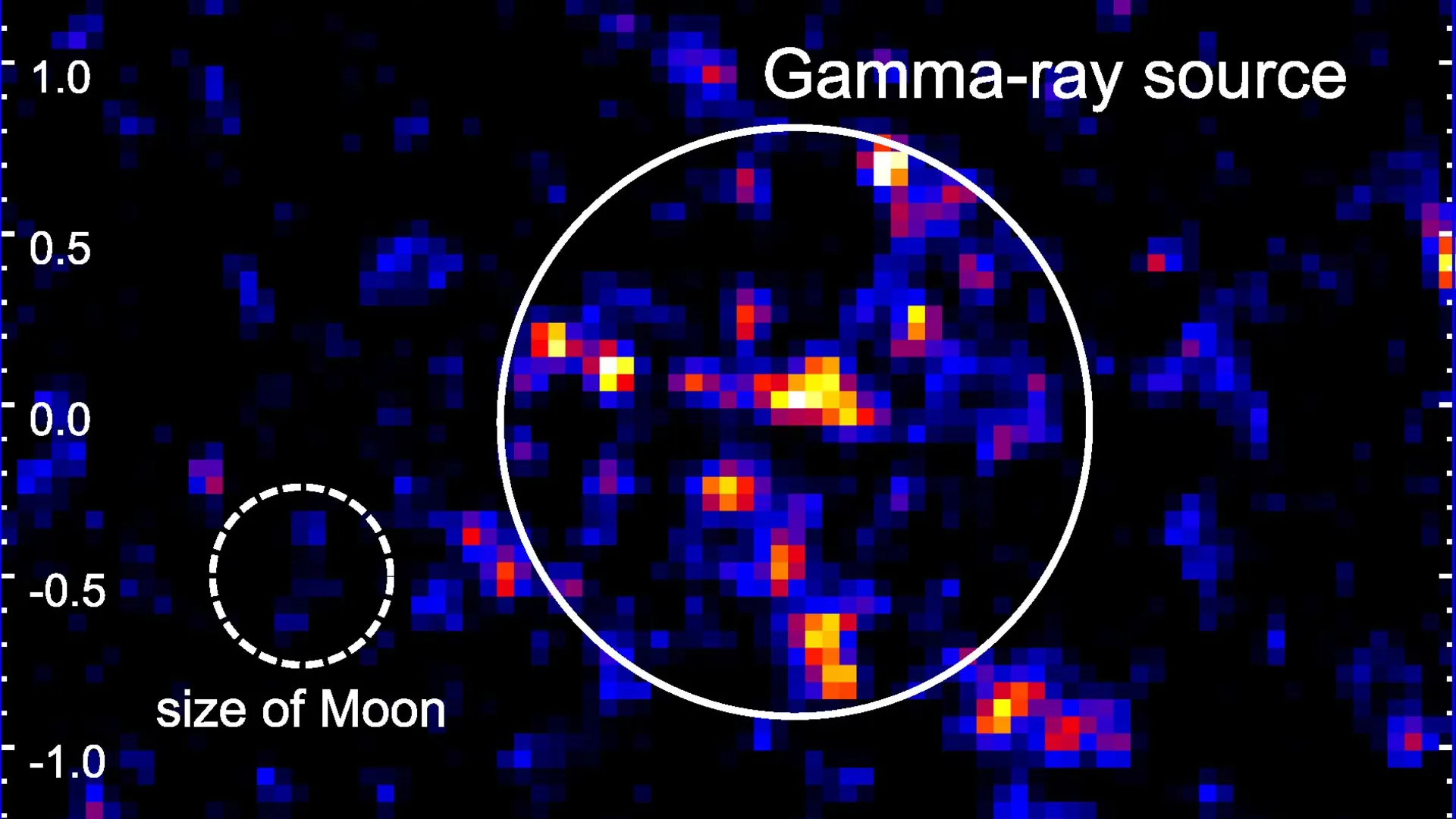
Tsunefumi Mizuno explained that galactic cosmic rays can reach and exceed one quadrillion (1015) electron volts, or a peta electron volt (PeV), making the identification of a proton PeVatron one of the most compelling topics in modern astrophysics.
Combining Observatories Across the Electromagnetic Spectrum
For decades, pinpointing the source of these particles proved difficult because charged protons are deflected by interstellar magnetic fields, effectively erasing their directional history. To bypass this, astronomers rely on secondary gamma rays produced when accelerated particles collide with surrounding gas. However, distinguishing between gamma rays generated by protons versus those produced by highly energetic electrons required data beyond what single facilities could provide.

The Tibet AS gamma experiment—run jointly by Japan and China since 1990—alongside China’s Large High Altitude Air Shower Observatory (LHAASO), previously detected more than forty gamma-ray sources exceeding 0.1 PeV. Yet, as Mizuno noted, experiment data alone could not definitively isolate proton sources.
Three Key Findings Confirm the Galactic PeVatron
By mapping observations across radio waves, X-rays, and gamma rays, the investigative team built a robust multiwavelength model that eliminated alternative explanations, such as a pulsar wind nebula or standard supernova debris.
Three core lines of evidence supported the conclusion that LHAASO J1912+1014u functions as a proton PeVatron. First, the gamma-ray emission spectrum extends smoothly from over 100 trillion electron volts down to 400 million electron volts without a break. Second, the spatial distribution of the gamma-ray emissions aligns closely with the distribution of interstellar gas mapped out by carbon monoxide radio surveys. Third, Chandra’s X-ray data revealed only minimal diffuse emissions, ruling out dominant electron acceleration models.
With data from multiple experiments, the research team successfully cataloged the total energy output that the object injects into its surrounding neighborhood in the form of cosmic radiation.
Keep reading