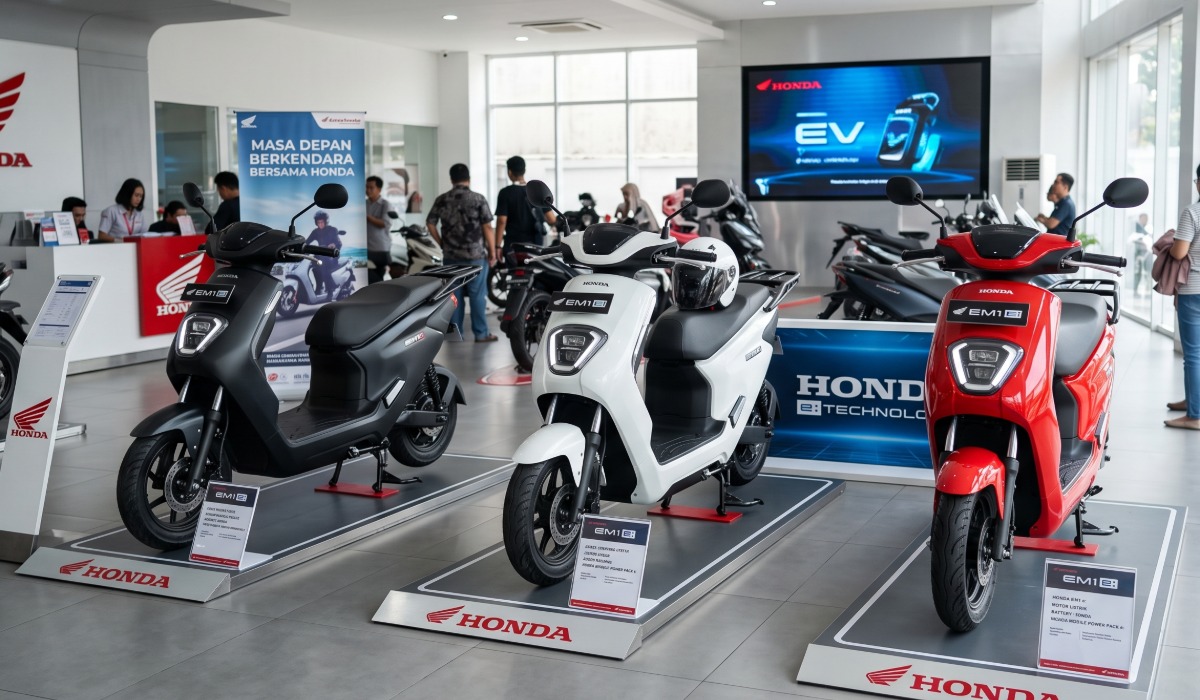
Indonesia’s push toward electric mobility has accelerated significantly, bringing consumer focus squarely onto models like the Honda EM1 e: and newer additions to the lineup such as the CUV e:. As buyers navigate incentives, pricing, and technical specifications, understanding the current market landscape requires looking closely at battery options, vehicle capabilities, and eligibility criteria for government subsidies. According to market reports from automotive analysts, the adoption of battery-powered two-wheelers depends heavily on upfront costs, charging infrastructure, and whether a model qualifies for state-backed financial support.
When PT Astra Honda Motor (AHM) first introduced its electric vehicle line in the country, initial pricing sparked considerable discussion across the industry. The Honda EM1 e:, which debuted as the brand’s pioneering electric scooter offering for Indonesian consumers, carried an initial price point hovering around the Rp 40 million mark. Industry data shows that early sales configurations frequently separated the battery and charging units from the vehicle purchase price, requiring buyers to consider total deployment costs rather than just the base MSRP.
Urban mobility demands unique engineering choices, particularly regarding power storage and daily usability. Honda’s lineup addresses these varied requirements by offering distinct battery configurations across its urban and touring models. For city commuters and students looking for efficient daily transportation, battery capacity and swap accessibility dictate the best choice. Models tailored for metropolitan environments prioritize lightweight handling and manageable charging cycles, making them practical for navigating dense traffic conditions.
Honda Electric Scooter Lineup and Specifications
The current Honda electric catalog features distinct options designed for different user profiles, ranging from daily student commuters to long-distance riders. The Honda EM1 e: remains a benchmark for personal urban transit, featuring a compact electric motor paired with the Honda Mobile Power Pack e:, a swappable lithium-ion battery system designed for convenience at designated swap stations. According to vehicle specifications published by manufacturing updates, the scooter delivers adequate torque for city streets while maintaining zero tailpipe emissions.
For riders requiring extended range and higher performance, newer additions like the Honda CUV e: step into the market as viable touring alternatives. Industry evaluations indicate that the CUV e: provides superior battery capacity and a longer travel range per charge compared to entry-level city variants. This makes it a preferred option for intercity travel and longer daily commutes where charging frequency is a primary concern. Technical breakdowns of these models highlight how differing kilowatt-hour ratings directly influence top speed, acceleration profiles, and overall hauling capability.
Pricing Structure and Subsidy Framework
Navigating the financial incentives for electric motorcycles in Indonesia involves meeting specific government-mandated administrative requirements. The Indonesian government provides financial assistance programs designed to lower the barrier to entry for eco-friendly vehicles, lowering the effective retail price for eligible buyers. Official guidelines state that these subsidies apply to specific locally assembled electric motorcycles that meet a mandatory domestic content level (TKDN) threshold.
Consumers looking to purchase a subsidized Honda electric motorcycle must verify their eligibility through authorized dealership networks. Typically, the program requires a valid Indonesian identity card (KTP) and limits the subsidy quota to one unit per Nik (Nomor Induk Kependudukan). Market analysts note that while base prices for models like the EM1 e: and newer releases fluctuate based on battery lease options and dealer promotions, the government incentive program reduces the final transaction cost significantly for qualifying citizens.
Infrastructure and Charging Ecosystem
The practicality of owning an electric scooter depends heavily on the availability of charging infrastructure and battery-swapping stations. Honda has addressed this by integrating its ecosystem with designated swapping points where users can exchange a depleted power pack for a fully charged one in a matter of minutes. According to corporate expansion updates from energy and automotive stakeholders, expanding these swap stations across major metropolitan areas remains a top priority for supporting long-term adoption.
For home charging, owners utilize dedicated off-board chargers supplied with the vehicle, though charge times vary depending on household electrical capacity. Prospective buyers are encouraged to evaluate their daily commuting distance against the real-world battery range of their chosen model to determine whether home charging or public swapping infrastructure best suits their routine.
As regulatory bodies and manufacturers release further updates regarding fiscal year adjustments and vehicle catalog expansions, consumers should monitor official dealer announcements for the most accurate pricing data. Future updates on subsidy quotas and new model rollouts are expected to shape the trajectory of Indonesia’s electric vehicle market throughout the coming months. Readers are encouraged to share their thoughts or experiences with electric mobility in the comments below.
Keep reading