
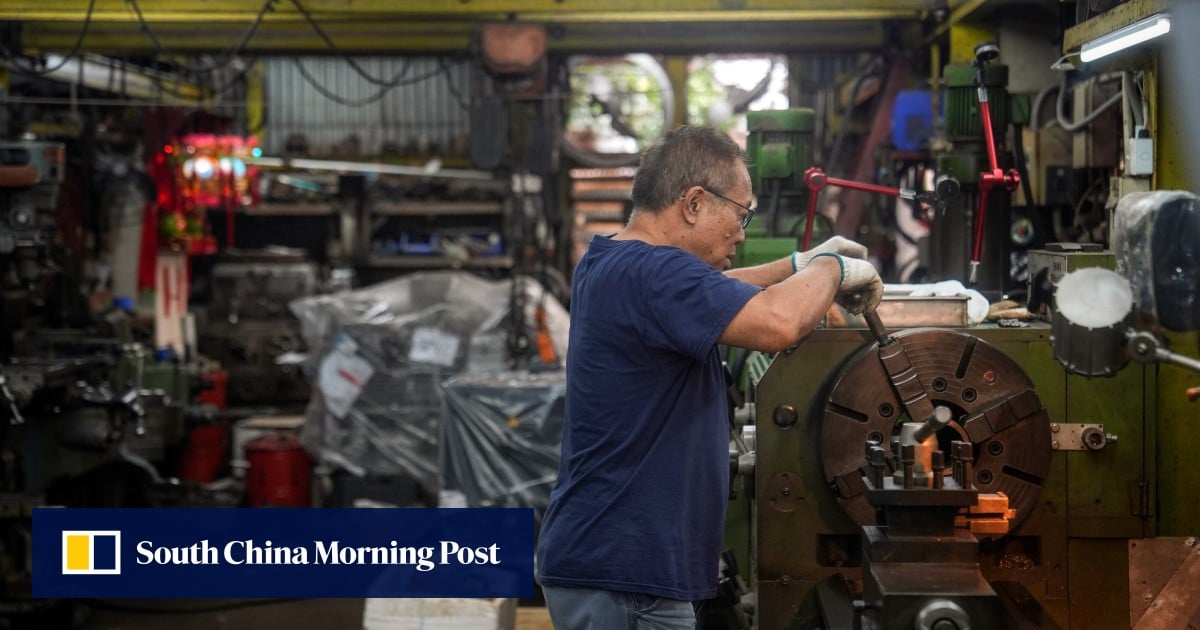
In the narrow waterways of Aberdeen Harbour, where the scent of salt and diesel lingers in the air, a quiet crisis is unfolding for Hong Kong’s last generation of traditional ship mechanics. Among them is David Chan, a 78-year-old veteran whose hands have spent over six decades keeping fishing trawlers and cargo vessels seaworthy. Now, as the Aberdeen marina redevelopment project advances, Chan and a dwindling number of peers face an uncertain future — their livelihoods threatened not by age or obsolescence, but by urban transformation.
The Po Chong Wan temporary industrial area, where Chan has worked since the 1980s, sits on land earmarked for conversion into a mixed-use waterfront zone under the Aberdeen Waterfront Enhancement Scheme. Announced by the Hong Kong Special Administrative Region (SAR) government in 2021, the initiative aims to revitalise the southern district with public promenades, residential towers, and recreational berths — part of a broader push to rebalance land use in one of the city’s most densely populated areas. For Chan, who learned his craft repairing wooden junks in Ap Lei Chau during the 1960s, the shift represents more than just relocation; it risks severing a living link to Hong Kong’s maritime heritage.
“No mood for operate,” Chan told a local reporter in early 2024, his voice weary but resolute. “They talk about progress, but what happens to the skills that built this harbour? Who will fix the boats when the last of us are gone?” His words echo a growing anxiety among traditional maritime tradespeople, many of whom operate in informal, licence-exempt workshops that have long slipped through regulatory nets. Unlike their counterparts in shipyards serving international fleets, these artisans specialise in maintaining the small, ageing vessels that still support Hong Kong’s inshore fishing and leisure boating sectors — a niche now under pressure from both redevelopment and declining demand.
Verified records from the Marine Department show that as of 2023, fewer than 150 licensed vessel mechanics remain active across Hong Kong’s entire fleet of over 4,000 local craft — a figure that excludes unregistered practitioners like Chan, who operate under temporary toleration in zones such as Po Chong Wan. The department’s annual report noted a 40% decline in apprentices entering marine engineering trades since 2010, citing ageing workforces and limited career progression as key deterrents. “We’re not just losing workers,” said a senior officer at the Marine Department’s Ship Safety Division, speaking on condition of anonymity. “We’re losing tacit knowledge — how to read a propeller’s wear by feel, how to adjust a gearbox without digital diagnostics. That can’t be taught in a classroom.”
The Aberdeen marina project itself has undergone several revisions since its inception. Originally proposed in 2018 as a modest upgrade to existing facilities, it was expanded in 2021 following a public consultation that highlighted demand for greater public access to the waterfront. The current plan, approved by the Town Planning Board in January 2022, includes a 1.2-kilometre promenade, 500 new residential units, and a marina capable of berthing 150 pleasure craft — all to be built on reclaimed and rehabilitated land along the southern shore of Aberdeen Channel. Construction is being overseen by the Civil Engineering and Development Department (CEDD), with the first phase — site clearance and seawall reconstruction — scheduled for completion by late 2025.
Chan’s workshop, housed in a corrugated metal shed near the former Aberdeen Typhoon Shelter boundary, falls within the zone designated for Phase 2 redevelopment. While officials have stated that affected businesses will be offered rehousing or compensation, no formal relocation plan has been published for the Po Chong Wan industrial cluster as of May 2024. A spokesperson for the Development Bureau told World Today Journal that discussions with stakeholders are ongoing, but declined to provide a timeline for when affected tenants might receive formal notices. “We recognise the cultural value of traditional marine services,” the spokesperson said. “Any redevelopment will seek to balance modernisation with preservation — but details remain under review.”
This ambiguity leaves veterans like Chan in limbo. Unlike factory workers or office staff, traditional mechanics often lack formal business registrations, making them ineligible for standard compensation schemes. Many operate on cash-in-hand basis, with no written leases or invoices — a reality that complicates efforts to assess economic impact or provide transitional support. Social workers from the Hong Kong Federation of Trade Unions have begun documenting these informal livelihoods, warning that without targeted intervention, an entire skills ecosystem could vanish within a decade. “These men aren’t just fixing boats,” said one union officer who has visited Aberdeen workshops regularly since 2020. “They’re keeping alive a way of understanding the sea that no simulator can replicate.”
The broader implications extend beyond employment. Hong Kong’s inshore fishing fleet, though diminished from its mid-20th century peak, still lands over 2,000 tonnes of catch annually — much of it sold fresh at Aberdeen’s bustling seafood market. A 2023 study by the University of Hong Kong’s School of Biological Sciences found that vessels maintained by traditional mechanics were 30% less likely to suffer critical engine failure at sea compared to those serviced only through commercial channels, attributing the difference to frequent, hands-on inspections that catch wear early. “There’s a preventive wisdom in their work,” explained Dr. Lena Ho, the study’s lead author. “They don’t wait for breakdowns. They listen, they feel, they anticipate — and that keeps both boats and fishermen safer.”
Environmental considerations as well feature in the debate. Proponents of the marina project argue that modernising Aberdeen’s waterfront will reduce pollution by replacing ageing septic systems with centralised treatment and encouraging electric-powered leisure craft. Opponents counter that displacing low-impact, repair-based livelihoods in favour of high-density residential and recreational use may increase the area’s overall carbon footprint over time. The Environmental Protection Department has not yet released a full lifecycle assessment of the scheme, though its 2022 scoping document acknowledged “potential indirect effects on local marine trades” as a factor requiring further study.
For now, Chan continues to work, his arthritic fingers adjusting carburettors and filing down propeller shafts with the same precision he learned half a century ago. He has no plans to retire — not because he must, but because, as he puts it, “the sea doesn’t take holidays, and neither do the boats that depend on it.” Whether his workshop will still stand when the new promenade opens remains unknown. But in the creak of a winch and the hiss of a steam cleaner, Aberdeen’s maritime soul still hums — faintly, perhaps, but not yet silenced.
What the Aberdeen Marina Project Means for Traditional Ship Mechanics
The redevelopment of Aberdeen Harbour is part of a wider strategy to transform underutilised waterfront zones into mixed-use public spaces. Officially known as the Aberdeen Waterfront Enhancement Scheme, the project seeks to address long-standing complaints about poor pedestrian access, fragmented seawalls, and underused marine facilities in the Southern District. According to the Civil Engineering and Development Department’s project portal, the initiative covers approximately 16 hectares of land and seabed, stretching from Wong Chuk Hang to Ap Lei Chau.
Central to the plan is the creation of a continuous, barrier-free promenade linking existing parks and recreational areas. This will be achieved through a combination of land reclamation, seawall reinforcement, and the integration of existing structures where feasible. The marina component — designed to accommodate both visiting yachts and local pleasure craft — will feature floating berths, utility hookups, and a small management office. Authorities say the goal is to promote sustainable marine tourism while improving resilience against typhoons and sea-level rise.
However, the project’s impact on existing marine industrial users has received less public attention. Unlike formal shipyards or licensed marinas, the informal workshops in Po Chong Wan and nearby Ap Lei Chau operate under temporary toleration rather than long-term leases. Many date back to the 1970s and 80s, when the Hong Kong government permitted certain maritime-related activities in non-designated zones to support the declining fishing industry. Over time, these tolerations have been renewed periodically, but never converted into formal rights — leaving occupants vulnerable to redevelopment.
Verified land use maps from the Planning Department show that the Po Chong Wan site is currently zoned as “Government, Institution or Community” (G/IC) with a temporary industrial overlay — a designation that allows for short-term use but does not guarantee tenure beyond the next planning review. The last such review occurred in 2019, with the next scheduled for 2025 — coinciding closely with the anticipated start of Phase 2 construction. Until then, tenants like Chan operate under a rolling tolerance that can be withdrawn with three months’ notice.
The Vanishing Craft: Skills at Risk in Hong Kong’s Maritime Sector
David Chan’s expertise is emblematic of a broader trend: the gradual erosion of traditional marine maintenance skills in Hong Kong. Unlike the certified technicians employed by international shipping companies, who follow standardised manuals and use diagnostic software, veterans like Chan rely on apprenticeship-based learning and sensory judgment. Their knowledge includes metallurgical intuition — knowing how a brass fitting will behave under stress by its colour and weight — and hydrodynamic awareness — sensing propeller imbalance through vibration alone.
These competencies are not covered in the city’s current vocational training framework. The Vocational Training Council (VTC) offers marine engineering courses focused on merchant navy standards and offshore rig maintenance, but none address the specific needs of small wooden or fibre-glass vessels under 24 metres in length. A 2022 review by the Labour Department found that fewer than 5% of marine technology graduates entered work with local fishing or leisure craft operators, with most opting for higher-paying roles in international shipping or offshore wind.
Efforts to preserve this knowledge have been sporadic and underfunded. The Hong Kong Maritime Museum runs occasional oral history projects, but lacks resources for systematic skills documentation. In 2021, the Intangible Cultural Heritage Office included “traditional boatbuilding and repair techniques” in its preliminary inventory of practices worthy of safeguarding — a step that raises awareness but confers no legal protection or funding. Without intervention, experts warn, the window to capture this expertise from living practitioners may close within five to ten years.
Some suggest that integrating traditional mechanics into the new marina’s maintenance ecosystem could offer a solution. Rather than displacing them, the redevelopment could incorporate dedicated bays for heritage vessel servicing, creating a niche market for classic boats and culturally significant craft. Similar models exist in Sydney’s Darling Harbour and Singapore’s Keppel Bay, where working boatyards coexist with leisure marinas under shared management frameworks. Whether such an approach will be considered in Aberdeen remains uncertain, pending further stakeholder engagement.
What Comes Next: Timelines and Unanswered Questions
As of May 2024, the Aberdeen Waterfront Enhancement Scheme remains in its pre-construction phase. The Civil Engineering and Development Department has completed geotechnical surveys and preliminary design work, but no main works contract has yet been awarded. According to the government’s works programme update published in April 2024, site clearance and seawall reconstruction for Phase 1 are expected to begin in Q4 2025, contingent on legislative funding approvals and tender processes.
Phase 2, which includes the Po Chong Wan area, is not scheduled to start before 2027 — though this timeline is subject to change based on funding, environmental assessments, and public feedback. The Town Planning Board has stated that a second round of consultation will occur before finalising detailed landscaping and architectural plans for the waterfront zone. No date has been set for this exercise, but officials have indicated it will likely take place in late 2024 or early 2025.
For David Chan and his peers, the waiting is the hardest part. Without clarity on whether they will be offered relocation, compensation, or the opportunity to continue working in a modified form, many are hesitant to invest in new tools or take on apprentices. “We’re not against progress,” Chan said during a recent interview outside his workshop. “But progress shouldn’t mean erasing the people who made the harbour what it is. We deserve to grasp where we stand — before it’s too late.”
Until official updates are released, those seeking information can monitor the Development Bureau’s waterfront projects portal or attend public meetings hosted by the Southern District Council. The Marine Department also maintains a public register of licensed vessel operators, though it does not capture informal tradespeople like Chan. As the conversation continues, one thing is clear: the future of Aberdeen’s waterfront will be measured not just in metres of promenade or numbers of berths, but in whether a city chooses to carry its history forward — or leave it behind at the tide’s edge.