Beyond the Hype: Healthcare AI Shifts Focus to Operational Efficiency in 2025
For years, Artificial Intelligence in healthcare felt like a promise perpetually on the horizon. Now, according to a complete new report analyzing trends across over 1,700 healthcare organizations, that promise is being realized – but not in the revolutionary way many predicted. We’ve moved decisively past the experimental phase and entered an era defined by operational efficiency.
As a veteran of the healthcare technology space, I’ve seen waves of innovation come and go. What’s striking about this current shift is its pragmatism. Healthcare organizations aren’t chasing futuristic visions of AI-driven diagnostics replacing physicians; they’re strategically deploying AI to solve today’s most pressing challenges – staffing shortages, administrative burdens, and revenue cycle inefficiencies.
The report, a deep dive into current adoption rates and future strategies, confirms this pivot. “Healthcare organizations increasingly view AI as an essential tool for improving performance,” it states, emphasizing a clear preference for automating well-defined, lower-risk workflows rather than attempting to fundamentally reinvent care delivery. This isn’t about replacing clinicians; it’s about empowering them.
The Dominance of “Boring” AI: Where the Real Investment Lies
while generative AI - think ChatGPT for healthcare – continues to dominate headlines, the vast majority of investment dollars are flowing into what some might call “boring” AI. This refers to the unglamorous, yet incredibly impactful, applications focused on the back-end of hospital operations.Organizations are prioritizing solutions that deliver immediate and measurable Return on Investment (ROI), particularly in areas where they’re feeling the most pain.
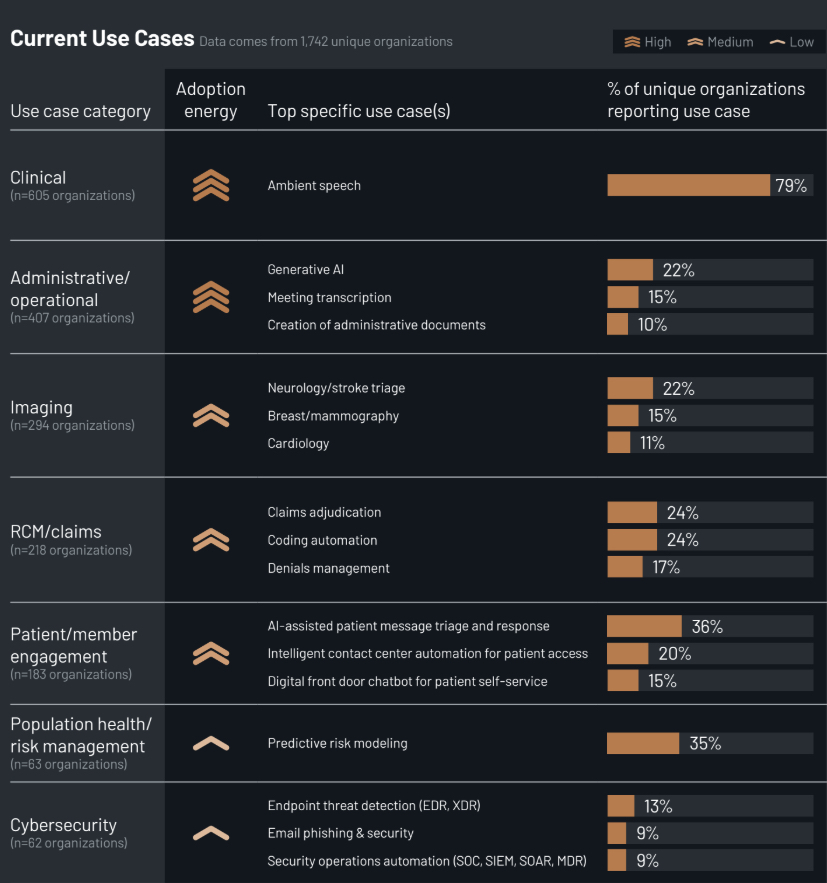
Let’s look at the numbers:
* Patient Engagement (36%): AI-powered triage of patient messages is now the most adopted use case. The explosion of patient portal messages has overwhelmed primary care physicians, and AI is providing a crucial lifeline, ensuring timely responses and appropriate resource allocation.
* Revenue Cycle Management (24%): CFOs are laser-focused on optimizing cash flow, and AI is delivering. Claims adjudication and coding automation are seeing notable adoption, reducing denials and accelerating reimbursement.
* Clinical Efficiency (22%): Ambient speech technology - systems that listen to patient-physician conversations and automatically draft clinical notes – is rapidly becoming a standard tool. This is far outpacing the adoption of more complex clinical decision support systems.Imagine the time saved for physicians, allowing them to focus more on patient interaction and less on documentation!
The message is clear: healthcare is embracing AI where it demonstrably improves the bottom line and alleviates immediate pressures. And,importantly,organizations are proceeding wiht caution regarding higher-stakes clinical applications,recognizing the need for rigorous validation and oversight.
The “Agentic AI” Reality Check: hype vs. Implementation
Perhaps the most revealing finding of the report is the stark contrast between the marketing hype surrounding “Agentic AI” – systems capable of autonomous decision-making and action – and the actual reality on the ground.
Despite being touted as the next big thing in tech publications, adoption of agentic AI is, frankly, negligible. Out of over 3,000 healthcare professionals interviewed, only 17 specifically mentioned it, and a single organization is currently utilizing it in a live setting.
This isn’t a technology failure,but a data maturity issue. As the report explains, many organizations are still grappling with the foundational work of ensuring their data is clean, accurate, and trustworthy.Without a pristine data foundation, deploying autonomous agents introduces unacceptable risks, particularly within the highly regulated healthcare environment. You simply can’t trust an AI to make critical decisions if the data it’s relying on is flawed.
Microsoft and Epic Tighten Their Grip: The Rise of Integrated Solutions
The vendor landscape in 2025 is characterized by consolidation. While over 650 vendors are vying for a piece of the healthcare AI pie, the market is increasingly dominated by established players.
Microsoft and Epic are leveraging their existing, deeply embedded footprints to aggressively push AI capabilities. This isn’t surprising; they have the trust, the data access, and the integration capabilities that many smaller vendors lack.
Here’s a snapshot of the key players in specific areas:
* Ambient Speech: Microsoft (through its Nuance/Dragon acquisition) currently leads the pack, followed closely by Abridge and Oracle Health.
* imaging: Niche players like Aidoc, RapidAI, and Viz.
Keep reading