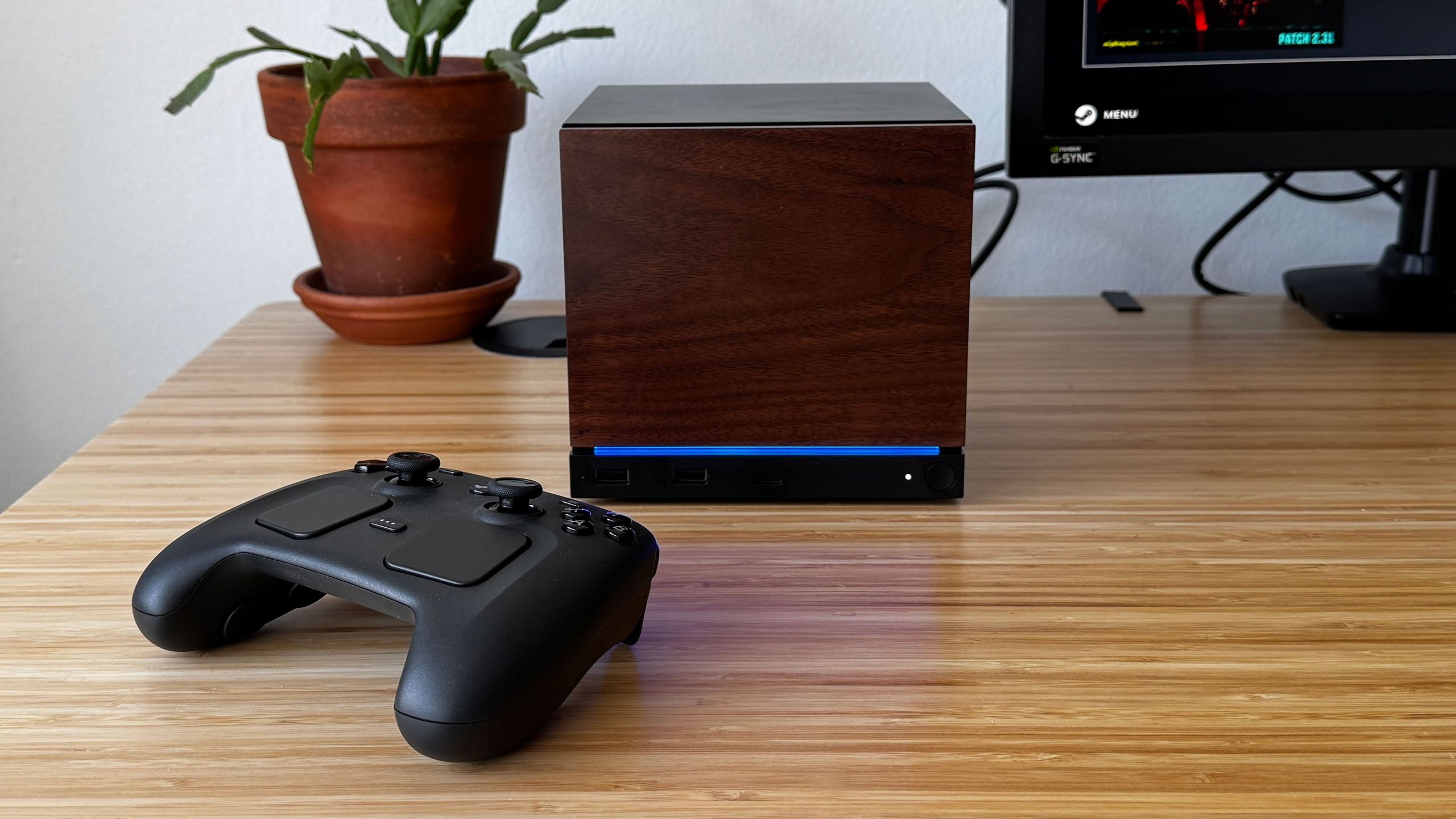
For tech enthusiasts seeking a console-like gaming experience without purchasing Valve’s new Steam Machine, a 50-foot fiber-optic HDMI cable and a Steam Controller 2 have emerged as an unconventional solution. Matthew Brunelle, a Linux-based gamer from San Francisco, has transformed his PC into a couch-friendly setup using these components, bypassing the need for a dedicated console. This DIY approach highlights the growing trend of customizing gaming hardware to meet specific needs, even if it means navigating complex technical challenges.
Brunelle’s setup involves a custom-built PC running NixOS, a Linux distribution known for its advanced package management system. However, the primary hurdle was bridging the gap between his work computer in a separate room and his living room TV. While wireless streaming options like Moonlight or Steam’s remote play were available, they introduced latency issues and failed to replicate the seamless console experience. To address this, Brunelle opted for a 50-foot fiber-optic HDMI 2.1 cable, which he claims eliminates signal degradation over long distances.
The DIY Approach to Gaming
Brunelle’s project began as a response to the limitations of existing wireless solutions. “Wireless streaming works, but there’s always a lag, especially during fast-paced games,” he explained. “I wanted something that felt as responsive as a console.” His solution required a combination of hardware and software, including a Linux-based OS called Bazzite, designed to streamline gaming experiences on PCs.

Bazzite, a lightweight Linux distribution, automatically handles display and audio outputs when booting into Steam’s “Big Picture” mode. This eliminates the need for manual configuration, a task Brunelle previously performed when switching between his work OS, NixOS, and gaming mode. “Without Bazzite, I’d have to physically connect the HDMI cable and adjust settings every time I wanted to play,” he said. “Now, it’s almost like a console—just boot up, play, and sleep.”
Key Components of Matthew’s Setup
The centerpiece of Brunelle’s setup is the 50-foot fiber-optic HDMI 2.1 cable, which costs $75. This cable, according to industry standards, supports 4K resolution at 120Hz and 8K at 60Hz, making it suitable for high-performance gaming. Despite its length, the cable avoids signal loss, a common issue with traditional HDMI cables. Brunelle connected the cable to a TCL Roku TV, which he acknowledges is limited to 60Hz. However, he plans to upgrade to an LG C5 OLED TV, which supports higher refresh rates and better bandwidth utilization.

The second critical component is the Steam Controller 2, which Brunelle describes as “the perfect companion for Linux gaming.” Unlike the PlayStation DualSense, the Steam Controller 2 offers symmetrical joysticks, large touchpads, and back buttons, all of which are fully compatible with Steam and Linux. “The DualSense is great, but the Steam Controller 2 feels more intuitive for me,” he said. “It doesn’t drop connections, and the layout is better suited for PC games.”
Challenges and Solutions
Despite the success of his setup, Brunelle faced several technical hurdles. One of the main challenges was managing dual-boot systems between NixOS and Bazzite. “Switching between the two required rebooting and manually selecting the OS, which was tedious,” he said. To streamline this process, he installed Bazzite on a third SSD, allowing him to boot directly into the gaming environment without disrupting his work setup.
Another challenge was ensuring seamless sleep and wake states. Linux-based gaming distros, including Bazzite, have historically struggled with power management. However, Brunelle noted that recent updates have improved this functionality. “When I put the system to sleep, it wakes up exactly where I left off,” he said. “It feels just like a console.”
The Future of Console Alternatives
Brunelle’s setup reflects a broader shift in the gaming industry, where consumers are increasingly opting for customizable, high-performance hardware over traditional consoles. While Valve’s Steam Machine offers an out-of-the-box experience, Brunelle argues that his DIY approach provides greater flexibility. “If I want to upgrade my GPU or add more storage, I can do it without buying a new console,” he said. “It’s all about control.”

However, his solution is not without limitations. For instance, the current setup requires manual intervention to switch between work and gaming modes. Brunelle is currently experimenting with hibernate-to-disk functionality on Bazzite, which would allow him to save his game state and resume later without rebooting. “