
In the intricate world of social insects, the difference between a cooperative neighbor and a deadly intruder is often a matter of a few chemical molecules. For millions of years, ant colonies have operated as “superorganisms,” where thousands of individuals function as a single unit. To maintain this order, ants must possess an unerring ability to identify their own kin and repel outsiders who might attempt to hijack the colony’s resources.
For a long time, scientists believed this system of nestmate recognition was relatively rigid—a biological “password” set early in life. However, fresh research is revealing that the process of how ants tell friends from foes is far more flexible and adaptable than previously understood. By studying a unique species of ant, researchers have discovered that these insects can actually “reprogram” their sense of belonging throughout their adult lives.
The findings, published in the journal Current Biology, demonstrate that ants can learn to tolerate genetically distinct outsiders through repeated exposure. This behavioral plasticity suggests that the social bonds maintaining an ant colony are not just hardwired by genetics, but are actively maintained and updated through social experience.
This discovery provides a critical behavioral foundation for future neuroscience. By understanding how ants update their social templates, scientists can now begin to investigate the specific regions of the ant brain that process social odors and facilitate this type of complex learning.
The Chemical Signature of the Colony
To understand how ants distinguish “self” from “other,” one must first appear at their chemistry. Ants do not rely on sight or sound to recognize their sisters; instead, they use a sophisticated system of waxy chemical compounds that coat their bodies. These compounds, known as cuticular hydrocarbons, act as a chemical fingerprint.
Whereas different colonies may use the same basic set of chemical compounds, they combine them in different ratios. This creates a subtle, colony-specific odor signature. Early in life, ants learn to recognize the specific scent of their own colony, which allows them to instantly identify a nestmate or detect a social parasite attempting to infiltrate the nest.
However, as Daniel Kronauer, head of the Laboratory of Social Evolution and Behavior at Rockefeller University, notes, these scents are not static. Environmental changes, shifts in the genetic composition of the colony, or encounters with new neighbors may require the colony to update its recognition rules. If the system were entirely rigid, the colony would be unable to adapt to its changing surroundings.
Reprogramming Identity: The Clonal Raider Ant Study
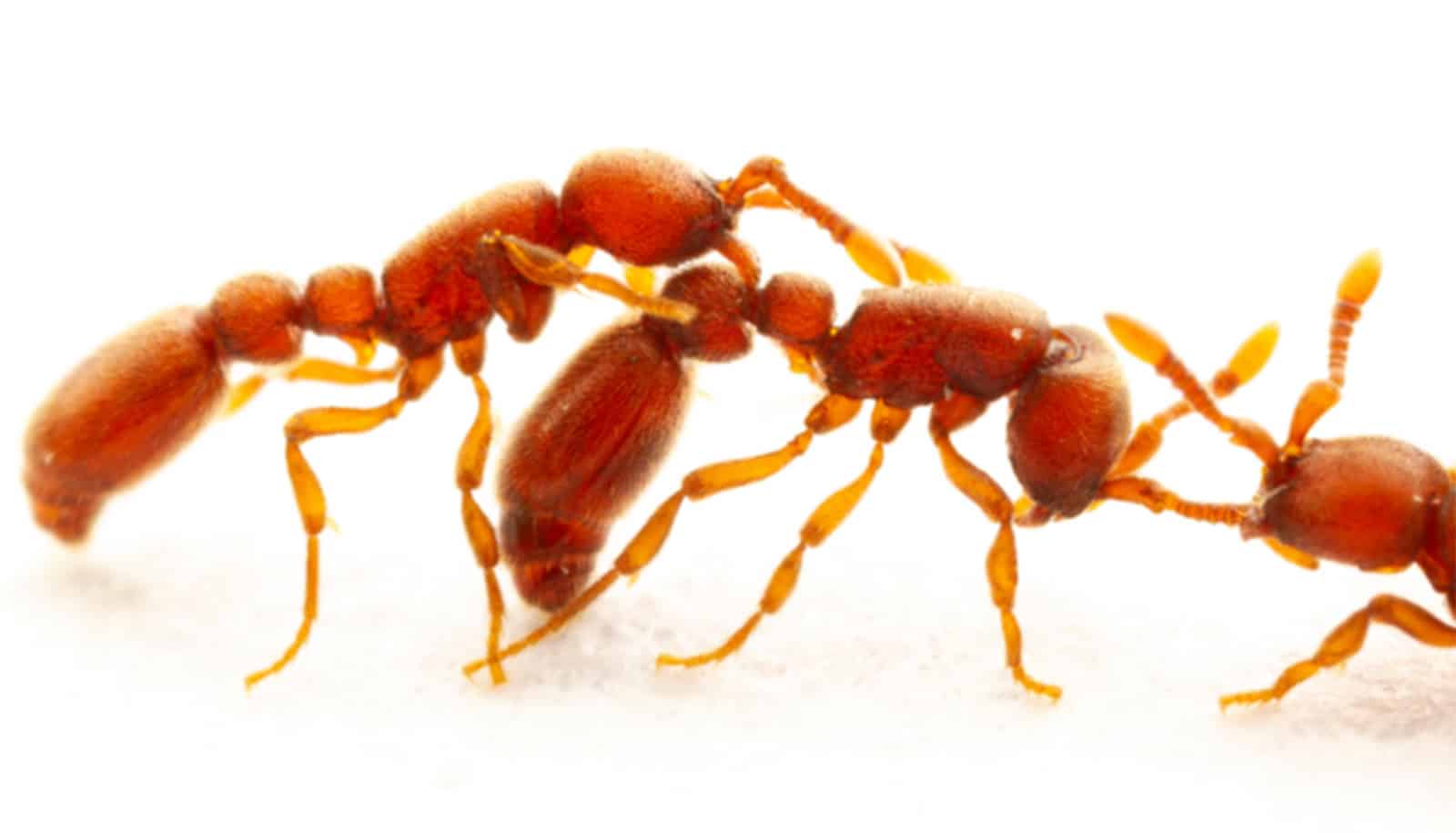
To test the flexibility of this system, Tiphaine Bailly and her colleagues in the Kronauer lab focused on the clonal raider ant (Ooceraea biroi). This species is particularly useful for researchers given that it reproduces asexually. This allows scientists to create lineages of genetically identical ants and then combine different clonal lines to build mixed colonies, making it easier to track how social cues are learned and updated.
The team began by establishing a baseline. When ants from different genotypes were introduced to one another, the results were consistent: the ants attacked the foreign genotypes, often through aggressive biting. This confirmed that the ants had a clear, intrinsic ability to recognize an outsider.
The researchers then attempted to “reprogram” this recognition. They placed young ants, whose chemical profiles were still faint, into foreign colonies. The results showed that prolonged exposure could fundamentally reshape both the ants’ chemical profiles and their behavior. After one month, these ants chemically resembled their foster colonies and no longer showed aggression toward them, behaving as if they had been born into the colony.
The Limits of Social Learning
While the study proved that ants can learn to tolerate outsiders, the research also revealed that this flexibility has strict biological limits. The ants’ “sense of self” appears to be an intrinsic trait that cannot be fully erased by experience.

Even ants that were separated from their biological kin from the egg stage still accepted other ants of their own genotype. This suggests that while social experience can broaden an ant’s definition of “friend,” it cannot replace the fundamental recognition of its own genetic identity.
the learned tolerance was found to be fragile. The study observed that if contact between a newcomer and the foster colony was severed, aggression returned within about one week. Over time, the newcomer’s chemical profile drifted back toward its original form, eventually leading the foster nestmates to view them as an enemy once again.
Interestingly, the researchers found that the tolerance did not require constant contact. Brief, occasional encounters were enough to maintain the bond. In one instance, ants maintained their tolerance even after five days of complete separation. This indicates that the process involves a long-term olfactory memory rather than a short-term sensory desensitization, which would typically fade in minutes or hours.
Biological Parallels: From Ants to the Human Immune System
The way ants update their social templates bears a striking conceptual resemblance to the human immune system. In humans, the immune system must distinguish between the body’s own cells and invading pathogens. When a person has an allergy, the immune system overreacts to a harmless substance, such as pollen.
Medical treatments for allergies often involve giving patients small, controlled doses of the allergen. Over time, the immune system learns to tolerate the substance rather than attacking it. Ants appear to follow a similar logic: repeated, low-level exposure to a foreign colony odor gradually dampens the defensive response, teaching the ant that the “foe” is actually a “friend.”
Kronauer explains that while the molecular mechanisms differ, the evolutionary parallels are significant. The transition from a solitary insect to a highly cooperative ant colony is conceptually similar to the transition from single-celled organisms to multicellular organisms. In both cases, the success of the system depends on the ability to define the boundary between “self” and “non-self.”
Key Findings on Ant Nestmate Recognition
| Condition | Behavioral Outcome | Timeline/Duration |
|---|---|---|
| Initial Encounter (Foreign Genotype) | Aggression (Biting) | Immediate |
| Prolonged Exposure to Foster Colony | Acceptance/Toleration | 1 Month |
| Complete Separation from Foster Colony | Return of Aggression | ~1 Week |
| Occasional/Brief Encounters | Maintained Tolerance | Up to 5 Days Separation |
| Genotype-Based Recognition | Intrinsic Acceptance | Permanent/Lifelong |
What This Means for the Future of Neuroscience
The ability of ants to update their social templates throughout adulthood provides a powerful new model for studying the brain. Because the behavioral parameters of this learning process are now well-defined, researchers can move from observing behavior to imaging neural activity.

The next phase of research will involve using neurobiological tools to image the ant brain in real-time as an individual encounters a nestmate versus a non-nestmate. This will allow scientists to pinpoint exactly where in the brain this social learning and adaptation occurs.
By uncovering the mechanisms that maintain cooperation in such complex societies, researchers hope to gain deeper insights into the evolution of social behavior and the biological foundations of cooperation across different species.
As researchers continue to probe the neurobiological underpinnings of ant society, the scientific community awaits further data on how these “superorganisms” process social information and adapt to their environments.
Do you locate the parallels between insect behavior and human biology surprising? Share your thoughts in the comments below or share this article with your network.