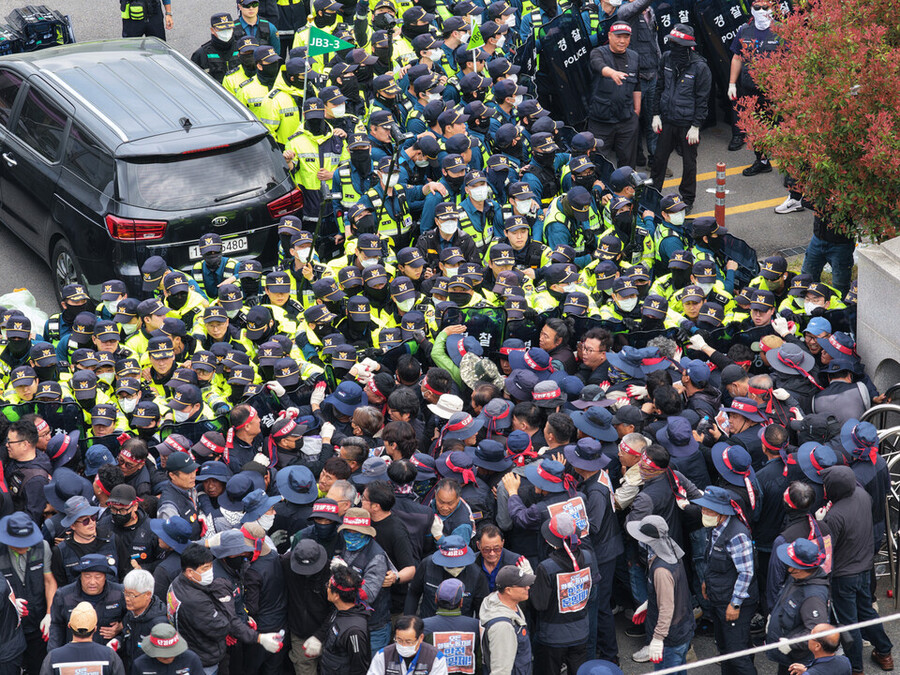
South Korea’s controversial labor reform, known as the “Yellow Envelope Act,” has triggered a significant shift in corporate employment practices, with major conglomerates reducing their reliance on outsourced and dispatched workers even as increasing direct hires. Since the amended Trade Union and Labor Relations Adjustment Act took full effect on March 10, 2026, companies across key industrial sectors have begun restructuring their workforce strategies in response to expanded liability for subcontracted labor.
The reform, officially enacted to strengthen workers’ collective bargaining rights and limit excessive damage claims against striking employees, has particularly impacted industries where outsourcing has long been a cost-saving measure. According to verified data from the Ministry of Employment and Labor, analyzed through the Worknet employment statistics system, the number of non-regular workers employed through third-party agencies declined by 8.2% over the three years preceding the law’s implementation, with a sharper drop observed in the months immediately following its enactment.
This trend is most pronounced in the petrochemical and secondary battery sectors, where outsourced labor previously accounted for approximately one-third of total operational staff. Major players such as POSCO have reported notable shifts toward direct employment, citing both regulatory compliance and evolving industrial relations as motivating factors. The steelmaker, which operates integrated facilities in Pohang and Gwangyang, stated in its 2025 sustainability report that it had increased the proportion of directly hired technicians and maintenance staff by 15% year-on-year as part of a broader “responsible supply chain” initiative.
Understanding the Yellow Envelope Act’s Core Provisions
The legislation derives its informal name from historical labor movements in which citizens donated money in yellow envelopes to support workers facing ruinous financial penalties after participating in strikes. Formally, it amends Articles 2 and 3 of the Trade Union and Labor Relations Adjustment Act to redefine the scope of “employer” liability and expand the range of issues considered legitimate subjects of labor dispute.
Most significantly, the law introduces a “real influence” test for determining employer status, meaning that companies exerting substantial control over working conditions—such as setting production schedules, supervising safety protocols, or dictating performance metrics—may be deemed joint employers even if they do not directly sign workers’ paychecks. This provision directly challenges the traditional two-tier labor model prevalent in South Korea’s manufacturing and logistics sectors, where core operations are performed by regular employees while ancillary functions are outsourced to specialized subsidiaries or third-party contractors.
the reform places new restrictions on damage claims that companies can file against unions or individual workers arising from lawful strike actions. Under previous interpretations, businesses could seek compensation for lost production, reputational harm, or supply chain disruptions. The amended statute now requires courts to consider whether the striking workers’ actions were proportionate and whether the employer pursued genuine negotiation before resorting to legal action.
Sector-Specific Impacts: Petrochemicals and Battery Manufacturing
In the petrochemical industry, where plant turnarounds and routine maintenance have traditionally relied heavily on contracted technical specialists, firms are reassessing their staffing models. Data compiled by the Korea Petrochemical Industry Association indicates that among its top 10 member companies, the average ratio of outsourced to direct labor in maintenance operations fell from 38% in 2023 to 29% in early 2026, with several companies piloting in-house training programs to absorb previously externalized skill sets.
Similarly, in the rapidly expanding secondary battery sector—home to global suppliers such as LG Energy Solution, Samsung SDI, and SK On—companies are recalibrating their approach to facility operations and cell production line staffing. While exact figures remain proprietary, industry analysts note that new gigafactory projects approved after March 2026 increasingly include provisions for direct hiring of operational technicians, particularly for roles involving hazardous material handling or high-precision equipment operation.
LG Energy Solution’s Ochang plant in North Chungcheong Province, which began mass production of lithium-ion batteries for electric vehicles in late 2024, reported in its quarterly ESG update that it had reduced its dependence on dispatched personnel in cleanroom environments by 22% compared to the prior year, attributing the change to both automation investments and revised labor risk assessments under the new legal framework.
Corporate Responses and Industrial Relations Shifts
The policy change has elicited varied reactions from business associations and labor organizations. The Korea Employers Federation has expressed concern that the broadened definition of employer could lead to unintended legal exposure, particularly for multinational corporations with complex supply chains. In a policy brief released in February 2026, the federation urged for clearer administrative guidelines on how the “real influence” standard would be applied in practice, especially concerning remote monitoring technologies and performance-based contracting arrangements.

Conversely, the Korean Confederation of Trade Unions (KCTU) has welcomed the reform as a necessary step toward dismantling what it describes as a “two-tier workforce” that perpetuates wage disparities and limits collective bargaining power. During nationwide rallies held on March 10, 2026—the law’s first anniversary of implementation—KCTU representatives highlighted cases where subcontracted workers in logistics and electronics manufacturing had successfully initiated direct negotiations with parent companies over overtime pay and shift scheduling.
POSCO remains the most frequently cited example of a major industrial corporation adapting proactively to the reform. Beyond its stated increase in direct hires, the company has expanded its internal grievance redress mechanisms and begun hosting quarterly labor-management forums at its major worksites that include representation from both regular and recently integrated non-regular staff. These forums, modeled after European-style works councils, aim to address workplace safety concerns and productivity metrics through joint problem-solving rather than adversarial negotiations.
Verification Challenges and Data Limitations
While aggregate trends are discernible through national employment statistics, precise sectoral breakdowns remain challenging to verify due to reporting lags and variations in how companies classify different categories of non-regular work. The Ministry of Employment and Labor’s monthly “Labor Force Survey” provides detailed insights into temporary and day labor categories but does not always distinguish between agency-dispatched workers, subcontracted specialists, and short-term project hires—all of which may be affected differently by the Yellow Envelope Act’s provisions.
some analysts caution that observed reductions in outsourced labor could reflect broader economic headwinds rather than solely regulatory influence. South Korea’s manufacturing PMI has fluctuated between contraction and stagnation since late 2024, prompting cost-review exercises across industries that may independently drive decisions to insulate core operations or delay non-essential outsourcing.
Nonetheless, temporal correlation between the law’s enactment and measurable shifts in employment patterns—particularly the accelerated decline in dispatched workers reported in News1’s analysis of Worknet data covering 432 major enterprises—suggests that the Yellow Envelope Act is at least a contributing factor in the observed realignment of corporate labor strategies.
What This Means for Workers and Employers
For employees previously employed through intermediaries, the potential shift to direct hiring could mean improved access to company benefits, clearer career progression paths, and stronger legal protections under national labor standards. Direct hires typically qualify for severance pay, retirement bonuses, and company-sponsored training programs that may not be extended to agency staff, even when performing identical roles side-by-side.

For employers, the transition entails higher fixed labor costs but may yield long-term benefits in terms of workforce stability, knowledge retention, and reduced turnover in critical operational roles. Industries requiring specialized technical expertise—such as semiconductor fabrication, nuclear maintenance, or aerospace assembly—stand to gain particularly from retaining skilled personnel through direct employment models that foster organizational loyalty.
Moving forward, the effectiveness of the reform will depend significantly on how regulatory bodies interpret and enforce its key provisions. The Ministry of Employment and Labor has announced plans to issue additional guidance later in 2026 regarding the calculation of “real influence” in joint employer determinations, with a public consultation period scheduled for June. Stakeholders on all sides are advised to monitor official bulletins from the ministry’s Labor Relations Policy Bureau for updates on enforcement priorities and compliance timelines.
As South Korea continues to navigate the evolving dynamics of its post-industrial labor market, the Yellow Envelope Act represents a pivotal attempt to recalibrate the balance between economic flexibility and worker protection. Whether it achieves its intended goals of fostering more equitable industrial relations while maintaining competitiveness remains a subject of ongoing evaluation by scholars, policymakers, and industry leaders alike.
Stay informed about developments in labor policy and industrial relations by following World Today Journal’s Business section. Share your insights on how these changes are affecting workplaces in your region, and join the conversation on the future of fair labor practices in a globalized economy.
Related reading