
Scientists have long sought to explain the origins of human language, a complex cognitive ability that remains one of the greatest mysteries in evolutionary biology. Despite centuries of inquiry, there is no single, universally accepted theory explaining how or why our ancestors transitioned from rudimentary communication to the sophisticated linguistic systems used today. Researchers have categorized various historical hypotheses—often given colorful, informal nicknames—to describe how early vocalizations might have emerged as precursors to speech, according to The Linguistic Society of America.
These early attempts to understand language evolution include theories such as the “bow-wow” theory, which suggests language began as an imitation of animal sounds, and the “pooh-pooh” theory, which posits that speech originated from involuntary emotional exclamations. While these concepts are largely considered outdated or incomplete by modern linguistic standards, they represent the foundational curiosity that eventually led to more rigorous scientific investigations into the biological and social pressures that shaped human communication, as noted by the Nature Education Knowledge Project.
Historical Hypotheses and Their Informal Origins
In the 18th and 19th centuries, scholars proposed several theories to explain the birth of language, many of which were later given derogatory labels by critics. The “bow-wow” theory, or onomatopoeic theory, suggests that early words were direct imitations of natural sounds, such as the bark of a dog or the rustle of leaves. Similarly, the “ding-dong” theory proposes that humans possess an innate tendency to produce vocal sounds that harmonize with the physical properties of objects in their environment. A third concept, the “pooh-pooh” theory, suggests that language emerged from instinctive cries triggered by pain, surprise, or other intense emotions.

These theories were often grouped together and dismissed by the linguistic community; in 1866, the Linguistic Society of Paris famously banned any further discussion on the origin of language, deeming the topic too speculative for serious scientific inquiry. This moratorium lasted for decades, as researchers lacked the empirical tools—such as fossil records, genetic mapping, or neuroimaging—to test these ideas. According to the Max Planck Institute for Evolutionary Anthropology, the field only began to move beyond these speculative models in the late 20th century, as researchers began to integrate data from primatology, archaeology, and cognitive science.
Moving Toward Modern Evolutionary Science
Modern research has shifted focus from the “how” of vocal imitation to the “why” of social cooperation. Current models often emphasize the role of complex social structures in driving the need for more efficient communication. For instance, the “social grooming” hypothesis, proposed by anthropologist Robin Dunbar, suggests that language evolved as a more efficient alternative to physical grooming for maintaining social bonds in increasingly large groups, as documented by the University of Oxford.
This approach moves away from the simplistic “bow-wow” or “pooh-pooh” frameworks, instead examining the physiological and neurological requirements for speech. The development of the FOXP2 gene, for example, is frequently cited in genetic research as a potential marker for the biological capacity for speech. However, experts caution that language evolution was likely a multi-faceted process involving the co-evolution of anatomy, brain structure, and social culture, rather than a single evolutionary “event.”
Challenges in Reconstructing Ancient Communication
One of the primary obstacles for linguists is that speech does not leave a fossil record. While researchers can examine the shape of the vocal tract in hominid skulls or the size of the canal for the hypoglossal nerve—which controls tongue movement—these physical traits do not provide definitive evidence of language use. As a result, many questions regarding the timeline of language evolution remain unresolved.
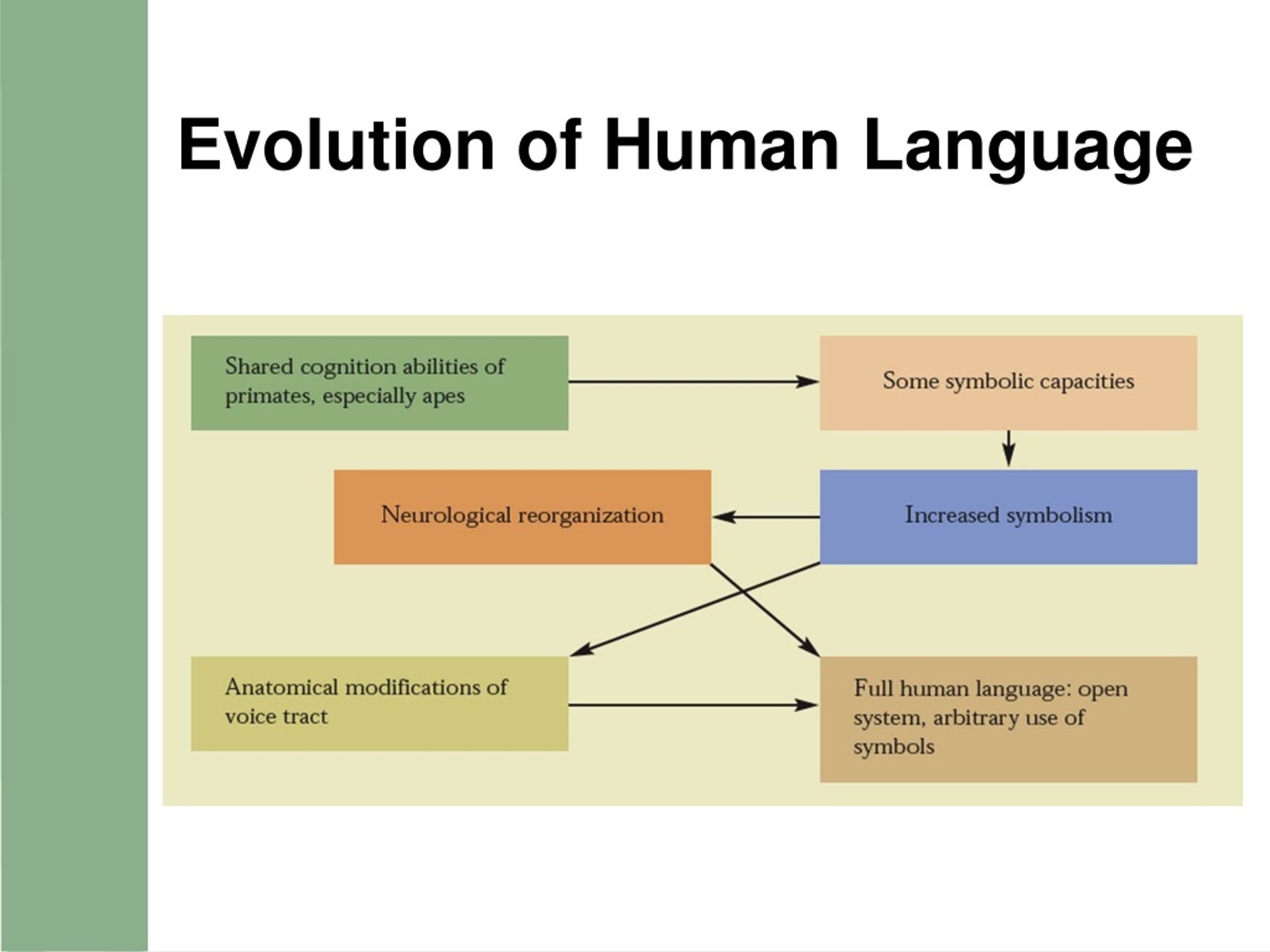
Current academic discourse focuses on the “continuity versus discontinuity” debate. Some theorists argue that language evolved gradually from the communication systems of non-human primates, while others contend that it appeared suddenly as a result of a specific genetic mutation or cognitive leap. According to research published by Trends in Cognitive Sciences, the consensus among contemporary researchers is that language is an emergent property of multiple interacting systems, making it unlikely that any single theory—even those with catchy names—will ever fully account for its complexity.
Future Directions in Linguistic Research
The next phase of discovery in this field will likely rely on advances in computational linguistics and comparative genomics. By analyzing the communication patterns of extant primates and modeling the potential vocal ranges of extinct hominids, scientists hope to build a more granular understanding of how symbolic thought and vocal control converged. The field remains active, with interdisciplinary teams at institutions like the Max Planck Institute continuing to publish findings on the intersection of vocal learning and social cognition.
For readers interested in the latest developments, the Evolution of Language International Association provides ongoing updates on conferences and peer-reviewed research regarding the cognitive and biological underpinnings of language. As new data emerges from archaeological sites and genetic sequencing, our understanding of these early theories and their limitations continues to evolve. We welcome your thoughts on this complex topic in the comments section below.
Related reading