
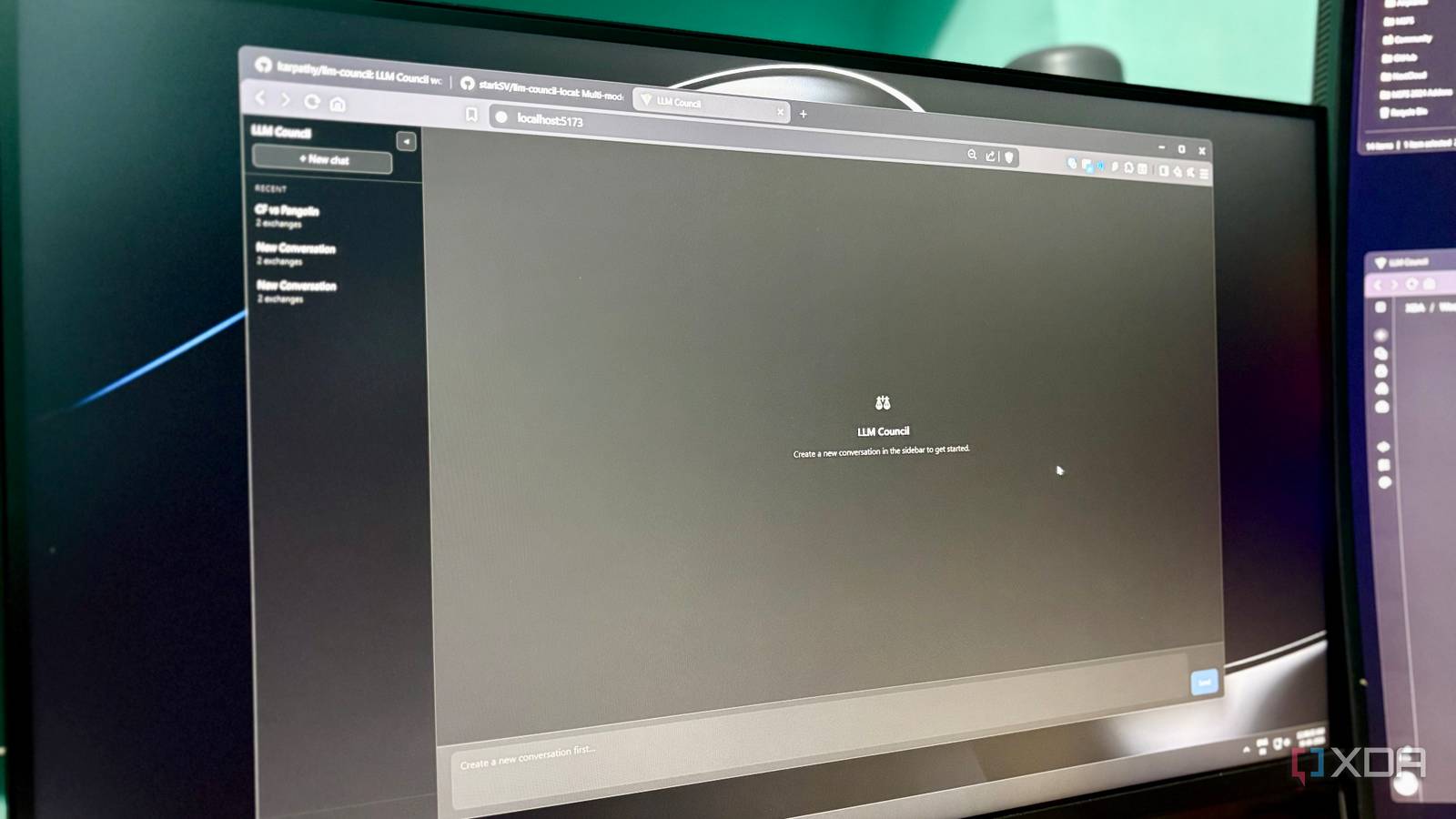
Deploying a local “LLM Council”—a multi-agent system where several local language models evaluate one another’s outputs—can significantly improve response quality compared to relying on a single, general-purpose model. By routing prompts through a heterogeneous ensemble of models running on consumer-grade hardware, such as an NVIDIA RTX 4070 Ti, users can synthesize specialized strengths while mitigating the limitations of individual parameters, according to architectural patterns popularized by AI researchers like Andrej Karpathy.
The Evolution of Local Model Orchestration
For many developers and enthusiasts, the journey into local Large Language Models (LLMs) often begins with frustration. Early iterations, particularly the 7B and 8B parameter models, frequently failed to match the reasoning capabilities of massive, cloud-based proprietary systems. As noted in benchmarks from Hugging Face’s Open LLM Leaderboard, while smaller models have seen rapid performance gains, they often struggle with complex multi-step logic or domain-specific nuances.

The traditional approach of picking one “default” model often leads to a compromise. A model optimized for coding might lack the creative writing flair of a model fine-tuned for instruction following. By implementing a council-based architecture, a user no longer needs to rely on a single weight set. Instead, a controller agent dispatches a task to multiple local models—each running on dedicated VRAM—and aggregates the results. This approach mirrors the “LLM Council” concept, which was originally proposed as a method to leverage various cloud APIs for consensus-based decision-making. Transitioning this to local hardware requires sufficient VRAM and efficient inference backends, such as Ollama or llama.cpp, to manage concurrent processes.
Hardware Constraints and Practical Implementation
Running an ensemble of models locally is limited primarily by the available VRAM on a user’s graphics card. An NVIDIA RTX 4070 Ti, which features 12GB of GDDR6X memory, provides a capable baseline for running quantized versions of smaller, high-performance models. According to technical documentation from NVIDIA, quantization techniques like 4-bit or 8-bit integer precision are essential to fitting these models into limited memory buffers without sacrificing significant accuracy.
To build a functioning local council, one must configure a system where:
- The controller parses the incoming prompt for intent.
- The prompt is dispatched to two or more local models (e.g., a logic-heavy model and a creative-writing model).
- A final model acts as a “judge” or “summarizer” to consolidate the best elements of the generated outputs.
This creates a workflow where the final answer is not the product of a single model’s bias, but an emergent property of the group.
Why Diversity in Model Selection Matters
The primary advantage of a council-based system is the reduction of “model collapse” or hallucination patterns specific to one architecture. Research into mixture-of-experts (MoE) and ensemble methods suggests that model diversity is a critical factor in output reliability. When a user relies on a single model, they are bound by the specific training data and fine-tuning biases of that model. By maintaining a library of specialized local models, the system can dynamically select the best tool for the job.
For example, if the prompt requires a concise technical explanation, the system can prioritize the output of a model fine-tuned on code documentation. If the prompt requires a nuanced summary of a document, it can defer to a model with a larger context window or one trained on journalistic prose. This modularity allows the user to update individual models as new, more efficient iterations are released, without needing to reconfigure the entire council.
Future Developments in Local AI Agents
The field of local AI orchestration is moving toward more automated management. Projects currently under development aim to automate the “judge” process, reducing the latency overhead that comes with running multiple inferences per prompt. As hardware vendors continue to increase VRAM capacities in consumer GPUs, the barrier to entry for running complex ensembles will continue to drop.

For users interested in tracking the state of local LLM capabilities, the LMSYS Chatbot Arena provides ongoing, crowdsourced rankings that can help in selecting the best models to include in a personal council. The integration of these models into a unified local workflow represents a significant shift from passive consumption of cloud models toward active, curated AI infrastructure.
How have you optimized your local hardware for multi-model workflows? Share your configurations and results in the comments below.