The U.S. legal system faces persistent challenges in providing constitutionally mandated language access, as the right to a fair trial often hinges on the availability of qualified interpreters for defendants who speak Indigenous or minority languages. While the Sixth Amendment guarantees the right to understand court proceedings, systemic gaps in linguistic support continue to affect judicial outcomes for millions of individuals with limited English proficiency. These issues frequently stem from a lack of awareness regarding linguistic diversity among law enforcement and court personnel, leading to instances where defendants are unable to communicate effectively with counsel or comprehend the charges against them.
In a notable case from October 2025, two Guatemalan farmworkers who spoke the Indigenous Mayan language Mam were detained by Immigration and Customs Enforcement (ICE) in northern Oregon. According to their sworn declarations, the individuals were not provided with an interpreter despite informing officers of their language needs. The detainees were subsequently released with ankle monitors under an intensive supervision program. In January 2026, a federal judge ruled the actions of the agents to be “reckless and erroneous,” ordering the removal of the monitors and the termination of the supervision program, as reported in court filings.
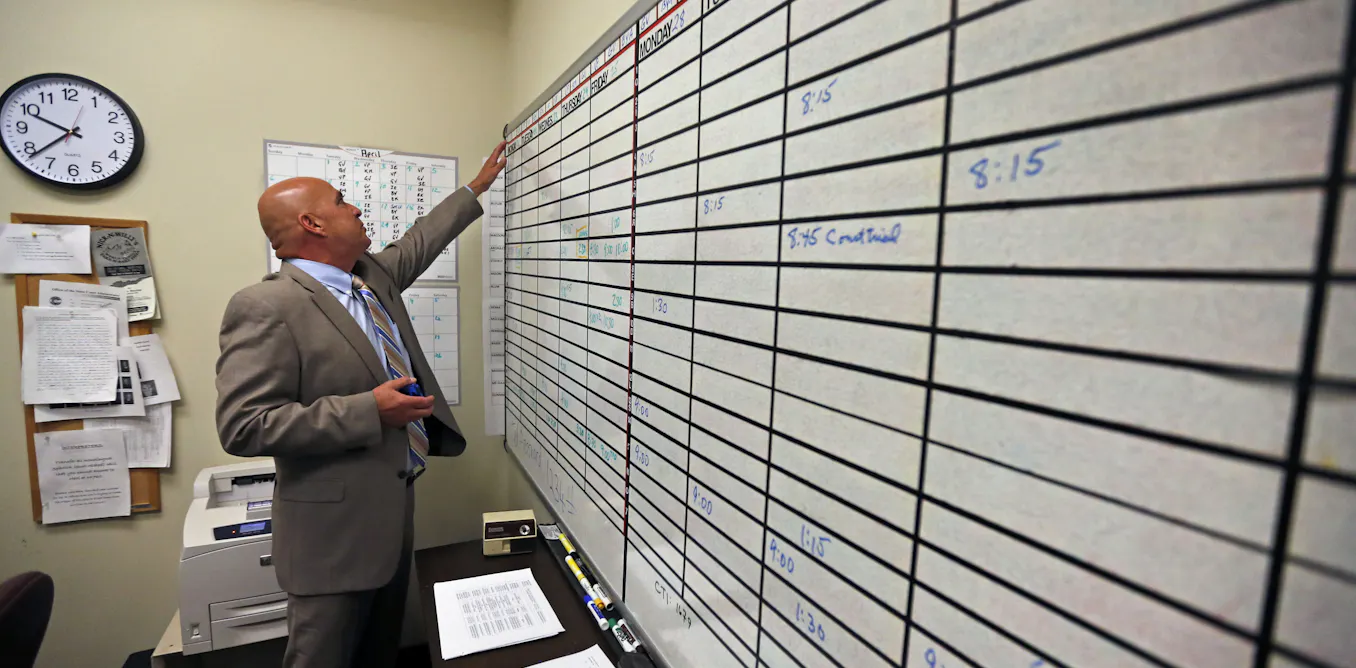
A court interpreter checks the day’s schedule of assignments. AP Photo/Brennan Linsley
Constitutional Protections and the Right to Due Process
The U.S. Constitution provides broad protections to all individuals within the country, regardless of their immigration status. The Sixth Amendment specifically guarantees the right to a fair trial, which includes the necessity of understanding the proceedings and the ability to communicate with legal counsel. Furthermore, the Fifth and 14th amendments mandate that no person shall be deprived of “life, liberty, or property, without due process of law,” a requirement that legal scholars argue is impossible to meet without adequate interpretation services.
Despite these protections, the practical application of language access remains inconsistent. The U.S. Census Bureau reported in recent data that millions of residents speak a language other than English at home, and many of these individuals have limited English proficiency. When court systems or law enforcement agencies fail to identify the specific linguistic needs of a detainee, they risk violating these fundamental constitutional rights. The reliance on inaccurate language identification—such as incorrectly logging an Indigenous speaker as a Spanish speaker—often prevents the deployment of necessary resources, effectively barring individuals from meaningful participation in their own defense.
The Impact of Linguistic Misidentification
The failure to distinguish between distinct linguistic families often leads to severe judicial errors. Mayan languages, for example, comprise more than 30 distinct languages, each with its own grammar, vocabulary, and sound systems. A speaker of one Mayan language, such as Ch’ol, cannot understand another, such as Mam. When courts fail to recognize these differences, defendants are frequently provided with interpreters who speak a language they do not understand, or who speak a different dialect entirely. This misidentification can lead to wrongful convictions, as seen in historical cases where defendants were unable to contest testimony or understand the evidence presented against them.
In 2022, a man who spoke the Northern Tepehuan language was convicted of a drug-related charge in Texas and sentenced to 24 months in prison. During the proceedings, the lack of appropriate interpretation meant the defendant did not understand the nature of the court process. Similarly, in the 1980s, a Mixtec speaker was wrongfully convicted of murder after a trial conducted through a Spanish interpreter, a language in which he had negligible proficiency. These cases demonstrate that the inability to access a qualified interpreter in one’s native language is not merely a procedural hurdle; it is a fundamental breakdown of the adversarial system.
Rachel Jeantel, a key witness in George Zimmerman’s trial, testifies in Florida in 2013. AP Photo/Orlando Sentinel, Jacob Langston
Challenges Beyond Non-English Languages
Linguistic discrimination also extends to speakers of nonstandard varieties of English, including African American English (AAE). Research conducted on court reporting accuracy in Philadelphia found that when transcribing AAE, accuracy rates for court reporters dropped below 60% in some instances, compared to the required 95% threshold for standard legal transcription. Because AAE possesses its own rule-governed syntax and phonology, the failure of court reporters to accurately capture testimony can fundamentally alter the official record, potentially leading to wrongful interpretations of witness credibility.
The 2013 trial of George Zimmerman serves as a high-profile example of how linguistic bias can influence jury perceptions. Rachel Jeantel, a witness for the prosecution, provided extensive testimony that was ultimately disregarded by jurors, with some citing difficulty understanding her speech as a reason for doubting her credibility. Studies in both the U.S. and the U.K. have consistently shown that witnesses who speak with nonstandard accents or dialects are often perceived as less credible or more likely to be guilty by jurors, regardless of the actual evidence presented. Legal experts suggest that the use of expert witnesses to explain linguistic diversity could help juries distinguish between the content of a testimony and the way in which it is delivered.
Future Developments in Language Access
The demand for qualified interpretation services is expected to grow as the demographic landscape of the U.S. continues to evolve. While federal agencies are tasked with providing language access under various statutes, the implementation of these services remains subject to funding and administrative priorities. Legal advocates emphasize that early language identification is the most effective way to prevent the infringement of rights. Without formal training for law enforcement and court officials on how to identify and accommodate diverse linguistic needs, the risk of constitutional violations remains significant.
The next major developments in this area will likely come from ongoing litigation regarding the treatment of Indigenous detainees and potential updates to administrative policies governing federal language access. Individuals seeking information on their rights or current court filings may monitor updates from the U.S. Department of Justice’s Civil Rights Division or local federal court dockets. As the legal community continues to address these systemic gaps, the focus remains on ensuring that language is not a barrier to the fundamental right to due process.
Keep reading