
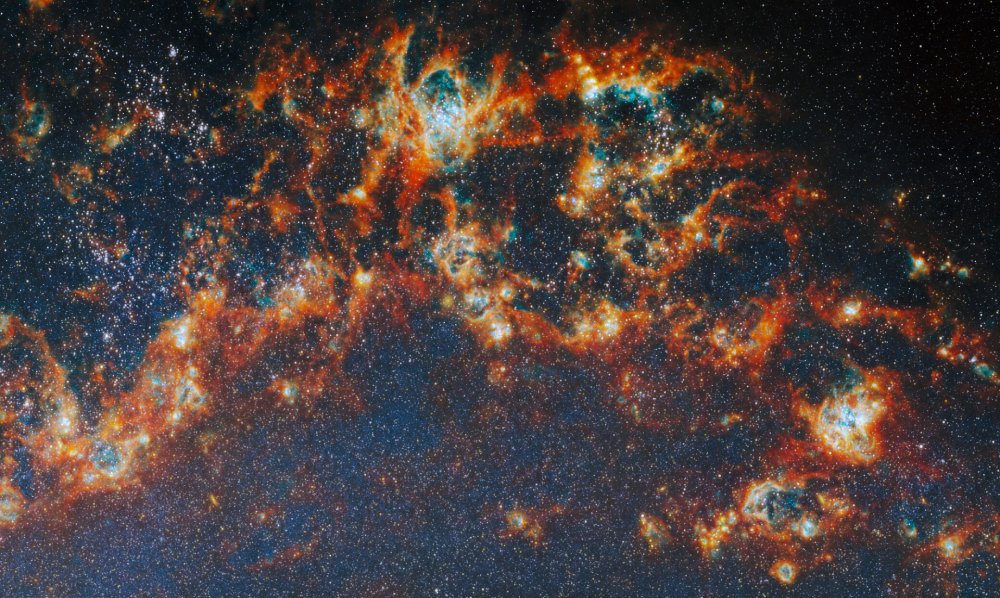
For decades, astronomers have looked at the glittering expanses of distant galaxies and wondered about the chaotic, hidden nurseries where stars are born. These regions, often choked with thick curtains of cosmic dust, have remained largely opaque to traditional telescopes, leaving a significant gap in our understanding of how the universe’s building blocks are assembled.
New observations from the James Webb Space Telescope (JWST) and the Hubble Space Telescope are now lifting that veil. By analyzing nearly 9,000 young star clusters across four nearby galaxies—Messier 51, Messier 83, NGC 628 and NGC 4449—researchers have uncovered a critical link between a star cluster’s mass and its ability to reshape its environment. The findings suggest that the most massive clusters are not just larger. they are more aggressive in clearing their birth clouds, a process that fundamentally alters the evolution of the galaxy and the potential for planet formation.
This research, led by Alex Pedrini of Stockholm University and the Oskar Klein Centre in Sweden, represents a collaborative effort involving the FEAST JWST team. By combining the infrared capabilities of Webb with the visible light precision of Hubble, the team has created a comprehensive timeline of stellar emergence, from the first shrouded moments of birth to the eventual exposure of fully formed stellar groups.
The study reveals a dynamic “tug-of-war” between gravity, which pulls gas together to form stars, and stellar feedback—the radiation, ionized gas, and powerful stellar winds that push that same gas away. The result is a vivid portrait of galaxies in constant motion, where the size of a cluster determines exactly how quickly it can break free from its gaseous cradle.
The Synergy of Infrared and Visible Light
To understand the life cycle of a star cluster, astronomers must be able to see through the “smoke” of the interstellar medium. Here’s where the technical synergy between the James Webb Space Telescope and Hubble becomes essential. Cosmic dust is highly effective at blocking visible light, which is why many newborn stars remain invisible to telescopes like Hubble during their earliest stages.
JWST’s infrared vision allows scientists to peer through these thick clouds of gas and dust, revealing “brilliant knots” of newborn stars and the glowing cavities carved out by stellar winds. While Webb exposes the hidden, dust-shrouded infancy of these clusters, Hubble is used to trace older, fully exposed clusters in visible light. Together, these two instruments allow researchers to map the transition from an embedded, hidden state to an emerged, visible state.
The images captured from the four studied galaxies show a complex architecture of “dark rivers of dust” and glowing regions of ionized gas. In galaxies like Messier 51, Webb’s Near-Infrared Camera (NIRCam) has highlighted dense, extremely bright clusters of massive stars that have only recently formed, many of which would be entirely invisible to the human eye or visible-light instruments.
Mass as a Catalyst for Emergence
The central discovery of the study is that mass determines destiny. The researchers found that the most massive young star clusters escape their birth clouds significantly faster than smaller clusters. This phenomenon is driven by a process known as stellar feedback.
Stellar feedback occurs when massive stars release immense amounts of energy into their surroundings. This energy takes several forms:
- Ultraviolet Radiation: Intense UV light ionizes the surrounding hydrogen gas, creating high-pressure bubbles that expand outward.
- Stellar Winds: Massive stars emit powerful streams of particles that physically push the surrounding gas and dust away.
- Supernova Explosions: As the most massive stars in a cluster reach the end of their short lives, they explode, sending shockwaves that further clear the remaining natal material.
Because massive clusters contain a higher concentration of these high-energy stars, their collective feedback is far more potent. They effectively “blow away” their birth clouds with greater speed and force than smaller clusters, which may remain embedded in their dust for millions of years longer. This rapid emergence means that massive clusters interact with the wider galaxy much sooner, influencing the distribution of gas and the triggering of subsequent star formation in nearby regions.
Implications for Planet Formation and Galactic Structure
The speed at which a star cluster emerges from its birth cloud is not just an astronomical curiosity; it has profound implications for the birth of planets. Planets form from the remnants of the gas and dust that surround a young star—the protoplanetary disk. If a cluster clears its birth cloud too quickly or too violently, the raw materials needed to build planets may be stripped away before they can coalesce.
Conversely, if the environment is too stable or the feedback too weak, the disk may be subjected to different pressures. The research suggests that the stellar environment—specifically the mass of the surrounding cluster—shapes the early conditions where planets begin to form. This adds a new layer of complexity to the search for habitable worlds, as it implies that the “neighborhood” a star is born into may be just as important as the star’s own composition.
On a larger scale, this process regulates the evolution of the entire galaxy. By clearing out molecular clouds, massive star clusters limit the amount of fuel available for future stars, acting as a cosmic thermostat that prevents galaxies from consuming all their gas too quickly. This feedback loop ensures that star formation is a prolonged process, allowing galaxies to evolve over billions of years rather than in one sudden burst.
Key Takeaways: How Star Clusters Shape the Cosmos
- Mass-Driven Emergence: Massive star clusters clear their surrounding birth clouds faster than smaller clusters due to more intense stellar feedback.
- Multi-Wavelength Analysis: The study utilized JWST’s infrared capabilities to see through dust and Hubble’s visible light to track fully emerged clusters.
- Stellar Feedback: Radiation and stellar winds from massive stars carve out cavities in molecular clouds, regulating the rate of star formation.
- Planetary Impact: The speed and intensity of cloud clearance may influence the availability of materials for planet formation in young stellar systems.
- Galactic Scale: This process helps shape the overall structure of galaxies like Messier 51 and Messier 83.
As Alex Pedrini noted, this work bridges the gap between those simulating star formation and those observing it in real-time. By integrating these observations with theoretical models, astronomers are moving closer to a complete understanding of the “lifecycle” of stellar birth.

The next phase of this research will likely involve deeper dives into the specific chemical compositions of the cleared regions, using JWST’s spectroscopic tools to analyze the “dark rivers of dust” and identify the complex molecules that serve as the precursors to planetary systems. As more data from the FEAST JWST team becomes available, our map of the galactic nursery will continue to sharpen.
Do you think the environment of a star cluster is the most critical factor in the search for Earth-like planets? Share your thoughts in the comments below or share this article with your fellow space enthusiasts.