
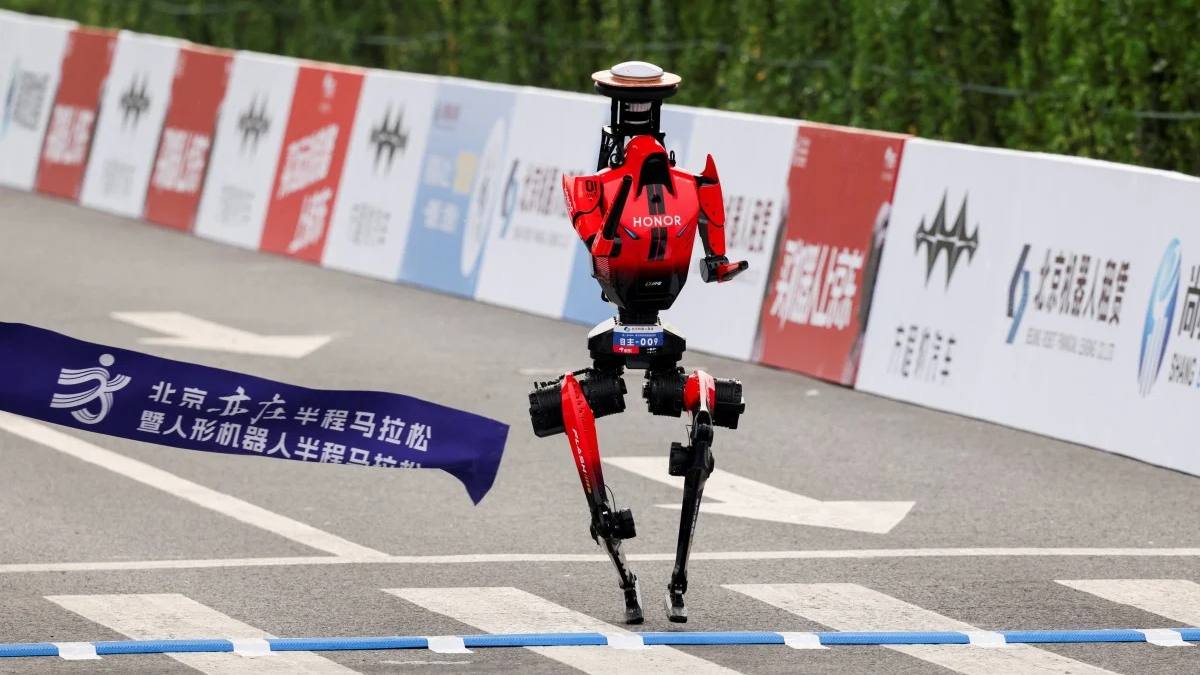
The Honor Lightning humanoid robot completed a half-marathon in 50 minutes and 26 seconds on April 19, 2026, setting a new benchmark for robotic endurance and physical performance. This achievement, which surpassed the human world record by seven minutes, highlights significant advancements in hardware cooling and mechanical design within the robotics sector. While the feat demonstrates the potential for specialized machines to outperform humans in specific athletic tasks, experts note that such results stem from intentional engineering trade-offs rather than a singular technological breakthrough.
For those tracking the rapid evolution of autonomous systems, the Lightning’s performance provides a clear look at the current limitations and capabilities of legged robotics. The robot’s ability to sustain high-speed locomotion for over 21 kilometers relies on specific thermal management strategies that distinguish it from more versatile, general-purpose platforms currently in development by companies like Unitree and Agibot. Understanding these distinctions is essential for separating engineering milestones from the broader, more complex goals of creating humanoids capable of navigating diverse, unpredictable environments.
The Mechanics of Robotic Locomotion
At its core, a running robot must manage the transition between the stance phase—where the leg exerts force against the ground—and the aerial phase, during which the body is suspended in motion. According to fundamental principles of robotics engineering, each of these phases requires precise torque control from electric motors. To achieve the necessary output, engineers typically utilize a geartrain to amplify torque, yet this introduces a significant thermal challenge. As motors work to maintain speed, the energy lost as heat increases, often becoming the primary constraint on a robot’s operational duration.
The Honor Lightning appears to address these constraints through a design optimized specifically for high-intensity running. By carefully selecting a gear ratio—a critical design choice that balances acceleration with power consumption—the engineers behind the Lightning have minimized heat buildup in the knee motors. While a robot designed for standard walking might utilize a 30:1 gear ratio to prioritize efficiency at lower speeds, a running-optimized system often requires a higher ratio to handle the stresses of consistent, high-impact movement. This design choice, however, creates a clear trade-off: the robot becomes highly efficient at running but potentially less capable or more energy-hungry when performing more varied, slower-paced tasks.
Thermal Management as a Performance Enabler
The most notable technical advancement in the Lightning’s design is its sophisticated liquid-cooling system. Unlike standard air-cooled systems, which often struggle to dissipate the substantial heat generated by high-torque knee and hip motors during prolonged activity, the Lightning utilizes a capillary-based liquid cooling network. According to technical specifications shared during the project’s development, this system features a high-power pump capable of a heat-exchange flow rate exceeding 4 liters per minute, with independent circuits dedicated to each of the four drive motors in the lower limbs.
This approach to thermal control is not common in commercial humanoid platforms. While companies like Apptronik have explored liquid cooling in prototype stages for their Apollo platform, it remains a specialized solution rather than an industry standard. The ability to extract approximately 150W of heat from a single knee motor continuously allows the Lightning to maintain a consistent pace without the risk of thermal shutdown. This cooling architecture represents a departure from the air-convection methods often seen in more widely-shipped robots, such as those from Unitree, which may require external measures—such as ice packs—to manage heat during extended periods of high-intensity operation.
Engineering Trade-offs and Future Applications
The performance of the Honor Lightning serves as a case study in the necessity of engineering trade-offs. By prioritizing running efficiency, the robot’s designers opted for larger, more powerful motors that offer superior performance on a track but introduce practical limitations for indoor or domestic use. These larger components increase the overall weight of the robot and can hinder its ability to navigate tight spaces or interact safely with objects in a home or factory setting. The result is a highly specialized machine that excels in a controlled, linear environment at the expense of the versatility required for broad commercial deployment.
The industry is now looking toward how these developments will influence the next generation of legged platforms. While the Lightning’s speed is impressive, the focus for many researchers remains on achieving a balance between the robustness required for heavy-duty tasks and the agility needed for general-purpose interaction. The integration of advanced artificial intelligence models, which handle real-time decision-making and course navigation, alongside these hardware advancements, will likely determine the practical utility of future humanoid robots. As engineering teams refine their designs, the ability to adapt motor cooling and gear ratios for specific missions will become a standard consideration in robot architecture.
Looking ahead, the robotics community expects further technical disclosures from developers as more humanoids undergo rigorous field testing. Observers are particularly interested in how these cooling technologies will be adapted for robots that must operate for longer durations without the benefit of a high-flow liquid pump. Readers interested in the latest updates on humanoid performance benchmarks and industry-wide technical disclosures can monitor upcoming robotics conferences and official company filings for further details on these evolving systems. We welcome your thoughts on the balance between specialized performance and general utility in the comments below.
Keep reading