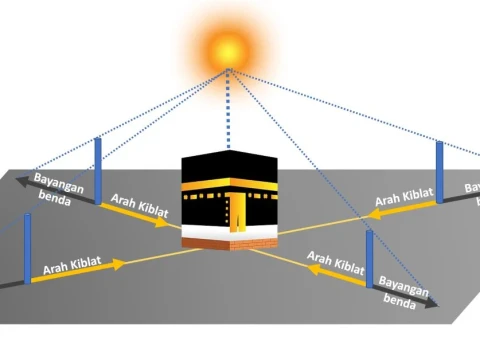
Twice a year, the sun reaches a position directly above the Ka’bah in Mecca, a celestial alignment known as Rashdul Qiblat. This annual event, which occurs when the sun’s declination matches the latitude of the Ka’bah, provides a precise, natural method for Muslims worldwide to verify the accuracy of their Qibla—the direction faced during daily prayers.
When the sun reaches this same latitude, it passes directly overhead at the Grand Mosque in Mecca. According to astronomical data provided by the Indonesian Ministry of Religious Affairs, this year’s second alignment is calculated to occur on July 15 and July 16, 2024, at approximately 16:27 Western Indonesian Time (WIB), or 09:27 UTC. During these moments, any vertical object—such as a plumb line or a sturdy stick—will cast a shadow that points directly toward the Ka’bah.
The Science of Solar Alignment for Qibla Verification
The method relies on the basic principles of solar geometry. Because the sun is at the zenith over the Ka’bah, the shadow cast by a perfectly vertical object will align with the great circle path toward Mecca.
Local religious authorities often utilize this window to conduct community-wide checks. For instance, the Ministry of Religious Affairs in various regions, including Padang Lawas in North Sumatra, regularly coordinates the measurement of mushalla and mosque orientations during these dates to address potential deviations caused by structural shifts or initial measurement errors. Verification efforts in places like the Masjid Puro Pakualaman in Yogyakarta have historically demonstrated that once a Qibla direction is established with high-precision astronomical tools, it often remains stable for over a decade, provided no major structural renovations occur.
Practical Steps for Accurate Measurement
To perform a personal check of the Qibla direction, the process requires minimal equipment but high attention to detail. The primary requirement is a reference object that is perfectly perpendicular to the ground.
- Select a vertical object: Use a plumb line (a string with a weight) or a straight, sturdy pole. A plumb line is generally preferred as it is less susceptible to leaning.
- Ensure a level surface: Place the object on a flat, even floor or ground area where sunlight can hit it clearly.
- Check the timing: Consult local astronomical tables to find the exact time the sun reaches the zenith in your specific location. While the phenomenon occurs globally, the exact minute varies slightly depending on the observer’s longitude relative to Mecca.
- Mark the shadow: At the precise moment calculated, the shadow cast by the string or pole represents the Qibla line. Mark this line on the floor clearly.
- Verify alignment: The line drawn from the base of the object toward the end of the shadow points directly toward the Ka’bah.
This verification is particularly useful for older buildings where the original orientation might be in question. In Tulungagung and other districts across Indonesia, local religious offices frequently document these observations as part of their public outreach, ensuring that worshippers have the necessary guidance to maintain accurate prayer orientations.
Why Periodic Verification Matters
While the Qibla direction is constant, the physical orientation of a building can be affected by environmental factors or construction changes. By using the sun as a natural compass, communities can bypass the potential calibration errors sometimes associated with magnetic compasses, which can be affected by local metal structures or geological anomalies.

The sun’s position during these dates provides an objective, universal standard. As global awareness of these astronomical windows increases, more individuals are taking advantage of the opportunity to ensure their home prayer areas are aligned. For those who miss the specific minute of alignment, the shadow will remain largely accurate for a short period before and after the event, though the highest precision is achieved at the exact calculated time.
For updates on regional calculation times or to consult official astronomical guidelines, residents are encouraged to visit the official websites of their national religious ministries or local astronomical observatories. Have you verified your Qibla direction this year? Share your experiences or questions in the comments below.
Keep reading