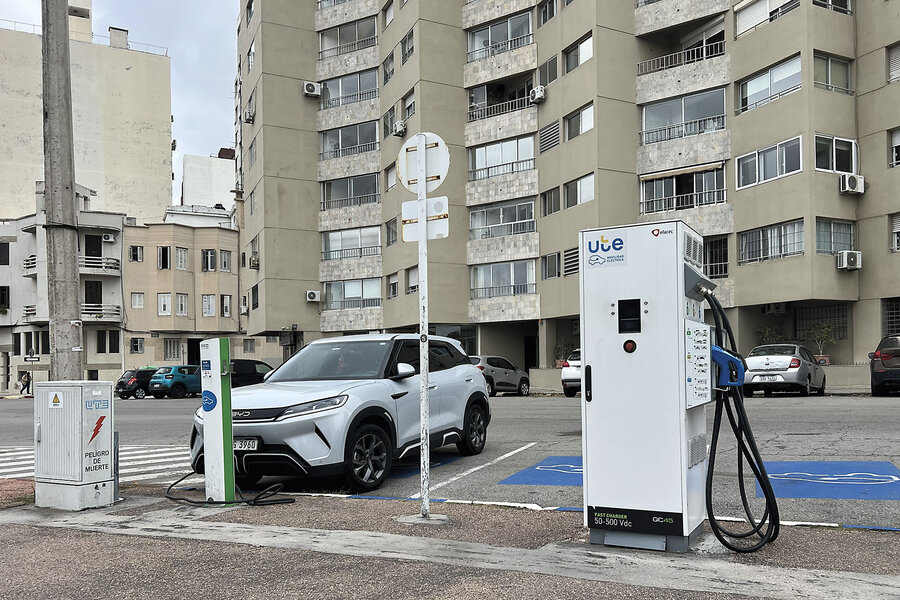
Uruguay became the first country in the world to run entirely on renewable energy in 2015, a milestone achieved through a decade-long push into wind and hydro power that now serves as a blueprint for nations seeking to decarbonize their grids. The small South American nation, often overshadowed by its neighbors Brazil and Argentina, proved that even countries with limited resources could transition to clean energy—decades before global tensions over the Strait of Hormuz or oil dependence made renewables a geopolitical priority.
By 2023, Uruguay’s renewable energy share had climbed to 98.5% of total electricity generation, with wind power alone supplying over half its needs. The transformation was not just environmental but economic: costs for wind and solar have since plummeted globally, while Uruguay’s energy bills have stabilized—contrasting sharply with oil-dependent nations now facing volatility in global markets.
Yet the journey was far from smooth. Political shifts, infrastructure challenges, and skepticism from fossil fuel interests tested Uruguay’s resolve. Today, as climate agreements stall and energy crises deepen, Uruguay’s model offers a rare success story—one now being studied by policymakers from the World Bank to the International Energy Agency (IEA).
Why Uruguay’s Renewable Shift Matters
Uruguay’s success hinged on three factors: political will, strategic partnerships, and public investment. Unlike many nations that rely on fossil fuel subsidies, Uruguay’s government treated renewables as an economic opportunity from the start. Here’s how it worked:
- Wind power dominance: By 2023, wind accounted for 56% of Uruguay’s electricity, with projects like the Parque Eólico Punta del Este (2012) proving commercially viable.
- Hydro’s backbone: The Uruguayan National System Administrator (ANS) reported that hydro provided 12% of capacity, with the Río Negro and Salto Grande Dam (shared with Argentina) as critical assets.
- Solar’s rapid rise: While solar lagged behind wind, its share grew from near-zero in 2010 to 10% by 2023, driven by Law 19,280 (2014), which mandated renewable energy auctions.
How Uruguay Did It—And Why Others Struggle to Follow
Uruguay’s transition was not accidental. It began in 2005, when then-President Tabaré Vázquez (a physician and leftist leader) launched a National Energy Plan targeting 75% renewables by 2015. The plan included:
- Public-private partnerships: Uruguay attracted $10 billion in foreign investment by offering long-term power purchase agreements (PPAs) to companies like Acciona and Engie.
- Regulatory flexibility: The ANS simplified permits for renewable projects, reducing approval times from years to months.
- Grid modernization: Uruguay upgraded transmission lines to handle variable wind output, a challenge that has stymied other nations like India and South Africa.
Yet even Uruguay faced hurdles. In 2018, a drought reduced hydro output by 30%, forcing the government to temporarily import diesel. Critics argued that renewables alone couldn’t guarantee 24/7 power—but Uruguay’s response was telling: it accelerated battery storage projects and expanded gas as a backup, not a primary source.
What Other Nations Can Learn (and Where They’re Falling Short)
Uruguay’s model has inspired moves in Costa Rica (98% renewable in 2023), Denmark (60% wind), and even Indonesia, which aims for 23% renewables by 2025. But three key differences emerge when comparing Uruguay’s success to global efforts:
| Factor | Uruguay’s Approach | Global Challenges |
|---|---|---|
| Political continuity | Consistent bipartisan support since 2005, regardless of government. | Many nations (e.g., U.S.) see policy reversals under new administrations. |
| Grid integration | Early investment in smart grids and storage. | Countries like India face blackouts due to mismatched supply-demand. |
| Public acceptance | High social trust in government energy plans. | Protests against wind farms in Germany and France delay projects. |
The Next Step: Can Uruguay’s Model Scale Globally?
Uruguay’s story is far from over. In 2024, the government launched Plan Energético 2030, targeting net-zero emissions by 2040—a decade ahead of the Paris Agreement’s global timeline. Key initiatives include:
- Green hydrogen: Uruguay is partnering with Air Liquide to build a $500 million hydrogen plant by 2026, using excess wind power.
- Regional leadership: Uruguay is pushing for a MERCOSUR-wide renewable energy market, aiming to integrate grids with Argentina and Brazil.
- Energy poverty focus: The Ministry of Social Development reports that 99% of rural homes now have electricity, up from 85% in 2005.
Yet challenges remain. The ANS’s 2024 report warns that intermittency risks could resurface without further storage investment. Meanwhile, neighboring Argentina’s economic crisis has delayed regional grid projects, forcing Uruguay to rely more on domestic solutions.
What Happens Next?
The next critical checkpoint is the 2025 MERCOSUR Energy Summit, where Uruguay will propose a binding renewable energy protocol for member states. If adopted, it could accelerate clean energy adoption across South America—though political instability in Venezuela and Bolivia may complicate progress.
For readers tracking Uruguay’s journey, the ANS’s monthly energy reports and the Ministry of Industry and Energy’s dashboard provide real-time updates on generation mixes and policy shifts.
As global energy markets tighten, Uruguay’s story offers a reminder: the transition to renewables is not just about technology—it’s about political courage, public trust, and long-term vision. For nations watching the Strait of Hormuz’s oil chokepoints, Uruguay’s path may be the only viable alternative.
Your thoughts: Could Uruguay’s model work in your country? Share your perspective in the comments below—or explore how your nation compares using the IEA’s energy statistics tool.
- Festival Tempo Rives à Angers : L’ouverture avec Lorkê Lorkê
- Tasha Fire in Santa Clarita: Evacuations and Updates as Brush Fire Burns Near Newhall Pass
- How Oman Became the Broker Behind the Latest Hormuz Deal (daybreakwire.com)
- Technology, Innovation, and Digital Transformation in Urban Development (archynewsy.com)