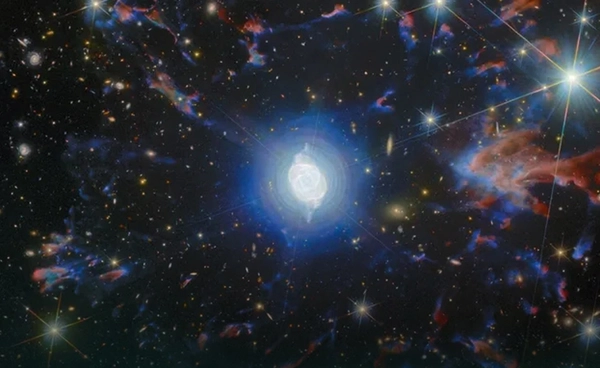
The Cat’s Eye Nebula, a celestial object famed for its intricate and colorful structure, has been captured in unprecedented detail thanks to a collaborative effort between the Hubble Space Telescope and the European Space Agency’s Euclid mission. This new imagery reveals the nebula’s complex layers and the final stages of a dying star’s life, offering astronomers valuable insights into stellar evolution. The combined power of these two advanced telescopes is providing a clearer understanding of the processes that shape planetary nebulae like the Cat’s Eye.
Located approximately 3,300 light-years away in the constellation Draco, the Cat’s Eye Nebula (NGC 6543) is a bipolar planetary nebula. These nebulae form when a sun-like star nears the complete of its life and expels its outer layers into space, creating expanding shells of gas and dust. The central star, now a white dwarf, emits intense ultraviolet radiation that ionizes the surrounding gas, causing it to glow in vibrant colors. The new images highlight the intricate structures within the nebula, including knots, filaments, and shells, revealing a level of detail previously unseen. This latest observation builds upon decades of Hubble’s contributions to understanding these cosmic phenomena.
A Combined View: Hubble and Euclid’s Strengths
The collaboration between Hubble and Euclid is particularly significant because each telescope brings unique capabilities to the observation. Hubble, renowned for its high-resolution imaging in visible and ultraviolet light, provides detailed views of the nebula’s inner regions. Euclid, is designed to map the geometry of the universe and study dark matter and dark energy. Its wide-field view and sensitivity to longer wavelengths allow it to observe the outer, fainter regions of the nebula, complementing Hubble’s observations. NASA reports that this synergy allows for a more complete understanding of the nebula’s structure and evolution.
Euclid’s ability to observe in infrared light is crucial for penetrating the dust clouds that obscure the inner regions of the nebula. This allows astronomers to study the composition and temperature of the gas and dust, providing clues about the star’s history and the processes that shaped the nebula. The European Space Agency highlights that Here’s one of the first scientific images released by the Euclid mission, demonstrating its capabilities and potential for future discoveries.
Unveiling the Nebula’s Complex Structure
The images reveal a remarkably complex structure, with multiple layers of gas and dust expanding outwards from the central star. These layers are not uniform; they exhibit intricate patterns of knots, filaments, and shells, shaped by the star’s powerful stellar winds and radiation. The different colors in the images represent different elements and their ionization states. For example, red typically indicates the presence of hydrogen, while blue and green represent oxygen and other elements. The detailed observations allow astronomers to study the distribution of these elements and understand how they contribute to the nebula’s overall structure.
One of the most striking features of the Cat’s Eye Nebula is its bipolar shape, with two distinct lobes extending outwards from the central star. The mechanism responsible for creating this bipolar structure is still not fully understood, but it is believed to be related to the star’s magnetic field and rotation. The new images provide further evidence supporting the idea that magnetic fields play a crucial role in shaping planetary nebulae. Researchers are using these observations to refine their models of stellar evolution and better understand the processes that lead to the formation of these attractive and complex objects.
The Life Cycle of a Star
The Cat’s Eye Nebula represents a relatively short-lived phase in the life cycle of a star. As a star like our Sun exhausts its nuclear fuel, it begins to expand into a red giant. Eventually, the outer layers of the star are expelled into space, forming a planetary nebula. The remaining core collapses into a white dwarf, a small, dense object that slowly cools over billions of years. The entire process, from the initial expansion of the star to the formation of the white dwarf, takes only a few million years – a blink of an eye in cosmic terms.
Studying planetary nebulae like the Cat’s Eye provides valuable insights into the future of our own Sun. While the Sun is not massive enough to explode as a supernova, it will eventually undergo a similar process of shedding its outer layers and becoming a white dwarf. Understanding the details of this process is crucial for predicting the long-term evolution of our solar system and the fate of Earth. The new images from Hubble and Euclid are helping astronomers to refine their models of stellar evolution and better understand the processes that will ultimately shape the future of our cosmic neighborhood.
Future Research and Discoveries
The collaboration between Hubble and Euclid is expected to yield many more exciting discoveries in the years to come. Euclid’s ongoing survey of the universe will provide a wealth of data on a wide range of astronomical objects, including planetary nebulae, galaxies, and dark matter. By combining Euclid’s wide-field observations with Hubble’s high-resolution imaging, astronomers will be able to study these objects in unprecedented detail.
Researchers are particularly interested in using Euclid to study the distribution of dark matter in and around planetary nebulae. Dark matter is a mysterious substance that makes up about 85% of the matter in the universe, but its nature remains largely unknown. By studying how dark matter interacts with the gas and dust in planetary nebulae, astronomers hope to gain new insights into its properties and distribution. The Euclid mission represents a major step forward in our quest to understand the fundamental nature of the universe.
The stunning new images of the Cat’s Eye Nebula serve as a reminder of the beauty and complexity of the cosmos. They also highlight the power of collaboration and the importance of investing in advanced astronomical instruments. As Hubble and Euclid continue to explore the universe, we can expect many more groundbreaking discoveries that will deepen our understanding of our place in the cosmos. The ongoing analysis of this data promises to reveal even more secrets hidden within this iconic nebula.
The next major data release from the Euclid mission is scheduled for late 2026, which will include a more comprehensive map of the Cat’s Eye Nebula and other celestial objects. Astronomers will then begin a detailed analysis of this data, searching for new clues about the nebula’s structure, evolution, and the role of dark matter. Stay tuned to World Today Journal for further updates on this exciting research.
What are your thoughts on these incredible images? Share your comments below and let us know what aspects of the Cat’s Eye Nebula you find most fascinating. Don’t forget to share this article with your friends and colleagues!
Keep reading