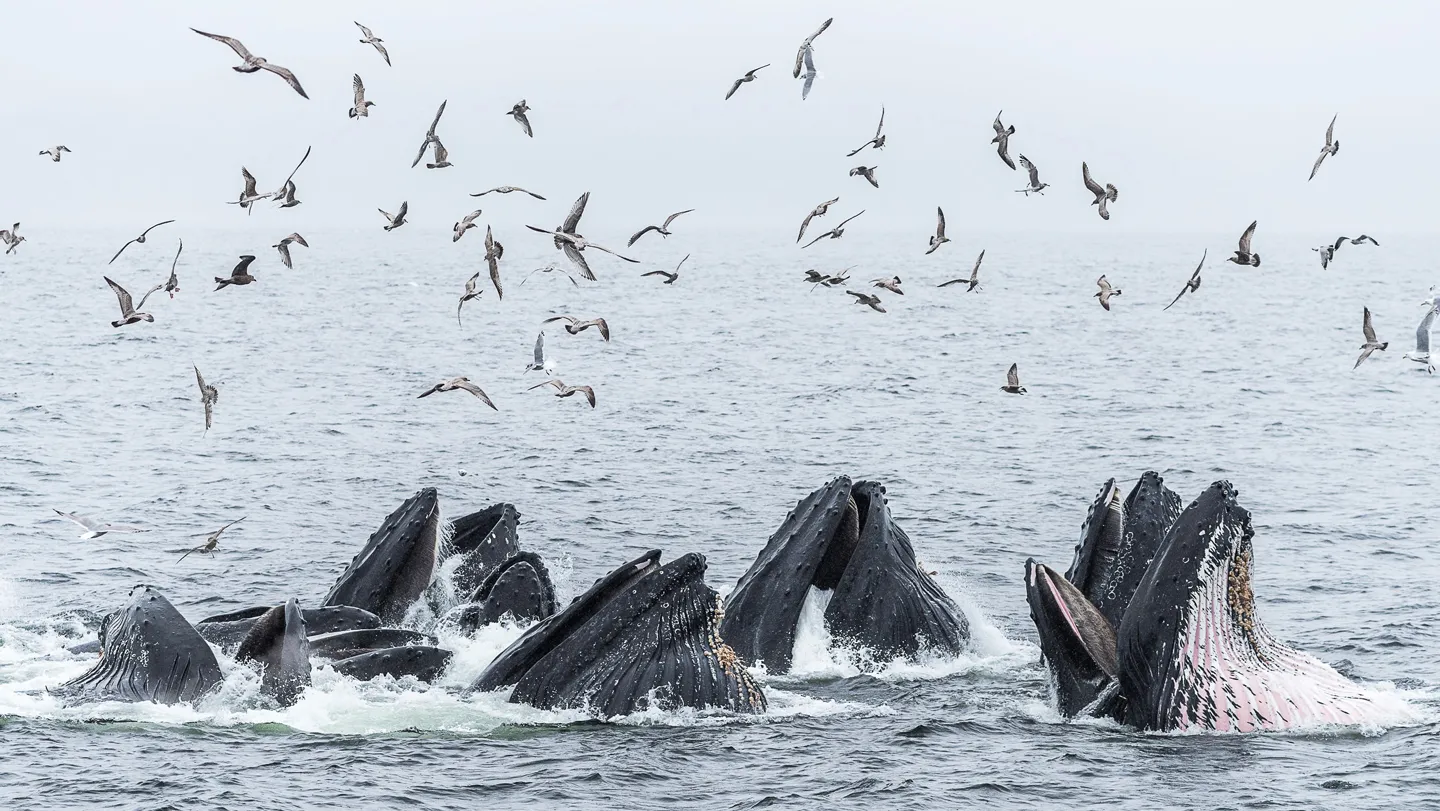
For one population of whales, teamwork makes teh dream work.
Decades after commercial whaling nearly drove them to extinction,a feeding behavior known as bubble netting is helping a group of humpback whales (Megaptera novaeangliae) in Canada recover. observational data collected over 20 years suggest a few key individuals are passing the knowledge through social networks, researchers report January 21 in Proceedings of the Royal Society B.
In the Kitimat Fjord System in northern British Columbia, humpback whale counts have been growing at a rate of 6 to 8 percent per year; the population now exceeds 500 individuals. Here, groups of up to sixteen humpbacks can now be spotted bubble netting as a team. Some of them swim in circles while blowing air through their blowholes, others vocalize. Below the water’s surface, entire shoals of herring get trapped in rings of bubbles, making it easy for the whales to lunge up to catch them.
“It gives me the chills. It’s one of the most astonishing things I’ve ever witnessed,” says Éadin O’Mahony, a marine mammal ecologist at the University of St. Andrews in Scotland.
Bubble netting had already been well-documented in Alaska by the time scientists started tracking it at the Kitimat Fjords in 2005, in collaboration with the Gitga’at First nation people, who continuously survey the population through Indigenous-led environmental stewarding programs.
Coauthor Nicole Robinson, a member of the Gitga’at First Nation who has been monitoring bubble netting for over a decade, says the whales come to the Kitimat Fjords to bubble net feed in “groups of regulars” starting around April or May each year. Whenever they dive, each individual whale follows a specific order within the group.
Sightings of bubble netting have increased steadily, and spiked when a heat wave struck the northern Pacific from 2014 to 2016. As fish and krill became scarce, the tactic proved strategic — through it, O’Mahony says, whales accessed more kinds of prey than they would have through lunging for it alone.
But it was unclear how the whales were learning the technique. “Is it individual invention or innovation over and over again, or are they socially bonded to each other and teaching each other?” O’mahony says.
Using nearly 7,500 photographs, the researchers built a map of the whales’ social interactions. Then they overlaid it with the order in which each individual started bubble netting. A statistical analysis let them predict how the behavior moved through the social groups.
The results hint that certain key individuals within the group taught the others how to bubble net. Canadian whales probably learned from Alaskan whales in Hawaii,where both populations breed,but there is no observation data to back that up yet,O’Mahony says.
Even so, the results show strong evidence of social learning, says Vanessa Pirotta, a whale scientist at Macquarie University in Sydney who was not involved with the study. She thinks feeding know-how is spreading similarly within the australian whale populations she studies.
“Whales may have to be more adaptable in their feeding methods, as they have to adapt to a changing environment,” Pirotta says.
Feeding strategies like bubble netting help whales adapt. If a boat strikes and kills one whale that can teach bubble netting, the whole population becomes less resilient as an inevitable result. This is why locations like the Kitimat Fjord System, where whales learn to feed from others, need to be targeted for conservation, O’Mahony says.
The gitga’at people have kept the ecosystem that the whales are a part of in balance for thousands of years, even when hunting the marine mammals for food, robinson says. the core of their Indigenous knowledge is to recognize shifts in food sources to harvest them sustainably. ultimately, it comes down to one value. “In my language we call it łoomsk: respect,” Robinson says. “Respect for our lands, respect for our waters, respect our elders, respect our children.”
Keep reading