
2026 Busan Mobility Show Opens with Hyundai Avante Premiere and Kia PBV Showcase
The 2026 Busan Mobility Show begins this week, featuring the world premiere of Hyundai Motor Company’s latest Avante model and a demonstration of Kia’s Purpose Built Vehicle (PBV) scalability. The event has expanded into a city-wide festival, integrating the Robot Expo and Big Tech Show to highlight the intersection of automotive technology, robotics, and digital infrastructure.
What are the primary automotive debuts at the 2026 Busan Mobility Show?
The central focus of this year’s exhibition is the world premiere of Hyundai Motor Company’s “The All New Avante.” While the Avante (known in many markets as the Elantra) has long been a staple of the compact sedan segment, this new iteration is expected to showcase the manufacturer’s latest advancements in software-defined vehicle (SDV) architecture and electrification.
Alongside Hyundai, Kia is utilizing the platform to demonstrate the scalability of its Purpose Built Vehicle (PBV) lineup. PBVs represent a shift away from traditional passenger cars toward modular platforms designed for specific use cases, such as last-mile delivery, ride-hailing, or mobile workspaces. Kia’s presentation aims to prove how these modular chassis can be adapted to meet diverse urban logistical needs through interchangeable body styles and specialized hardware.
Industry analysts note that the emphasis on PBVs and next-generation compact models reflects a broader industry transition. Rather than focusing solely on aesthetic design, manufacturers are prioritizing the underlying technology that allows vehicles to function as mobile nodes within a larger digital ecosystem.
How is Kia redefining urban transport through PBV technology?
Kia’s involvement in the Busan Mobility Show centers on the concept of “scalability.” Unlike standard automotive production, where a single chassis serves a fixed purpose, PBV technology allows for a “base-and-module” approach. This means the vehicle’s core components—such as the battery, motors, and steering—remain consistent, while the upper structure can be swapped to change the vehicle’s utility.
This scalability addresses several key challenges in modern urban planning:
- Logistics Efficiency: Modular cargo spaces that can be optimized for different package sizes.
- Urban Density: Smaller, highly maneuverable footprints for navigating crowded city centers.
- Operational Flexibility: The ability for fleet operators to switch a vehicle from a passenger shuttle to a delivery van within a single operational cycle.
The demonstration in Busan is intended to show how these vehicles can integrate with existing smart city infrastructures to optimize traffic flow and reduce energy consumption.
Why are the Robot Expo and Big Tech Show being held concurrently?
The 2026 Busan Mobility Show has moved beyond a traditional automotive exhibition by hosting the Robot Expo and Big Tech Show simultaneously. This convergence is designed to address the reality that future mobility is no longer just about the vehicle, but about the entire technological stack that supports movement.
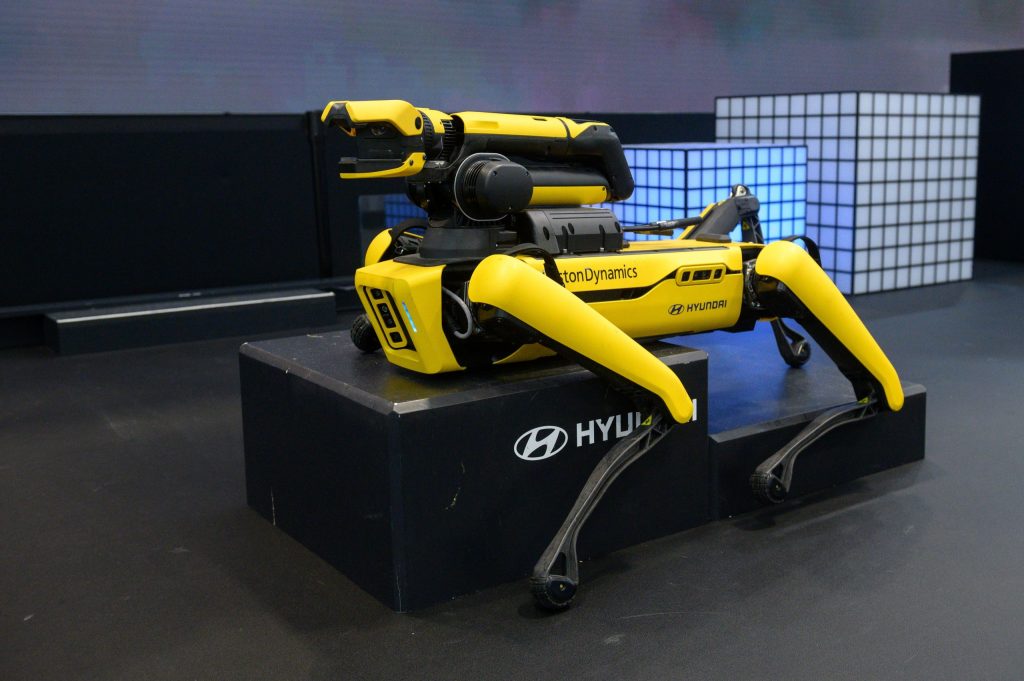
The Robot Expo focuses on the hardware aspect of this evolution, showcasing autonomous delivery bots, humanoid assistants, and automated manufacturing systems. These technologies are increasingly being integrated into the mobility sector, where robots may eventually handle everything from “last-meter” package delivery to automated vehicle maintenance.
The Big Tech Show complements this by focusing on the “brains” of the operation. This includes advancements in:
- Artificial Intelligence (AI): Powering autonomous driving algorithms and predictive maintenance.
- Connectivity (5G/6G): Ensuring seamless vehicle-to-everything (V2X) communication.
- Cybersecurity: Protecting the massive amounts of data generated by connected, autonomous fleets.
By grouping these sectors, organizers aim to provide a holistic view of how software, robotics, and automotive engineering are merging into a single “mobility-as-a-service” (MaaS) model.
How is Busan transforming the event into a city-wide festival?
In a departure from previous years, where the focus remained largely within the confines of the BEXCO exhibition center, the 2026 event has expanded into a city-wide festival. This expansion aims to increase public engagement and demonstrate how mobility innovations impact daily life in an urban environment.
The festival format includes various pop-up exhibits, test-drive zones in designated city districts, and interactive technology installations in public spaces. This approach allows residents and tourists to experience autonomous shuttles and robotic services in real-world settings, rather than observing them in a controlled showroom environment.
For the city of Busan, the mobility show serves as a strategic tool to bolster its reputation as a global hub for high-tech industry and smart city development. The integration of the event into the urban fabric is intended to showcase the practical benefits of smart infrastructure to a global audience.
Comparison of Key Exhibition Highlights
| Exhibitor/Event | Core Focus | Key Technology |
|---|---|---|
| Hyundai Motor Company | Compact Segment Evolution | The All New Avante (SDV Architecture) |
| Kia | Modular Utility | Purpose Built Vehicle (PBV) Scalability |
| Robot Expo | Autonomous Hardware | Delivery and Service Robotics |
| Big Tech Show | Digital Infrastructure | AI, V2X, and Connectivity |
Frequently Asked Questions
What makes the 2026 Busan Mobility Show different from previous years?
The 2026 edition is characterized by its expansion into a city-wide festival and the simultaneous hosting of the Robot Expo and Big Tech Show, moving the focus from traditional cars to an integrated mobility ecosystem.

What is a Purpose Built Vehicle (PBV)?
A PBV is a modular vehicle designed to be customized for specific tasks, such as delivery, passenger transport, or mobile offices, by changing its upper body while using a standardized chassis.
Which major car models are being debuted?
Hyundai Motor Company is conducting the world premiere of “The All New Avante” during the event.
Where can people experience these technologies?
While much of the exhibition is at BEXCO, the event includes city-wide festival elements and test-drive zones located throughout Busan.
The next scheduled update regarding official technical specifications for the new Hyundai Avante is expected to be released by the manufacturer following the conclusion of the opening ceremonies.
Do you think the shift toward modular PBVs will change how we think about car ownership? Let us know your thoughts in the comments below and share this article with your network.
Related reading