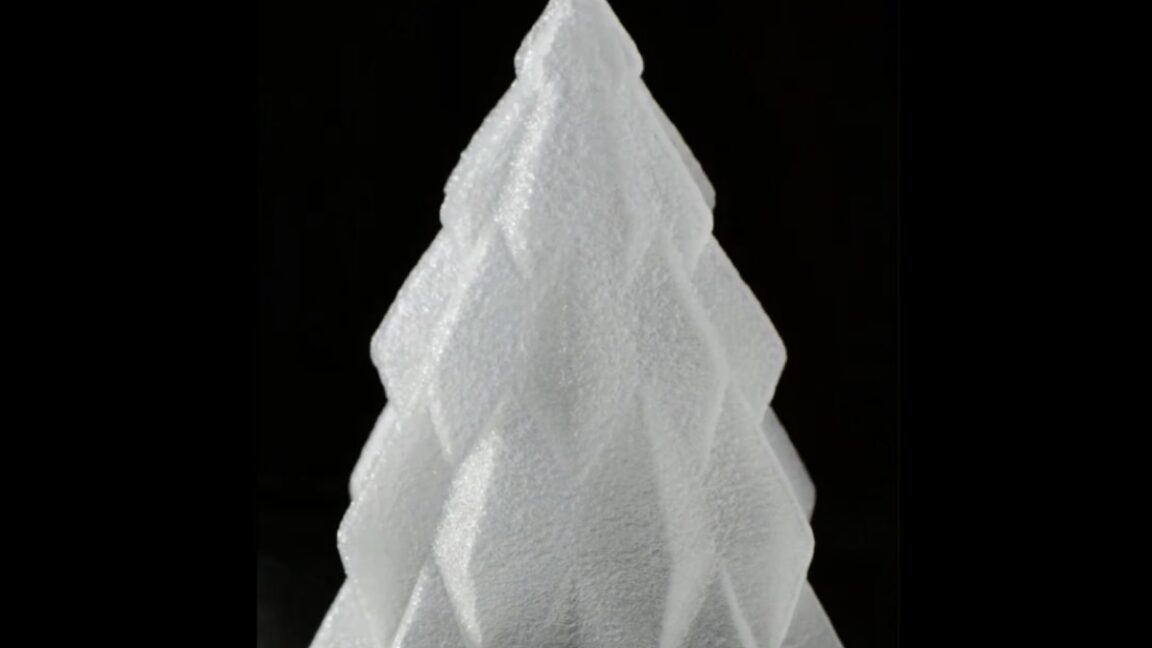
The Surprisingly Simple Science Behind a 3D-Printed Ice Christmas Tree
Imagine a miniature Christmas tree, perfectly formed from ice, sitting at room temperature – no freezer required. that’s exactly what physicists at the University of Amsterdam achieved, adn the science behind it is as interesting as the final product. This isn’t just a festive novelty; it’s a clever submission of a well-known principle: evaporative cooling.
From Coffee too Christmas Trees: Understanding Evaporative Cooling
Evaporative cooling isn’t some futuristic technology. You experience it daily. Think about how sweat cools your body. As moisture evaporates, it takes heat with it, lowering your skin temperature.
Here’s how it works in various scenarios:
* Your Morning Coffee: Notice how the steam rising from hot coffee carries heat away? That’s evaporative cooling in action. The hottest water molecules escape as steam, leaving the remaining coffee cooler.
* wine Tears: Those elegant ”legs” or “tears” that form in your wine glass aren’t just about alcohol content. Evaporative cooling, combined with other factors, plays a role in their formation.
* BBQ Pit Mastery: Ever heard of the “stall” in BBQ? It’s a common frustration for pit masters. As moisture evaporates from the meat, it cools the surface, halting the cooking process. Many pros combat this by wrapping the meat in foil.
* Cutting-Edge Physics: Evaporative cooling is even crucial in creating Bose-Einstein condensates – a state of matter where atoms behave as a single quantum entity.
A Novel Approach to 3D Printing with Ice
Conventional ice-printing methods rely on extremely cold temperatures, using cryogenics or chilled surfaces. But the team in Amsterdam took a different route. They pioneered a method using only evaporative cooling to 3D print a detailed, 8-centimeter tall Christmas tree.
Their breakthrough, detailed in a recent preprint on arXiv, centers around a unique setup:
- Vacuum Chamber: The 3D printing process takes place inside a vacuum chamber. This low-pressure surroundings is key to efficient evaporation.
- Jet Nozzle: A specialized jet nozzle acts as the printing head, precisely dispensing water.
- Layer-by-Layer Construction: The printer’s motion control guides the water jet, building the ice structure one layer at a time.
The finding was serendipitous. Researchers initially aimed to reduce air drag while spraying water in a vacuum. They realized the rapid evaporation and cooling effect could be harnessed for 3D printing. As the water is ejected into the vacuum, it instantly begins to evaporate, removing heat and freezing the droplets before they land.
Why This Matters: Beyond a Festive Decoration
This innovation isn’t just about creating cool Christmas ornaments.it demonstrates a perhaps low-cost and energy-efficient method for 3D printing with ice.This could have implications for:
* Temporary Structures: Imagine creating temporary ice sculptures or structures for events without the need for bulky refrigeration equipment.
* Scientific Research: The technique could be adapted for creating intricate ice structures for scientific experiments.
* Educational Demonstrations: It’s a fantastic visual exhibition of physics principles for students.
As the authors noted in a blog post for Nature, this method opens up exciting possibilities for exploring the boundaries of 3D printing with unconventional materials.
Evergreen Insights: The Power of Evaporative Cooling
Evaporative cooling is a basic principle with far-reaching applications. From ancient methods of preserving food to modern air conditioning systems, harnessing the power of evaporation has consistently provided innovative solutions. Understanding this process isn’t just about physics; it’s about recognizing how nature’s principles can inspire technological advancements. The Amsterdam team’s work exemplifies this beautifully, showcasing how a simple concept can lead to surprisingly complex and creative outcomes. Looking ahead,expect to see evaporative cooling playing an increasingly critically important role in sustainable technologies and materials science.
Frequently Asked Questions About 3D-Printed Ice and Evaporative cooling
Q: What is evaporative cooling, and how dose it work?
A: Evaporative cooling is the process where a liquid transitions to a gas, absorbing heat in the process and thus