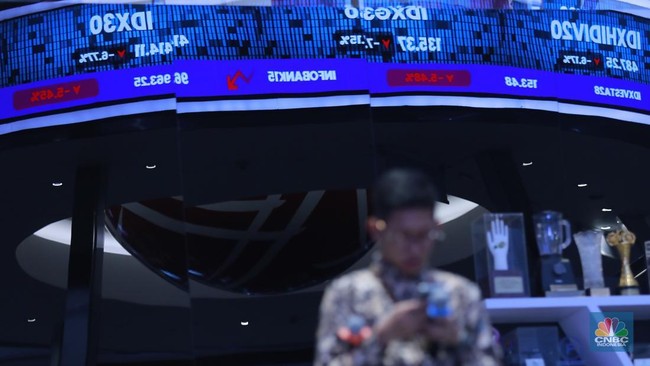
Indonesian Stocks Dip as Foreign Investors Sell, But Select Shares See Inflow
Jakarta – The Indonesian stock market experienced a downturn on Wednesday, March 11, 2026, reversing gains from the previous day. The benchmark Jakarta Composite Index (IHSG) closed down 0.69% at 7,389.40, reflecting a cautious market sentiment amid global economic uncertainties and approaching domestic holidays. The decline follows a period of positive momentum, highlighting the market’s sensitivity to both international events and local factors.
Wednesday’s trading saw a total transaction value of Rp15.72 trillion, with 32.20 billion shares changing hands across 1.85 million transactions. Market activity was mixed, with 312 stocks advancing, 366 declining, and 139 remaining unchanged. This indicates a degree of selective trading, as investors reassessed their portfolios in response to prevailing conditions. The IHSG opened higher at 7,484.77, compared to the previous day’s close of 7,440.91, before succumbing to selling pressure throughout the session, reaching a high of 7,527.32 and a low of 7,380.
Adding to the market’s complexity, foreign investors engaged in significant net selling, totaling Rp938.66 billion across all markets. This outflow was distributed between Rp730.31 billion in regular market transactions and Rp208.34 billion in negotiated and cash transactions. Net selling by foreign investors often signals concerns about the short-term outlook for Indonesian equities, though it doesn’t necessarily indicate a long-term negative trend. Although, despite the overall selling pressure, certain stocks attracted considerable foreign investment, suggesting targeted opportunities within the Indonesian market.
Foreign Investor Interest Concentrated in Key Sectors
While overall foreign outflows dominated Wednesday’s trading, a select group of ten stocks experienced substantial net buying from international investors, according to data from Stockbit. This indicates that despite broader market concerns, specific companies continue to hold appeal for foreign portfolios. The concentration of foreign buying in these stocks suggests a focus on companies with strong fundamentals, growth potential, or defensive characteristics.
- PT Telkom Indonesia (Persero) Tbk. (TLKM) – Rp160.54 billion: Telkom Indonesia, the country’s largest telecommunications provider, saw the largest net foreign buy, potentially driven by its stable revenue streams and expansion into digital services.
- PT Bank Mandiri (Persero) Tbk. (BMRI) – Rp39.65 billion: Bank Mandiri, one of Indonesia’s leading banks, attracted foreign investment likely due to its strong financial performance and exposure to the growing Indonesian economy.
- PT Indo Tambangraya Megah Tbk. (ITMG) – Rp30.90 billion: Indo Tambangraya Megah, a major coal producer, benefited from continued demand for coal, particularly from Asian markets.
- PT MD Entertainment Tbk. (FILM) – Rp22.65 billion: MD Entertainment, a prominent Indonesian entertainment company, saw increased foreign interest, potentially linked to the growth of the Indonesian media and entertainment industry.
- PT United Tractors Tbk. (UNTR) – Rp19.66 billion: United Tractors, a distributor of heavy equipment and mining services, experienced foreign inflows, possibly reflecting optimism about Indonesia’s infrastructure development and mining sector.
- PT Energi Mega Persada Tbk. (ENRG) – Rp19.16 billion: Energi Mega Persada, an energy company, saw foreign buying, potentially driven by expectations of increased energy demand.
- PT Bukit Asam Tbk. (PTBA) – Rp19.05 billion: Bukit Asam, a state-owned coal mining company, attracted foreign investment, likely due to its role in supplying coal to domestic power plants.
- PT Petrindo Jaya Kreasi Tbk. (CUAN) – Rp17.64 billion: Petrindo Jaya Kreasi, a relatively new player in the coal trading sector, saw significant foreign inflows, indicating investor confidence in its growth prospects.
- PT Barito Pacific Tbk. (BRPT) – Rp16.35 billion: Barito Pacific, a diversified conglomerate with interests in petrochemicals and energy, attracted foreign investment, potentially due to its long-term growth strategy.
- PT Astrindo Nusantara Infrastruktur Tbk. (BIPI) – Rp15.75 billion: Astrindo Nusantara Infrastruktur, an infrastructure company, experienced foreign inflows, likely driven by Indonesia’s ongoing infrastructure development projects.
Geopolitical Concerns and Holiday Preparations Weigh on Market Sentiment
The IHSG’s decline on Wednesday was attributed to a combination of factors, including rising geopolitical tensions in the Middle East and investor caution ahead of the upcoming Eid al-Fitr holiday. Ratna Lim, Head of Research at Phintraco Sekuritas, explained that investors are increasingly adopting a short-term trading strategy to secure their positions amidst heightened uncertainty. The escalating conflict between the United States and Israel with Iran, and the potential for military escalation in the Strait of Hormuz, are contributing to global market volatility.
According to Lim, investors are also bracing for the long Eid al-Fitr holiday, which is expected to begin in the middle of the following week. This often leads to reduced trading volumes and increased risk aversion as investors prefer to avoid holding positions during periods of potential market disruption. The combination of these factors created a challenging environment for the Indonesian stock market on Wednesday.
Sector performance reflected this cautious sentiment, with the energy sector experiencing the steepest decline, falling 1.69%. The raw materials and industrial sectors also saw significant losses, dropping 1.66% and 1.09%, respectively. However, the technology sector bucked the trend, gaining 1.06%, followed by the healthcare and property sectors, which rose 0.38% and 0.30%, respectively. This divergence suggests that certain sectors are perceived as more resilient to the prevailing headwinds.
Looking Ahead: Market Outlook and Key Considerations
The Indonesian stock market faces a complex outlook in the near term. Geopolitical risks remain elevated, and the Eid al-Fitr holiday is likely to continue to influence trading activity. Investors will be closely monitoring developments in the Middle East and assessing the potential impact on global energy prices and economic growth. Domestically, the focus will be on corporate earnings reports and government policies aimed at supporting economic recovery.
The selective foreign buying observed on Wednesday suggests that opportunities still exist within the Indonesian market, particularly in companies with strong fundamentals and growth potential. However, investors are advised to exercise caution and carefully assess their risk tolerance before making any investment decisions. Continued monitoring of global and domestic developments will be crucial for navigating the current market environment.
The next key economic indicator to watch will be the release of Indonesia’s inflation data for March, scheduled for early April. This data will provide further insights into the health of the Indonesian economy and could influence the Bank Indonesia’s monetary policy decisions. Investors will also be paying attention to any announcements regarding government stimulus measures or infrastructure projects, which could provide a boost to market sentiment.
What are your thoughts on the Indonesian market’s performance? Share your insights and opinions in the comments below. Don’t forget to share this article with your network to keep them informed about the latest market developments.
Related reading