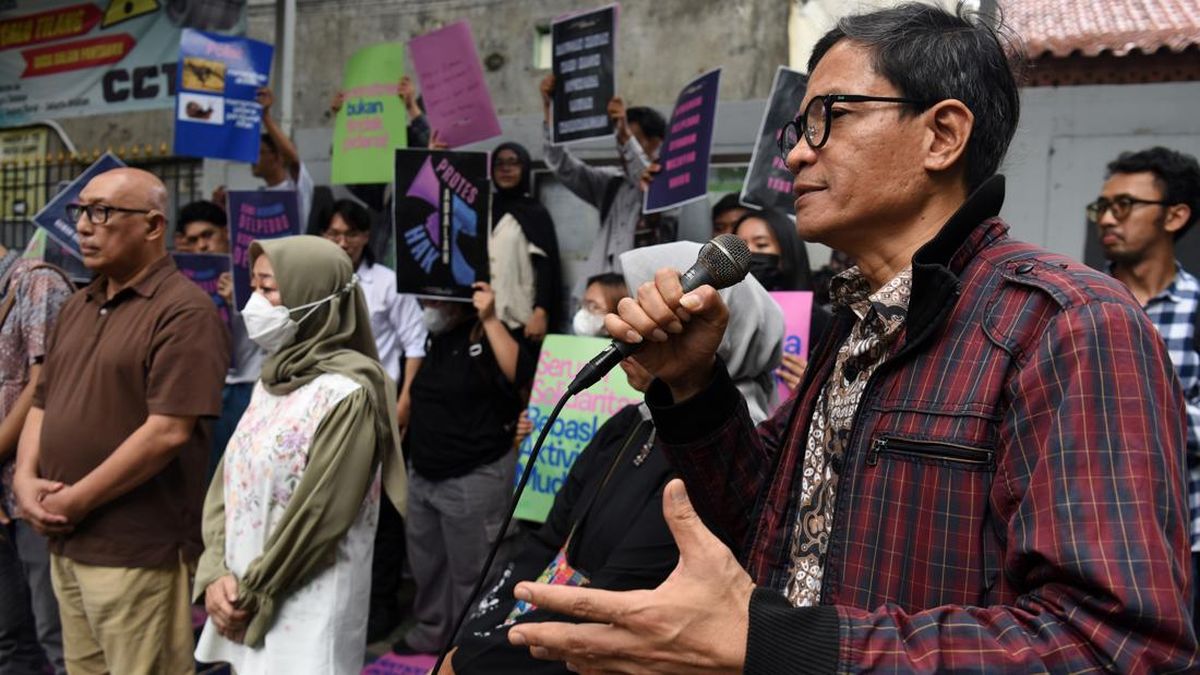
The Indonesian government is pushing back against a growing wave of public criticism, with Cabinet Secretary Teddy Indra Wijaya introducing a provocative new term to describe the current climate of political discourse: “inflasi pengamat,” or “observer inflation.” This phenomenon, according to Wijaya, refers to a surge in individuals offering opinions in the public sphere who lack the necessary professional expertise or accurate data to support their claims.
Speaking to the media at the Presidential Palace complex in Jakarta on Friday, April 10, 2026, Wijaya emphasized that whereas the administration remains open to constructive criticism, it expects such input to be rooted in verifiable facts. He argued that some of the prevailing opinions circulating among the public are not based on reality and have the potential to mislead the population CNBC Indonesia.
The Cabinet Secretary specifically highlighted discrepancies in the data provided by certain military and foreign affairs observers, stating that their information is often incorrect. To counter these narratives, Wijaya pointed to public sentiment as a primary metric of success, claiming that over 96 million citizens place their trust in President Prabowo, a figure he describes as “clear evidence of public trust” rather than a mere assumption CNBC Indonesia.
This tension between government rhetoric and public critique has sparked a wider debate over the boundaries of democratic expression in Indonesia. While the administration maintains that it does not close the door to criticism, the insistence that such critiques be “constructive” and not “cause unrest” suggests a narrowing window for dissent that the government deems destabilizing.
Defining ‘Observer Inflation’ and the Battle for Data
The term “inflasi pengamat” serves as a strategic rhetorical tool for the current administration to delegitimize critics by questioning their credentials. By framing the increase in public commentary as “inflation,” the government suggests that the “value” or reliability of public opinion has decreased due to the fact that It’s being produced by unqualified sources.
Secretary Teddy Indra Wijaya’s critique is centered on the gap between perceived narratives and official data. He asserted that some observers provide data that is “not in accordance with facts” and is “wrong,” particularly in the realms of military and international relations CNBC Indonesia. This approach shifts the debate from the substance of the criticism to the qualifications of the critic.
The government’s insistence on data-driven criticism comes at a time when the administration is managing various economic and energy policies. For instance, Wijaya was recently involved in a cross-ministerial coordination meeting led by Coordinating Minister for Economic Affairs Airlangga Hartarto regarding energy adjustment policies and other economic measures CNBC Indonesia.
Public Trust vs. Democratic Dissent
A central pillar of the government’s defense is the claim of overwhelming public support. By citing a figure of 96 million people who trust President Prabowo, the Cabinet Secretary is attempting to create a dichotomy between a “small group” of unqualified observers and a “massive majority” of the citizenry CNBC Indonesia.
However, this stance has raised questions about the administration’s tolerance for legitimate academic and activist critique. The government’s position is that while differences in opinion are a natural part of democracy, they must not lead to social unrest. This creates a complex tension: the government welcomes criticism in principle, but reserves the right to label it as “misleading” if it contradicts official narratives.
This discourse is particularly sensitive given the administration’s efforts to maintain a narrative of stability. Wijaya has previously dismissed claims that Indonesia is heading toward chaos, asserting that “there is no such thing” and that everything remains “under control” CNBC Indonesia.
Key Takeaways on the ‘Observer Inflation’ Debate
- Definition: “Inflasi Pengamat” refers to an increase in public commentators who the government claims lack professional expertise and accurate data.
- Government Stance: Open to criticism, provided it is constructive, data-based, and does not incite public unrest.
- The Trust Metric: The administration cites 96 million supporters of President Prabowo as evidence of high public confidence CNBC Indonesia.
- Targeted Critics: Specific mentions were made regarding observers in the military and foreign affairs sectors providing “wrong” data.
Broader Implications for Indonesian Governance
The focus on “observer inflation” suggests a government that is increasingly sensitive to how it is perceived by the intellectual and activist community. By framing the debate around “data and facts,” the administration positions itself as the sole arbiter of what constitutes a “fact,” potentially marginalizing qualitative critiques or systemic analyses that do not rely on the government’s own datasets.

This dynamic is further complicated by the government’s support for law enforcement actions. For example, Wijaya expressed support for the DKI Jakarta High Prosecutor’s Office (Kejati DKI) in conducting searches at the Ministry of Public Works, indicating that while the government is critical of “observers,” it remains active in internal institutional oversight CNBC Indonesia.
For the international community and global observers, this development highlights the delicate balance the Prabowo administration is striking between maintaining a strong, stable image and managing the expectations of a vibrant, often critical, democratic society. The insistence on “constructive” criticism may be seen as a way to streamline governance by reducing the noise of dissent, but it risks alienating the very academics and activists who provide essential checks and balances.
As the administration continues to implement its economic and energy policies, the tension between official data and observer analysis is likely to persist. The “observer inflation” narrative may serve as a template for how the government handles future criticisms across various sectors of policy and governance.
The government continues to monitor public sentiment and the impact of its policies on the general population. Further updates on energy adjustments and economic stability measures are expected to be released through official cabinet channels as the administration progresses with its current policy cycle.
World Today Journal encourages readers to share their perspectives on the balance between government stability and public critique in the comments section below.
Worth a look