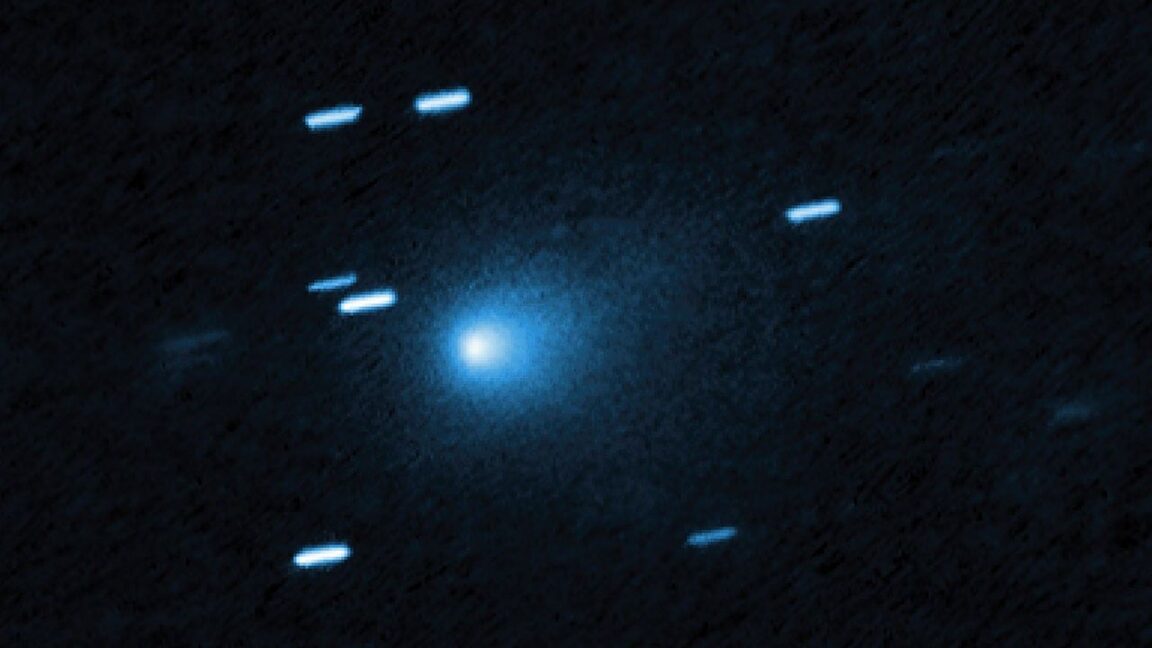
Unveiling 3I/ATLAS: A Comet From Beyond Our Solar System?
Have you ever wondered if comets originate solely from our own solar system? Recent observations of comet 3I/ATLAS are challenging that assumption, hinting at a possible interstellar origin – a relic from the early universe. This article dives deep into the fascinating discoveries surrounding 3I/ATLAS, exploring its unique composition, potential age, and what it reveals about the cosmos beyond our familiar planetary neighborhood.
A Comet Unlike Any Other: Initial Observations
comet 3I/ATLAS, discovered in early 2023, quickly captured the attention of astronomers. What sets it apart isn’t just its brightness,but how it behaves. Initial imaging revealed a significant release of material,appearing as dust grains streaming from the comet’s nucleus.
NASA’s lucy and Psyche missions proved invaluable in these observations. Positioned further from the Sun than 3I/ATLAS, these missions were able to capture backlit images of the comet’s coma - the hazy atmosphere surrounding the nucleus – providing crucial data.You can explore a stunning collection of these images on NASA’s dedicated webpage: https://science.nasa.gov/solar-system/comets/3i-atlas/comet-3i-atlas-image-gallery/.
Unusual Composition: A Clue to its Origins
While the amount of material ejected by 3I/ATLAS is comparable to other comets, its composition is strikingly different.Here’s what scientists have observed:
* High Carbon Dioxide Ratio: 3I/ATLAS releases a higher proportion of carbon dioxide compared to water than typical comets found within our solar system.
* Nickel-Rich Profile: Instead of the usual iron and nickel mix, this comet appears unusually rich in nickel.
These anomalies suggest a formation history distinct from the comets we’ve previously studied.Tom Statler,NASA’s lead scientist for Solar System bodies,emphasizes these details are key to understanding its origins.
Is 3I/ATLAS Older Than Our Solar System?
The most intriguing hypothesis surrounding 3I/ATLAS is its potential interstellar origin. The comet originates from the direction of the galactic core, and there’s no evidence of recent close encounters with other stars. This leads to a remarkable possibility:
3I/ATLAS could be an ancient object, predating our solar system. It may have formed around a star that existed relatively early in the universe’s history, a time when fewer heavy elements were available. This scarcity of heavy elements could explain the unusual composition observed.
Planetary Defense & Interstellar Discovery: A Fortuitous Connection
Interestingly, our ability to quickly identify and characterize 3I/ATLAS is a direct result of planetary defense initiatives. Systems designed to detect potentially Earth-threatening objects also excel at spotting and tracking interstellar visitors.
As automated surveys continue to expand, we can expect to discover more of these interstellar objects, gradually building a more comprehensive understanding of what lies beyond our solar system. This is a rapidly evolving field, and the initial findings surrounding 3I/ATLAS are subject to ongoing analysis and peer review.
What Does This Mean for Our Understanding of the Universe?
the study of 3I/ATLAS offers a unique window into the early universe.By analyzing its composition and trajectory, scientists hope to:
* Refine models of star and planet formation.
* Gain insights into the distribution of materials in the galaxy.
* Understand the conditions present in the early universe.
want to stay updated on the latest discoveries about 3I/ATLAS and other interstellar objects? Follow NASA’s Solar System Exploration website: https://science.nasa.gov/solar-system/
Evergreen insights: The Significance of Interstellar Objects
The discovery of interstellar objects like 3I/ATLAS represents a paradigm shift in our understanding of the cosmos. For decades, we’ve focused primarily on studying objects within our solar system. Now, we’re realizing that our solar system is just a small part of a much larger, more dynamic universe.
These interstellar visitors aren’t just curiosities; they’
Keep reading