
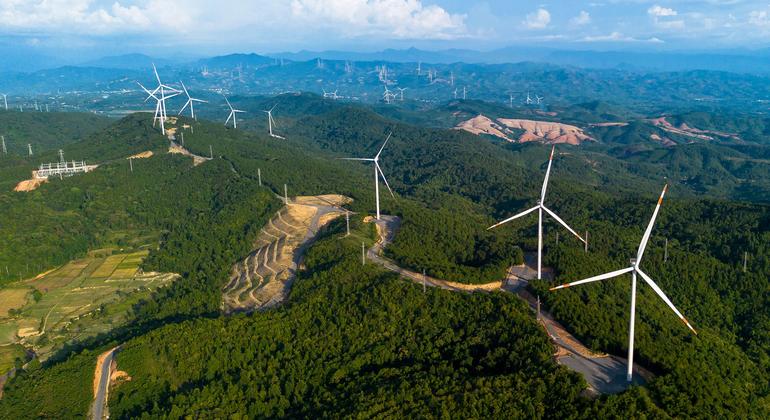
As global energy markets remain volatile and the price of oil high due to instability and conflict in the Middle East, more countries are looking at investing in renewables to shield their economies from the shocks caused by fossil fuel reliance, rein in import bills – and meet key climate action targets.
The ongoing instability in the Middle East has intensified pressure on global energy supplies, particularly affecting nations dependent on imported oil and gas. With Brent crude prices fluctuating above $90 per barrel in early 2026 amid supply concerns, governments from Southeast Asia to Latin America are accelerating plans to expand solar, wind, and hydroelectric capacity as a strategic hedge against geopolitical risk.
This shift reflects a broader recalibration of energy policy where energy security and climate resilience are increasingly seen as interconnected goals. Rather than viewing renewable adoption solely through an environmental lens, policymakers now emphasize its role in reducing vulnerability to external supply shocks and volatile commodity markets.
According to analysis from the International Institute for Energy Economics and Financial Analysis (IEEFA), the current Middle East conflict represents the second major disruption to global energy markets in less than four years, following the 2022 Russian invasion of Ukraine. IEEFA notes that such recurring shocks are prompting a structural shift in how countries approach energy planning, with greater emphasis on domestic renewable generation and grid modernization.
IEEFA’s crisis response portal provides updated data showing that oil-importing economies in South Asia and Africa have experienced heightened current account pressures due to elevated fuel import costs, reinforcing the economic case for renewable investment as a means of improving trade balances.
The International Monetary Fund (IMF) has also highlighted the uneven impact of the crisis, noting that while energy-exporting nations may benefit from higher prices, importing countries — particularly those with limited fiscal space — face intensified balance-of-payments strain. In its March 2026 blog post, the IMF observed that the shock is “global yet asymmetric,” with poorer nations disproportionately affected by rising energy costs despite contributing minimally to global emissions.
The IMF’s analysis underscores that fiscal buffers in many developing economies have been eroded by successive crises, leaving less room to absorb energy price spikes without cutting essential services or increasing debt burdens.
In response, several governments have introduced or expanded incentives for renewable deployment. India, for example, announced in February 2026 an additional $8 billion allocation under its Production Linked Incentive (PLI) scheme for solar module manufacturing, aiming to reduce reliance on imported photovoltaic components. Similarly, Brazil’s Ministry of Mines and Energy reported a 40% year-on-year increase in distributed solar installations in 2025, driven by residential and commercial consumers seeking to avoid volatile grid electricity prices.
These trends are supported by falling technology costs. The levelized cost of electricity (LCOE) for utility-scale solar has declined by nearly 90% since 2010, according to the International Renewable Energy Agency (IRENA), making it the cheapest source of new power generation in most of the world. Onshore wind costs have fallen by over 60% in the same period, further enhancing the economic competitiveness of renewables even without subsidies.
Beyond cost, energy independence is becoming a central motivator. Countries like Vietnam and Bangladesh have cited reducing fossil fuel import dependence as a key driver in their updated national power development plans. Vietnam’s 10-year power plan, revised in late 2025, targets 30% renewable electricity by 2030, up from 20% in the previous version, with specific attention to grid integration and battery storage to manage intermittency.
Industry observers at CERAWeek 2026 noted that geopolitical instability is increasingly being factored into corporate investment decisions, with energy firms and industrial consumers alike pursuing power purchase agreements (PPAs) for renewable energy to lock in long-term prices and avoid exposure to spot market volatility.
Reuters reported from CERAWeek that executives from major energy-intensive industries described renewable PPAs not only as sustainability tools but as risk management instruments, particularly in regions where grid reliability is compromised by fuel supply uncertainties.
Financing mechanisms are also evolving to support this transition. Multilateral development banks, including the Asian Development Bank and the Inter-American Development Bank, have expanded blended finance instruments that combine concessional loans with private capital to de-risk renewable projects in emerging markets. These facilities often include technical assistance for grid integration and regulatory reform, addressing non-financial barriers to deployment.
Still, challenges remain. Grid infrastructure in many countries was designed for centralized fossil fuel plants and requires significant upgrades to handle distributed and variable renewable generation. Permitting delays, land acquisition complexities, and policy uncertainty continue to slow project timelines in some regions, despite strong economic fundamentals.
Nonetheless, the directional trend is clear: energy insecurity is acting as a catalyst for faster renewable adoption. What began as a climate-driven agenda is now being reinforced by hard economic and strategic imperatives. For nations seeking to build resilience in an unpredictable world, investing in domestic renewable capacity is increasingly seen not as a cost, but as a form of insurance.
The next key checkpoint in this evolving landscape will be the release of the International Energy Agency’s (IEA) World Energy Outlook 2026, scheduled for October 2026. This report is expected to provide updated projections on global investment trends, policy impacts, and technology trajectories under various geopolitical and climate scenarios.
As nations navigate the dual pressures of market volatility and climate commitment, the role of renewables as both a stabilizing force and a long-term solution continues to gain traction across continents and economies.
We welcome your thoughts on how energy security is shaping renewable energy strategies in your country or community. Share your insights in the comments below, and help spread informed discussion by sharing this article with others who follow global energy developments.