Scott Peterson
2026-01-24 19:48:00
The way Iranian state television journalist Fatemeh Faramarzi describes it, the violence she witnessed at the peak of Iran’s latest street protests – including her face being sprayed with shotgun pellets – could only have been carried out by “terrorists” guided by foreign hands.
She was speaking to the IRIB channel’s prime-time “Eyewitness” program. It was created – after a lethal crackdown reportedly left thousands of Iranian citizens dead – to help shape the official narrative that Iran’s security forces were not to blame for the bloodshed, but were instead instrumental in stopping it.
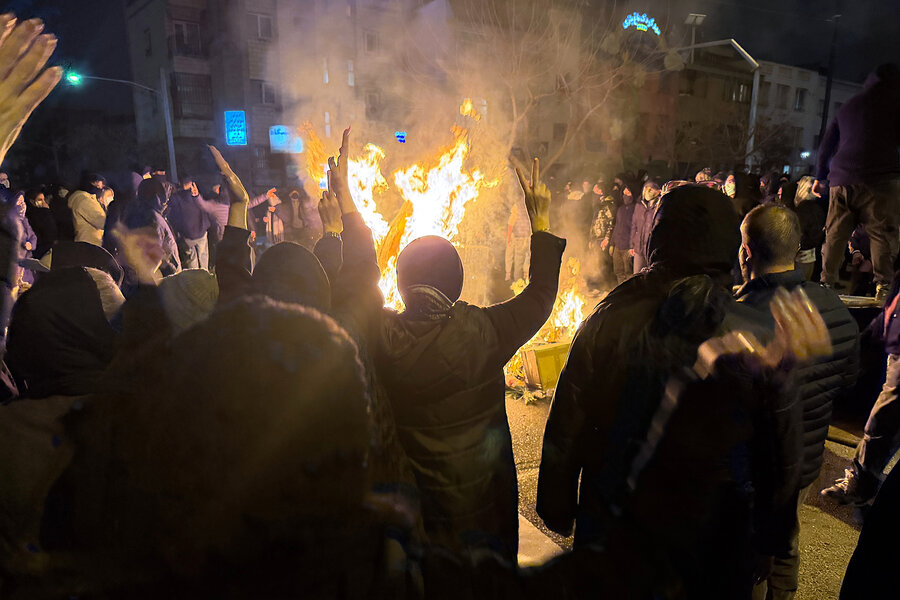
Beginning in late December, hundreds of thousands of Iranians demonstrated throughout the country. The protests, which were triggered by economic grievances, turned into vehicles for anti-regime anger.
Why We Wrote This
Feeling threatened, Iran’s leaders deployed unprecedented brutality to suppress the latest protests. Now, amid an internet blackout, the regime is blaming outside “agents” and “terrorists” for the death toll. Says one rights lawyer, such “denial and distortion” has been heard before.
Ms. Faramarzi described the burning of buses, a medical center, and a mosque in Tehran.
“The person who attacked and was right in front of my eyes was obviously a terrorist who had been trained to do the job and intended to kill me,” she said. Her injuries appeared similar to many in images posted by protesters from the crackdown on Jan. 8-9.
The “Eyewitness” program is one facet of a broad effort by Iran’s embattled leaders to create an alternative narrative, analysts say. It portrays legitimate street protests as having been hijacked by armed agents of the United States and Israel bent on boosting the death toll – and hastening the regime’s collapse.
The program now broadcasts daily on state TV, while an internet blackout continues to throttle other news sources.
Yet, a more accurate picture emerging from Iran – based on videos, and the voices of victims and their families – is of a ruling elite that deployed unprecedented brutality to suppress, for now, the most significant threat to the Islamic Republic in its 47 years.
“Long-standing pattern”
There is a “long-standing pattern of airing false statements and forced, torture-tainted confessions to blame killings and injuries on non-state actors,” says Raha Bahreini, a human rights lawyer and Iran researcher for Amnesty International, contacted in Geneva.
“This is completely contradictory to a mountain of evidence including eyewitness accounts, and dozens of verified videos, geolocated and chronolocated, that show security forces were the only forces bearing firearms, shooting into crowds, and relentlessly firing at unarmed protesters and bystanders,” says Ms. Bahreini.
The latest crackdown by Iranian authorities has been “far more shocking” than previous rounds of nationwide protests in 2017, 2019, and 2022, she says, and should prompt the United Nations’ referral of Iran to the International Criminal Court for crimes under international law.
Iranian officials have declared more than 3,000 people dead, which they blame on “terrorists.” Iran’s supreme leader, Ayatollah Ali Khamenei, on Tuesday blamed U.S. President Donald Trump – whose social media posts encouraged Iranian protesters, and promised to come to their “rescue” – for the “thousands” killed by “enemy agents.”
The U.S.-based Human Rights Activists News Agency, which has collated accurate data in the past, on Friday reported 5,002 confirmed deaths, with 9,787 others “still under investigation.” Officials say more than 100 security force members also died.
“The narrative of denial and distortion that they are promoting is very similar to the narrative we have heard from them for years now,” says Ms. Bahreini, noting that Iran has often deployed armed officers in plainclothes alongside uniformed units.
Security forces have been “dumping” victims at morgues “in the most undignified way … and [are pressuring] families to conduct burials in the dark,” she says. “These patterns of persecution, harassment, and intimidation against families are clear indications – along with the internet shutdown – that the state again wants to cover up its crimes.”
In a statement on Friday, Amnesty International described a “suffocating militarization” now prevailing in Iran, with armed patrols, curfews, and a ban on gatherings.
American and Israeli statements
Still, Iran’s security organs have advanced their narrative by using public comments made by Mr. Trump and Israeli officials, who explicitly stated that Israel’s Mossad intelligence service was active in Iran.
The day after protests began on Dec. 28, for example, Mossad posted on its Persian-language X account: “Let’s come out to the streets together. The time has come. We are with you. Not just from afar and verbally. We are with you in the field as well.”
Iranian officials now refer to the protests as the “13th day” of war, an extension to the 12-day bombing campaign last June by Israel, which assassinated Iran’s top military commanders and struck its missile capacity, and was joined by the United States, which targeted Iran’s nuclear program. The war followed several exchanges of ground- and air-launched missiles between Israel and Iran and its allies resulting from Israel’s war with Hamas in Gaza.
The intelligence arm of Iran’s Islamic Revolutionary Guard Corps (IRGC) announced on Friday it had achieved victory over the “American-Zionist sedition” by dismantling an “enemy command room composed of 10 hostile intelligence services.”
Seized documents, it said, described an operation based on “three pillars” – internal unrest, military intervention, and activation of groups – that aimed to “create an existential threat.”
Among blindfolded prisoners interviewed on state TV, which has broadcast coerced confessions in the past, was a man who said he joined a Mossad social media channel and was offered “whopping amounts of money.”
“I shared photos of a certain [security] location. I was asked whether I have shooting skills. I also learned how to make explosives,” said the man, identified only as “Mossad’s hand in Kermanshah.” He said he was caught before he could fulfill plans to distribute weapons.
Iran’s hard-line chief justice, Gholam-Hossein Mohseni Ejei, said on Wednesday that those who killed, set fires, caused “moral damage, and poured water into the enemy’s mill,” would face national security charges.

Though Mr. Trump backed off promises to “rescue” Iranian protesters and “hit very hard” if any were killed, U.S. military forces are now building in the region. The USS Abraham Lincoln carrier strike group will arrive from Asian waters within days.
“We have a lot of ships going that direction, just in case,” Mr. Trump said on Thursday. “I’d rather not see anything happen, but we’re watching them very closely.”
Maintaining unity
“The key question is how long the regime leadership can remain unified, prevent defections within the security services, and continue relying on extreme violence against the population,” says Ali Alfoneh, a senior fellow at the Arab Gulf States Institute in Washington.
A de facto collective leadership has emerged to manage day-to-day affairs, he says, “in the absence of effective leadership” by the 86-year-old ayatollah. It includes the president, speaker of Parliament, judiciary chief, and representatives of the IRGC and the army.
“The regime’s collective leadership, rather than Khamenei, has already changed the playbook of violence,” says Mr. Alfoneh, author of “Political Succession in the Islamic Republic of Iran.”
The group “is clearly aware of the risk of security service defections in the event of renewed protests,” he adds, and might seek an accommodation with the U.S. to bring sanctions relief, improve the economy, “and secure the regime’s long-term survival.”
Claims made about a Mossad presence, U.S. support, and thousands of Starlink satellite internet units smuggled into Iran do not add up to Israel or the U.S. “instigating the protests” as claimed by Iranian officials, he says.
“Rather, Israel and the U.S. took advantage of preexisting opposition to the Islamic Republic within Iran for their own purposes,” says Mr. Alfoneh.
And there is no shortage of such opposition inside Iran, with state failures leading to “severe polarization, mutual dehumanization, and the lack of a platform for dialogue,” said Ahmad Zeidabadi, a journalist at the reformist newspaper Ham-Mihan, in a video on Thursday.
The newspaper was closed after publishing one story about security forces raiding a hospital, and another about the severity of the crackdown.
Among contradictions in the official narrative, Mr. Zeidabadi noted: “If there is truth in all the claims about Mossad infiltration, and people having gone abroad to get trained and all that, then what have you been doing this whole time, while you claimed absolute dominance and intelligence superiority after the [12-day] war?”
An Iranian researcher contributed to this report.