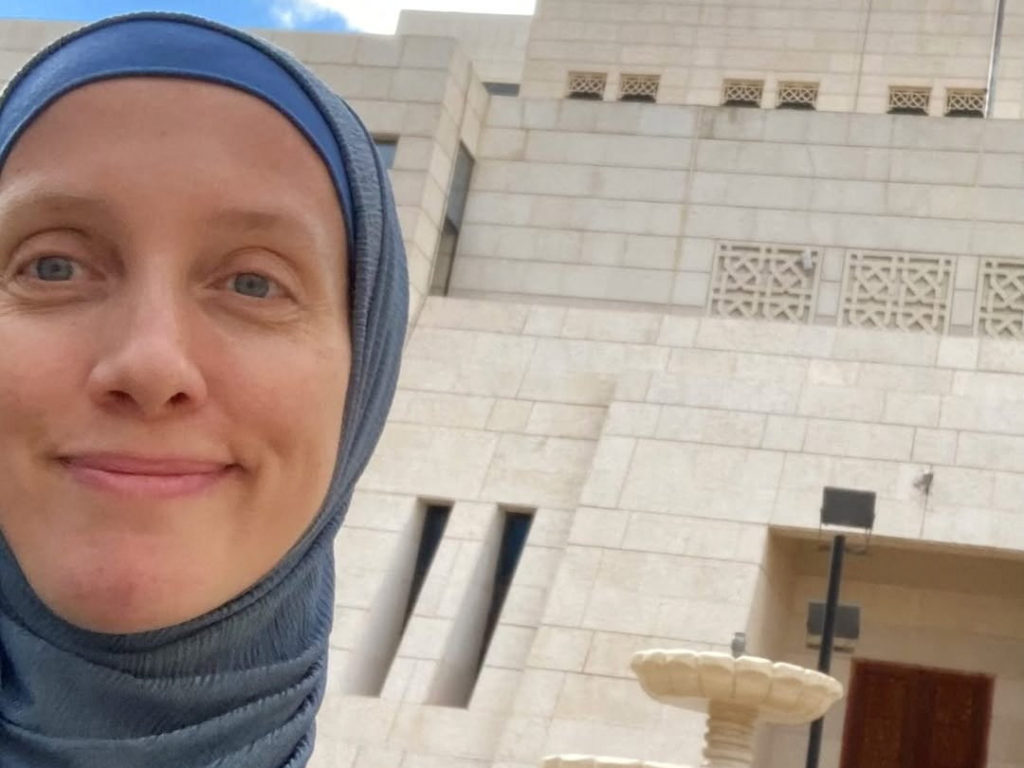
The tension surrounding the detention of an American citizen in Baghdad has eased following the announcement that US journalist Shelly Kittleson released from the custody of an Iran-aligned armed group. The release comes after weeks of uncertainty and regional volatility, with the group responsible for her abduction setting a strict condition for her freedom.
Kata’ib Hezbollah, a powerful Iraqi paramilitary organization, confirmed in a statement that the journalist would be freed on the condition that she departs from Iraq immediately. Kittleson had been abducted in Baghdad in late March 2025, sparking international concern and prompting Iraqi authorities to launch searches for her whereabouts according to reports.
The announcement of her release is unfolding against a backdrop of severe geopolitical friction in the Middle East, characterized by escalating threats between Iran and the United States and maritime warnings issued by Israel near Lebanese waters. The decision to release Kittleson is viewed by some as a tactical move amid these shifting regional dynamics.
The Terms of Release and the Baghdad Abduction
The release of the American journalist was formally announced by Abu Mujahid al-Assaf, a security official within Kata’ib Hezbollah. In his statement, al-Assaf characterized the decision as a recognition of the “national stances of the outgoing prime minister.” He further described the journalist as an “American defendant,” emphasizing that her freedom was contingent upon her immediate exit from the country as reported by Reuters.

Kittleson’s abduction in late March 2025 added a layer of diplomatic complexity to the already strained US-Iraq relationship. For several weeks, Iraqi officials had stated that top-level searches were underway to locate her, though the involvement of a non-state actor with deep ties to Tehran often complicates such recovery efforts.
The requirement for Kittleson to leave Iraq immediately highlights the precarious nature of the agreement. Such conditions are common in high-stakes releases involving non-state militias, often serving as a means for the group to signal its control over foreign nationals within its areas of influence.
Understanding Kata’ib Hezbollah’s Influence in Iraq
To understand the significance of this event, it is necessary to examine the entity that held Kittleson. Kata’ib Hezbollah is described by researchers as the “premier militia in Iraq,” operating under the direct command of Iran via the Washington Institute for Near East Policy. The group is a dominant force within the Popular Mobilization Forces (PMF), an umbrella organization founded in 2014 to combat the advance of ISIL (ISIS).
The organization is driven by an ideology of Shia Islamism and Khomeinism, adhering to the principle of Velayat-e Faqih. Its motivations are rooted in anti-Americanism, anti-Zionism, and a strong alignment with the Islamic Revolutionary Guard Corps (IRGC) of Iran according to Wikipedia. This ideological framework makes the group a central player in the “Axis of Resistance,” a network of state and non-state actors aligned with Tehran.
Currently led by Ahmad al-Hamidawi, Kata’ib Hezbollah maintains significant control over key departments within the PMF. Its operational reach extends across Baghdad, Southern Iraq, and Western Iraq, allowing it to exert influence over both security and political spheres within the country.
A Climate of Escalation: The “Total War” Warning
The release of Shelly Kittleson occurs at a time when Kata’ib Hezbollah has been issuing aggressive warnings toward Western powers. On January 26, 2026, the group’s chief, Abu Hussein al-Hamidawi, warned of a “total war” should Iran be attacked according to Al Jazeera.
Al-Hamidawi’s statement was a direct response to the United States amassing military assets in the region. He called upon fighters to prepare for conflict, describing Iran as the “fortress and pride” of Muslims and claiming that any war against the Islamic Republic would not be a “walk in the park” as reported by Al Jazeera.
This rhetoric underscores the volatility that journalists and diplomats face when operating in Iraq. While regional allies of Iran did not intervene during US and Israeli attacks on Iran in June of the previous year, al-Hamidawi has recently emphasized the “necessity of supporting it from the forces of the axis,” suggesting a more proactive military stance in the event of future escalations.
Key Contextual Summary
| Event/Entity | Detail/Date | Significance |
|---|---|---|
| Abduction of Shelly Kittleson | Late March 2025 | Increased diplomatic tension between US and Iraq. |
| “Total War” Warning | January 26, 2026 | Kata’ib Hezbollah signals military support for Iran. |
| Release Condition | Immediate Departure | Requirement for Kittleson to exit Iraq immediately. |
| Kata’ib Hezbollah Affiliation | Iran (IRGC) | Premier Iraqi militia within the PMF. |
Implications for Regional Security and Journalism
The abduction and subsequent release of a US journalist by a militia with ties to a foreign power highlight the severe security risks currently facing international media professionals in the Middle East. The use of journalists as leverage in broader geopolitical disputes is a recurring concern for global press freedom organizations.
The involvement of the Popular Mobilization Forces (PMF) and their internal factions, like Kata’ib Hezbollah, demonstrates the fragmented nature of Iraqi security. While the official Iraqi government may seek to maintain diplomatic ties with the US, the presence of autonomous, Iran-backed groups capable of abducting foreign nationals creates a volatile environment where official government assurances may not always align with the reality on the ground.
the timing of this release—amid maritime warnings in Lebanon and US military movements—suggests that the “Axis of Resistance” may be managing its external optics while maintaining a high state of combat readiness. The mention of the “national stances of the outgoing prime minister” by Abu Mujahid al-Assaf further indicates that internal Iraqi political transitions are inextricably linked to these security decisions.
As the region continues to navigate the tensions between the US, Iran, and Israel, the safety of foreign nationals in Iraq remains precarious. The case of Shelly Kittleson serves as a stark reminder of the influence wielded by non-state actors who operate with a level of autonomy that often challenges the sovereignty of the state they reside in.
The next confirmed checkpoint for regional observers will be the official confirmation of Kittleson’s departure from Iraqi territory and any further diplomatic responses from the US State Department regarding the conduct of the PMF factions.
We invite our readers to share their perspectives on the security of international journalists in conflict zones in the comments section below.