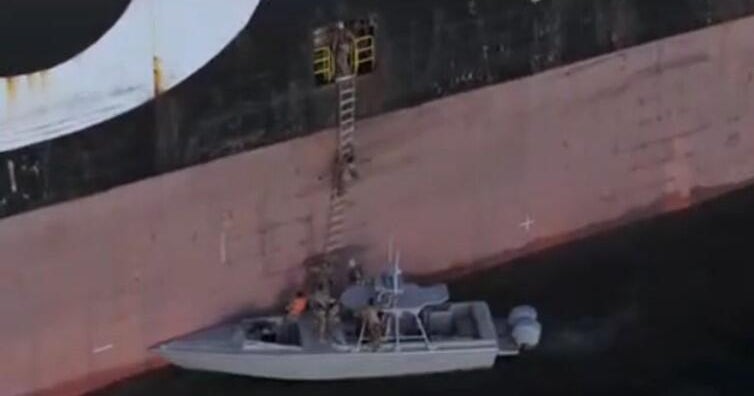
Iran has released a video showing its commandos seizing commercial vessels in the Strait of Hormuz, coinciding with a period of heightened tension and limited public comment from U.S. President Donald Trump regarding his next steps in the ongoing standoff. The footage, disseminated by Iranian state media, depicts Islamic Revolutionary Guard Corps (IRGC) forces boarding and detaining ships in the vital waterway through which approximately one-fifth of the world’s oil supply typically passes.
The video release comes amid conflicting signals about the status of maritime traffic in the strait. Whereas both the U.S. And Iran have at times declared the passage “completely open,” commercial shipping has remained significantly disrupted since the U.S.-Iran conflict escalated in late February 2026. Iran’s foreign minister previously announced that, in line with a ceasefire in Lebanon, the strait was open for commercial vessels on a coordinated route, though major caveats were noted by analysts regarding actual traffic resumption.
President Trump, for his part, has maintained a firm public stance on U.S. Control of the waterway. In a recent Truth Social post, he stated that he had ordered the U.S. Navy “to shoot and kill any boat” laying mines in the Strait of Hormuz and emphasized that “no ship can enter or depart without the approval of the United States Navy.” He further asserted that the U.S. Had “total control” of the strait, describing it as “Sealed up Tight” until Iran agrees to a deal.
The IRGC has justified the seizures by stating that the detained vessels were operating without required authorization and manipulating navigation systems. Iranian authorities identified two container ships, the MSC Francesca and the Epaminondas, as having been taken to Iranian ports, with a third vessel, the Euphoria, reported as having come under attack and being stranded off the Iranian coast. Tehran warned that disrupting order and safety in the strait is considered a “red line.”
These developments occur within the broader context of a U.S.-imposed naval blockade on Iranian ports, which U.S. Central Command said had directed 31 ships to turn around or return to port as part of efforts to pressure Tehran into negotiations. The blockade remains in place despite intermittent ceasefire declarations, with Trump having unilaterally extended a ceasefire earlier in the week pending a “unified plan” from Iran’s leadership.
Analysts note that the Strait of Hormuz remains a critical chokepoint for global energy markets, and any disruption risks significant volatility in oil prices. The recent video release by Iran appears intended to demonstrate its continued ability to enforce its interpretation of maritime rules in the waterway, even as diplomatic efforts to de-escalate the conflict appear stalled.
The next confirmed diplomatic checkpoint involves potential negotiations in Islamabad, which Pakistani sources indicated were set to take place within 36 to 72 hours following Trump’s ceasefire extension announcement, though Tehran has yet to show willingness to engage in further talks as of the latest reports.
For ongoing developments in this strategically vital region, readers are encouraged to follow updates from authoritative sources including the U.S. Central Command, Iran’s Ministry of Foreign Affairs, and international maritime monitoring agencies.
Share your thoughts on this evolving situation in the comments below, and help spread awareness by sharing this article with your network.