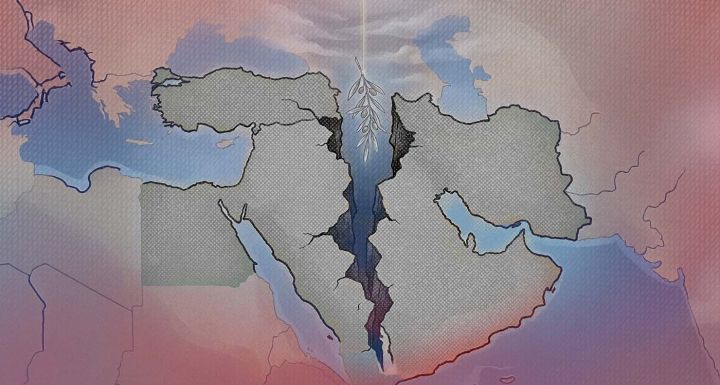
BEIRUT — The streets of Lebanon’s capital have long been a stage for the world’s geopolitical dramas, but in recent months, whispers of a fragile truce in one of the Middle East’s most intractable conflicts have begun to circulate. Diplomats, analysts, and even former adversaries are cautiously asking the same question: Could Lebanon’s proximity to Iran—and its own deep entanglement in regional power struggles—finally offer a blueprint for ending wars that have defied resolution for decades?
At the heart of this speculation lies Iran’s Islamic Republic, a regime that has spent years mastering the art of proxy warfare, funneling support to militant groups like Hezbollah while navigating its own domestic crises. Yet, as internal dissent grows and international sanctions tighten, some observers argue that Iran’s systemic vulnerabilities may force a reckoning—not just for Tehran, but for the broader Middle Eastern order. The question is whether this moment of flux could unlock negotiations where decades of confrontation have failed.
Dr. Helena Fischer, Editor of Health at World Today Journal, has spent years analyzing the intersection of public health and conflict resolution. In a region where healthcare systems often mirror the fractures of war—with hospitals bombed, medicines diverted, and populations caught between ideologies—she sees a parallel: the human cost of stalemate is too high to ignore. “Wars don’t end because leaders want them to,” she notes. “They end when the systems propping them up collapse under their own weight.” For Lebanon, Iran, and beyond, that weight may finally be showing.
From Proxy Wars to the Negotiating Table: Can Lebanon’s Position Force Change?
Lebanon’s geopolitical tightrope has never been more precarious. As Hezbollah—backed by Iran—continues its military buildup along the Israel-Lebanon border, the country’s fragile government teeters on the brink of collapse. Yet, paradoxically, this instability may create an opening for dialogue. Analysts point to three key factors:
- Economic despair: Lebanon’s currency has lost over 99% of its value since 2019, and Iran’s own inflation crisis has reached 50% annually, eroding the ability of both regimes to sustain prolonged conflicts. The IMF’s latest assessment warns that Lebanon’s economic model is “unsustainable,” while Iran’s Central Bank reports confirm a similar trajectory.
- Domestic unrest: Iran’s 2022-2023 protests, sparked by the death of Mahsa Amini and fueled by economic grievances, revealed deep cracks in the regime’s legitimacy. While the government has suppressed dissent, the International Crisis Group estimates that at least 500 protesters were killed, and thousands more arrested—a toll that has not been forgotten.
- International fatigue: The U.S. And its allies, weary of decades of sanctions and containment, are quietly exploring backchannel diplomacy. A 2023 report from the Wall Street Journal revealed that indirect talks on Iran’s nuclear program resumed in Qatar, with European mediators pushing for a phased sanctions relief in exchange for concessions.
For Lebanon, the stakes are personal. Hezbollah’s military involvement in Syria and Yemen has drained resources, while its domestic influence has deepened sectarian divisions. Yet, as Hezbollah Secretary-General Hassan Nasrallah warned in March 2024, “The region is on the brink of a wider war.” The question is whether this warning will galvanize action—or accelerate it.
Iran’s “Systemic Entropy”: What Happens When the House of Cards Collapses?
The term “systemic entropy”—often used to describe the unraveling of complex systems—has gained traction among Middle East scholars to explain Iran’s current predicament. Unlike traditional authoritarian regimes, which rely on brute force, Iran’s theocracy has long balanced:

- Ideological control (via the Revolutionary Guard and clergy)
- Economic patronage (subsidies, state jobs, and proxy funding)
- Regional influence (through Hezbollah, Hamas, and militias in Iraq and Yemen)
But as these pillars weaken, the regime’s ability to project power is eroding. A 2023 Brookings Institution analysis argues that Iran is now facing a “triple crisis”: economic stagnation, generational shifts, and technological isolation. The Financial Times reports that Iran’s youth unemployment rate now exceeds 30%, with 60% of the population under 30—a demographic time bomb.
Historically, such crises have led to two outcomes: revolution or reform. The 1979 Islamic Revolution was triggered by economic collapse, and U.S. Intervention. Today, the regime’s survival may depend on whether it can negotiate its way out of isolation—or if its opponents can exploit its weaknesses.
Lebanon as the Unlikely Mediator: Can Hezbollah Be the Bridge?
Hezbollah’s dual role—as a domestic political force and an Iranian proxy—makes it a critical, if reluctant, player in any potential negotiations. While the group has repeatedly rejected calls for disarmament, its leaders have also signaled a willingness to engage in “de-escalation dialogues” with Israel, provided certain conditions are met.

In a January 2024 speech, Nasrallah stated: “We do not seek war, but we will not retreat from our resistance.” This ambiguous stance has left room for backchannel talks, particularly with Egyptian mediators, who have facilitated indirect conversations between Israel and Hezbollah since 2020.
Yet, any progress hinges on three conditions:
- Iran’s commitment: Without Tehran’s explicit or implicit approval, Hezbollah’s actions are limited. Analysts suggest that Iran’s proxy warfare doctrine is evolving, with a growing focus on “strategic patience” rather than escalation.
- Lebanon’s stability: The country’s political vacuum—with no president since 2022 and a parliament mired in infighting—weakens Beirut’s ability to control Hezbollah’s actions. A UN Security Council report from December 2023 warned that Lebanon’s state institutions are “on the verge of collapse.”
- International leverage: The U.S. And EU must align on a carrot-and-stick approach, offering sanctions relief in exchange for verifiable concessions. A Council on Foreign Relations brief notes that past sanctions regimes have failed because they lacked clear exit ramps.
Healthcare as a Mirror: How War’s Human Cost Forces Compromise
Dr. Fischer points to Lebanon’s healthcare crisis as a microcosm of the broader regional stalemate. With 80% of hospitals operating at capacity and 60% of the population living in poverty, according to UNICEF, the country’s ability to treat war-related injuries—or even routine illnesses—is severely compromised.
“When a child dies from a preventable disease because a hospital lacks electricity, that’s not just a healthcare failure—it’s a failure of the entire system,” Fischer says. “The same is true for wars. The longer they drag on, the more they consume resources that could be used for reconstruction, education, or basic survival.”
In Iran, the healthcare system is similarly strained. A 2023 study in The Lancet found that 70% of Iranians report poor access to essential medicines, with 30% of hospitals facing critical shortages of medical supplies. The regime’s military spending—estimated at $20 billion annually—far outpaces its investment in public health.
“These are not just numbers,” Fischer adds. “They’re human lives. And when the cost of war becomes too high for the people who are supposed to be fighting it, that’s when the calculus changes.”
What’s Next? The Roadmap to a Truce—or Escalation
The next critical checkpoint is June 2024, when the UN Security Council is expected to review its Iran sanctions regime. Diplomats indicate that:

- The U.S. And EU will push for a “freeze-for-freeze” proposal, where Iran halts its enrichment of uranium beyond 60% in exchange for limited sanctions relief.
- Saudi Arabia and Israel may engage in direct backchannel talks, with Lebanon as a potential neutral ground.
- Hezbollah’s leadership will face internal pressure to demonstrate progress to its Iranian backers, who are increasingly skeptical of the group’s military strategy.
Yet, the biggest wild card remains public opinion. In Lebanon, protests against Hezbollah’s dominance have surged, with thousands taking to the streets in March 2024 to demand disarmament and political reform. In Iran, the “Women, Life, Freedom” movement continues to inspire dissent, with new protests erupting in March 2024 over economic grievances.
“The window for negotiations is narrow,” Fischer warns. “But history shows that wars don’t end because leaders want them to—they end because the people who are paying the price demand an end.”
“The Lebanese people are tired of being pawns in someone else’s game. If Hezbollah doesn’t deliver stability, they will turn against it—regardless of Iran’s wishes.” — @UNICEF_MRO, March 2024
Key Takeaways: What Readers Need to Know
- Lebanon’s crisis is accelerating. Economic collapse and political paralysis are weakening Hezbollah’s grip—but also reducing its ability to act as Iran’s enforcer.
- Iran’s regime is facing existential threats. Domestic protests, economic failure, and international isolation are creating a “perfect storm” for potential reform—or revolution.
- Healthcare is the canary in the coal mine. Both Lebanon and Iran are prioritizing military spending over public health, with devastating consequences for their populations.
- The next six months are critical. The UN Security Council’s June 2024 review of Iran sanctions will determine whether diplomacy gains traction—or if the region slides further into conflict.
- Public pressure may be the deciding factor. From Lebanon’s streets to Iran’s universities, ordinary citizens are demanding change—and their voices cannot be ignored.
As the world watches Lebanon’s delicate balance, one thing is clear: the negotiations and the end of wars are not just about treaties and ceasefires. They’re about breaking the cycle of violence—and that starts when the cost of war becomes too high for those who profit from it.
What do you think? Could Lebanon’s position as a proxy battleground finally force a reckoning? Share your insights in the comments below—or join the conversation on World Today Journal’s social channels.
Related reading