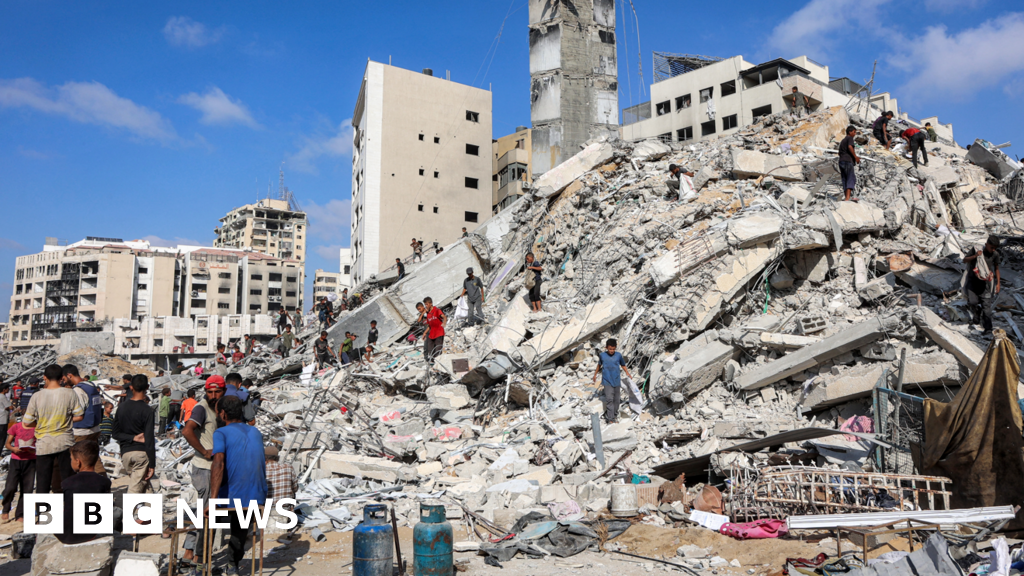
Gaza’s Skyline Crumbling: The Destruction of High-rise Towers and its Impact
The recent destruction of the Sussi Tower in Gaza City, following the collapse of the Mushtaha Tower just days prior, marks a devastating escalation in the ongoing conflict. These aren’t simply buildings falling; they represent a intentional targeting of Gaza’s infrastructure and a deepening humanitarian crisis. This article will delve into the meaning of these towers, the context of thier destruction, and the wider implications for the region.
(Image: The building is beginning to collapse, and two people can be seen in the foreground. Anadolu via getty Images. Caption: The Mushtaha Tower, located west of gaza City, was destroyed on Friday.)
A History Etched in Concrete
For many, the image of Gaza is one of densely populated refugee camps. Though,the rise of high-rise buildings – those exceeding five floors – signaled a period of hope and development. This began after the 1993 Oslo Accords, wich facilitated the return of Palestinians from exile.
Following israel’s withdrawal from most of Gaza in 1994, vertical construction became essential. The influx of returning Palestinians demanded innovative solutions to housing shortages. The Palestinian Authority actively encouraged investment in the construction sector, and neighborhoods even took their names from these prominent towers. these structures weren’t just about providing shelter; they symbolized aspirations for an independent Palestinian state and a future free from occupation.
Recent Destruction and Conflicting Narratives
The Sussi Tower is the second major high-rise to be demolished in quick succession.Footage circulating on social media showed the Mushtaha Tower collapsing after a critically importent explosion at its base on Friday. The Israel Defense Forces (IDF) maintains that precautionary measures were taken to minimize civilian harm. These included advance warnings and the use of what they describe as “precise munitions.”
However, Palestinian sources paint a drastically different picture.They allege that displaced families were sheltering within the Mushtaha Tower at the time of the strike. Mahmud Bassal, a spokesperson for Gaza’s civil defense agency, accused Israel of enacting “a policy of forced displacement.” Satellite imagery confirms widespread destruction across several Gaza City neighborhoods over the past month, further fueling these concerns.
The Wider Context: A Territory Under Siege
The destruction of these towers isn’t happening in a vacuum. Israeli Prime Minister Benjamin Netanyahu announced intentions to seize the entirety of the Gaza Strip after ceasefire negotiations with Hamas stalled in July.
the situation on the ground is dire. The United Nations estimates that nearly one million people remain in Gaza City, where a famine has already been declared. The UN warns of an impending “disaster” if the current military assault continues.Hear’s a breakdown of the key figures:
October 7th, 2023: Hamas-lead attack on southern Israel resulted in approximately 1,200 deaths and 251 hostages taken.
As October 7th: at least 63,746 people have been killed in Gaza due to Israeli attacks, according to the Hamas-run health ministry.
Malnutrition & Starvation: 367 deaths have been attributed to malnutrition and starvation during the war.
What Does this Mean for You?
The destruction of Gaza’s infrastructure has far-reaching consequences. It’s not just about buildings; it’s about the lives, livelihoods, and future of an entire population.
Humanitarian Crisis: The ongoing assault exacerbates an already critical humanitarian situation,with limited access to food,water,and medical care.
displacement: The targeting of residential buildings contributes to mass displacement, forcing civilians to seek refuge in overcrowded and unsafe conditions.
Long-Term Impact: The destruction of infrastructure hinders Gaza’s ability to rebuild and recover, perpetuating a cycle of conflict and instability.
As the conflict continues, understanding the historical context and the human cost is crucial. Staying informed and advocating for a peaceful resolution are vital steps you can take.
Additional reporting by Ruth Comerford.
Disclaimer: This article aims to provide a comprehensive overview of the situation based on available data as of November 26, 2023. The situation is rapidly evolving, and information may change.
Related reading